
Arbitrum’s DeFi landscape in late 2025 is experiencing a seismic shift, catalyzed by the launch of the DeFi Renaissance Incentive Program (DRIP). With $40 million in ARB incentives earmarked for high-performance protocols and innovative yield strategies, DRIP is not just another liquidity mining campaign; it’s a data-driven, phased experiment designed to maximize capital efficiency and push Arbitrum’s DeFi yields to new heights. The current ARB price stands at $0.2406, reflecting a market that is both competitive and ripe for strategic growth.
DRIP Season One: Loop Smarter on Arbitrum
Season One of DRIP, running from September 3,2025 to January 20,2026, targets one of the most capital-efficient yet risk-intensive strategies in DeFi: leverage looping. By incentivizing users to borrow against yield-bearing collateral such as weETH, wstETH, sUSDC, and syrupUSDC on leading lending protocols (Aave, Morpho, Fluid, Euler, Dolomite, Silo), DRIP aims to turbocharge both liquidity and protocol stickiness. Up to 24 million ARB are allocated for this season alone.
The program unfolds in two distinct phases:
- Discovery Phase: The first two epochs (two weeks each) establish baseline performance across participating protocols. Only 15% of the seasonal budget is distributed here, setting the stage for data-driven allocation.
- Performance Phase: Subsequent epochs dynamically direct rewards toward markets demonstrating the highest adoption and efficiency. This ensures that incentives are not wasted on underperforming pools or inefficient loops.
This phased approach reflects ArbitrumDAO’s commitment to transparency and optimization, a far cry from indiscriminate yield farming campaigns seen in earlier cycles.
Quantifying Impact: Explosive Growth Across Key Metrics
The numbers since DRIP’s launch are nothing short of remarkable. In just over two months:
- Stablecoin Market Cap: Eligible stablecoins on Arbitrum soared by 229.4%, reaching $1.02 billion (learn more about this surge).
- Total Value Locked (TVL): TVL jumped by approximately $400 million, now standing at $3.5 billion, a robust 12.4% month-over-month gain.
- Ecosystem Protocols: Theo_Network posted an eye-watering 8,610% market cap increase; SyrupFi followed with a 1,503% surge, clear evidence that targeted incentives can rapidly bootstrap new DeFi primitives.
This data validates DRIP’s hypothesis: performance-driven rewards not only attract capital but also foster genuine protocol innovation and user engagement across the stack.
Navigating Participation and Risk in Leveraged Yield Strategies
The mechanics of joining DRIP are straightforward but not without risk:
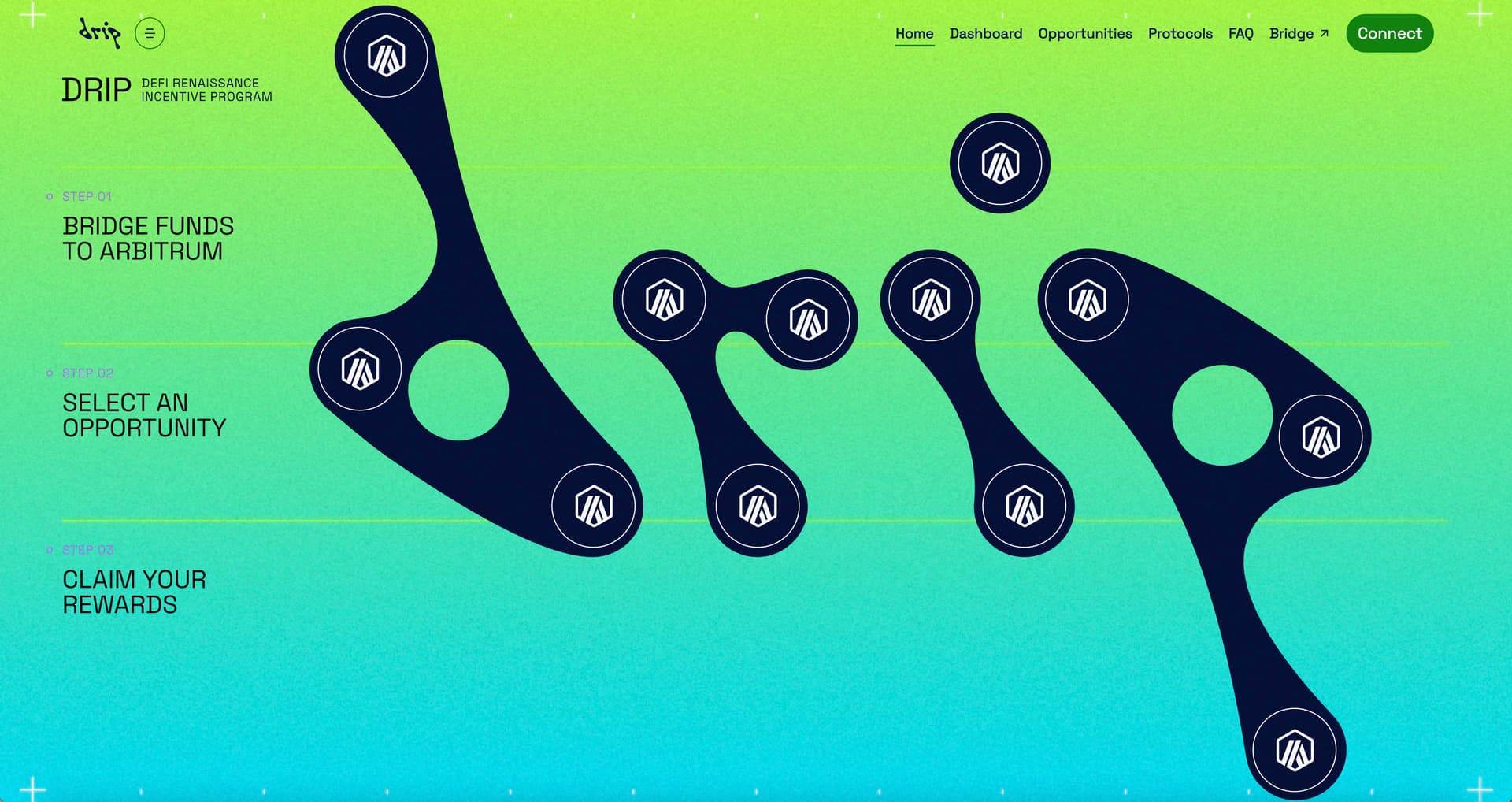
- Bridge eligible assets: Move weETH, wstETH, sUSDC or syrupUSDC onto Arbitrum One.
- Select a lending market: Choose from Aave, Morpho, Fluid, Euler, Dolomite or Silo, all integrated with DRIP’s incentive engine.
- Deposit collateral and loop: Supply assets as collateral; borrow against them; redeposit borrowed funds to maximize exposure, and yield potential.
This leverage looping amplifies returns but also magnifies risk, especially liquidation risk if asset prices move unfavorably or interest rates spike unexpectedly. As highlighted repeatedly by ArbitrumDAO governance forums and official blog posts: User vigilance is non-negotiable; rewards do not offset losses due to poor risk management or market volatility.
Arbitrum (ARB) Price Prediction 2026-2031
Forecast based on DeFi incentive trends and the impact of the DRIP Program (2025 baseline: $0.2406)
| Year | Minimum Price | Average Price | Maximum Price | Year-over-Year Change (Avg) | Key Market Scenario |
|---|---|---|---|---|---|
| 2026 | $0.18 | $0.29 | $0.45 | +20% | Post-DRIP stabilization; continued DeFi growth |
| 2027 | $0.22 | $0.36 | $0.60 | +24% | Increased adoption, new DeFi protocols, moderate bull trend |
| 2028 | $0.28 | $0.45 | $0.78 | +25% | Layer 2 scaling, regulatory clarity, ecosystem expansion |
| 2029 | $0.33 | $0.56 | $1.05 | +24% | Mainstream adoption, cross-chain integrations |
| 2030 | $0.41 | $0.70 | $1.35 | +25% | Peak DeFi cycle, institutional entry |
| 2031 | $0.52 | $0.88 | $1.70 | +26% | Mature DeFi ecosystem, possible new market cycle |
Price Prediction Summary
ARB's price outlook for 2026–2031 is positive, with forecasts reflecting robust DeFi growth driven by the DRIP program, increased TVL, and expanding use cases. While short-term volatility is likely as incentives phase out and the market digests new liquidity, the long-term trajectory remains upward, supported by rising adoption, ecosystem innovation, and potential regulatory clarity. Minimum and maximum ranges reflect both bearish (market downturn or incentive exhaustion) and bullish (major protocol success, new capital inflows) scenarios.
Key Factors Affecting Arbitrum Price
- Success and sustainability of the DRIP incentive program and future seasons
- Growth in Arbitrum's DeFi TVL and stablecoin market cap
- Expansion of the Arbitrum Stack and developer activity
- Competition from other Layer 2 and alternative DeFi ecosystems
- Macro crypto market cycles (bull/bear markets)
- Regulatory developments affecting DeFi
- Technological improvements (e.g., bridging, scalability, security)
- Institutional adoption and cross-chain integrations
Disclaimer: Cryptocurrency price predictions are speculative and based on current market analysis. Actual prices may vary significantly due to market volatility, regulatory changes, and other factors. Always do your own research before making investment decisions.
If you want a deeper dive into how these mechanisms are reshaping liquidity dynamics across protocols like Fluid and SyrupFi, or how capital efficiency benchmarks compare pre- and post-DRIP, see our related analysis at this link.
For advanced users and institutional allocators, DRIP’s data-driven structure introduces a new paradigm for DeFi incentives. Unlike legacy liquidity mining programs that rewarded TVL indiscriminately, DRIP’s performance phase ensures only the most efficient markets and active participants receive meaningful ARB distributions. This not only drives higher protocol utilization rates but also encourages iterative improvements in lending market design, risk management, and capital allocation models.
Protocol-Level Innovation and Competitive Dynamics
The competitive landscape among Arbitrum-native lending protocols has intensified as a direct consequence of DRIP. Platforms like Fluid and Dolomite have rolled out new risk tranching features and granular collateral options to capture a larger share of the incentivized user base. Meanwhile, established players such as Aave have expanded their product suites on Arbitrum One, integrating with DRIP’s reward engine to maintain relevance in a rapidly evolving market.
These competitive dynamics are reflected in protocol-level TVL growth rates, the emergence of novel looping strategies (e. g. , utilizing syrupUSDC for recursive stablecoin farming), and the proliferation of automated risk monitoring tools designed to prevent unnecessary liquidations during periods of volatility.
Long-Term Implications for Arbitrum DeFi Yields
With the ARB price at $0.2406, the impact of DRIP extends beyond short-term yield spikes. By tying incentives directly to performance metrics, such as utilization ratios, liquidation avoidance rates, and net new capital inflows, Arbitrum is setting a new standard for sustainable DeFi growth. The phased structure allows governance to adapt quickly: underperforming pools see rewards tapered off, while high-performing strategies are further amplified.
This approach is already inspiring similar incentive frameworks across other L2 ecosystems, but Arbitrum’s first-mover advantage is clear: it has successfully aligned user incentives with protocol health and network security. As more assets flow into composable lending markets on Arbitrum One, expect secondary effects such as deeper liquidity for spot/derivatives trading pairs and lower slippage on DEXs, further reinforcing the flywheel effect initiated by DRIP.
Key Takeaways for DeFi Traders and Protocol Builders
- Incentive Precision: Rewards follow real usage data, not just TVL, leading to smarter capital allocation.
- Risk-Reward Balance: Leveraged looping can supercharge yields but requires active monitoring; robust liquidation alerts are essential.
- Ecosystem Spillover: Growth in lending protocols translates into broader opportunities across DEXs, derivatives platforms, and emerging structured products on Arbitrum.
For an in-depth breakdown of how Fluid Lending leveraged DRIP incentives to achieve 126% growth or a technical analysis of dynamic liquidity loops post-incentive launch, explore our research at this link.




No comments yet. Be the first to share your thoughts!