
Arbitrum One vs. Nova at a glance
Choosing between Arbitrum One and Nova depends on whether you prioritize maximum security or lowest cost. Arbitrum One is the primary Layer 2 solution, designed for high-value DeFi applications that require the strongest possible security guarantees. It operates as a full EVM environment with a focus on decentralization and robustness.
Nova, by contrast, is a specialized chain optimized for gaming and social applications. It achieves significantly lower fees by using a different data availability model, which reduces costs for developers and users. While this makes it attractive for high-frequency interactions, it represents a different trade-off in the security spectrum.
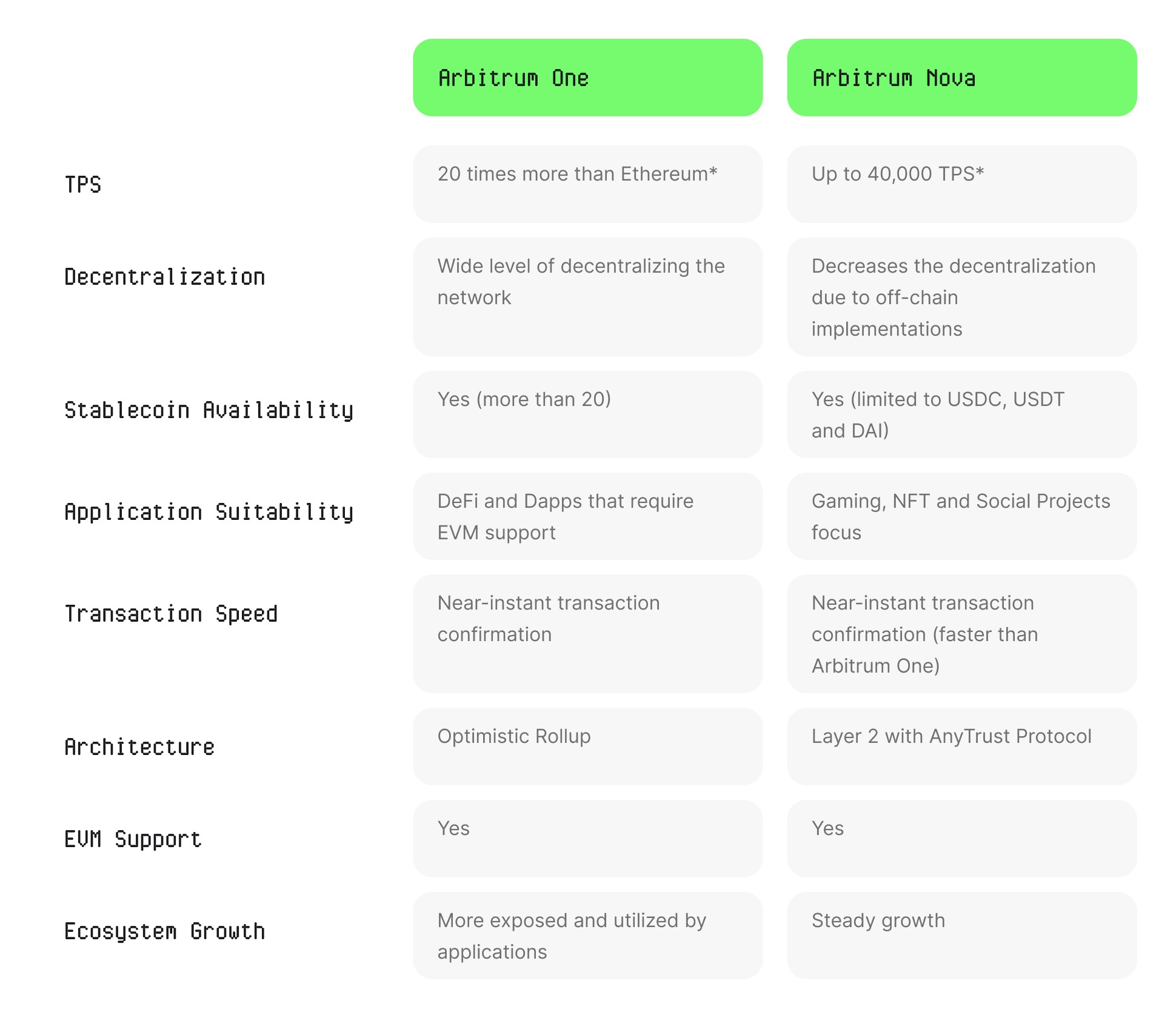
Use the table below to compare the core technical differences that impact your decision.
| Feature | Arbitrum One | Nova |
|---|---|---|
| Primary Use Case | DeFi & High-Value Apps | Gaming & Social |
| Security Model | Full EVM Fraud Proofs | Optimistic Rollup (Lite) |
| Data Availability | Ethereum L1 | Off-chain / Cheaper Storage |
| Typical Gas Fees | Low | Very Low |
| Finality | ~7 Days (Challenge Period) | ~1 Week |
Why Arbitrum One leads DeFi
Arbitrum One is the default choice for serious DeFi applications because it offers the closest experience to Ethereum mainnet while maintaining significantly lower costs. Unlike other Layer 2 solutions that require code modifications or use alternative virtual machines, Arbitrum One is fully EVM equivalent. This means developers can deploy existing Ethereum smart contracts with minimal changes, and users can interact with familiar wallets and interfaces without friction.
The primary advantage for DeFi is liquidity depth. Because it mirrors Ethereum's security and compatibility, Arbitrum One has attracted the majority of Ethereum's decentralized finance ecosystem. Major protocols like Uniswap, Aave, and GMX have deployed their core operations here, creating a deep pool of liquidity that is difficult to replicate on smaller chains. This concentration of value reduces slippage for traders and provides stability for lenders and borrowers.
For developers, this ecosystem effect creates a positive feedback loop. The availability of audited contracts, established liquidity, and a large user base means that new projects can launch with an existing audience rather than starting from zero. While Arbitrum Nova offers lower fees for casual users, Arbitrum One remains the superior choice for high-value transactions and complex financial instruments where security and liquidity are paramount.
Nova’s niche for gaming and social apps
While Arbitrum One serves as the primary settlement layer for significant capital, Arbitrum Nova is engineered for a different rhythm: high-frequency, low-value interactions. If Arbitrum One is a secure vault for significant assets, Nova is the bustling marketplace where transactions happen in milliseconds. This distinction makes Nova particularly well-suited for applications that require constant user engagement, such as blockchain-based gaming and social media platforms.
The architecture of Nova prioritizes speed and cost efficiency over the maximum security guarantees of the main Arbitrum chain. By utilizing a specialized sequencer and faster finality mechanisms, Nova can process thousands of transactions per second with fees often fractions of a cent. This economic model is critical for gaming, where players might make dozens of micro-transactions per session, and for social apps, where actions like liking, posting, or tipping need to feel instantaneous and frictionless.
For developers building these types of applications, the choice between Arbitrum One and Nova is not about which is "better," but which fits the user experience. High-stakes trading or large asset transfers benefit from the robust security of Arbitrum One. However, for real-time experiences where latency kills engagement and gas fees would otherwise ruin the economy, Nova provides the necessary infrastructure.
This specialization allows the Arbitrum ecosystem to handle diverse workloads simultaneously. Nova’s design ensures that gaming and social applications can scale without congesting the primary network, preserving the integrity and performance of Arbitrum One for its core financial use cases.
Security tradeoffs and finality times
Arbitrum One and Arbitrum Nova prioritize different aspects of blockchain security, primarily through their approach to data availability and fraud proofs. Arbitrum One is designed to be a direct, high-fidelity replica of the Ethereum Virtual Machine (EVM). It inherits Ethereum’s security model by posting transaction data to Ethereum’s mainnet. This means that the security of Arbitrum One is deeply tied to the security of Ethereum itself. If Ethereum is secure, Arbitrum One is secure. This design choice ensures that Arbitrum One offers a robust environment for high-value DeFi applications, where finality and data integrity are paramount.
Arbitrum Nova, on the other hand, takes a different path to achieve lower costs and higher throughput. It uses a decentralized sequencer network and compresses data more aggressively before posting it to Ethereum. While this makes Nova significantly cheaper and faster for certain types of transactions, it introduces a different security tradeoff. The compression and sequencing models mean that Nova relies more heavily on its specific validator set and sequencer network for data availability, rather than relying solely on Ethereum’s base layer for raw data posting. This makes Nova suitable for high-frequency, low-value interactions, such as gaming, where the cost per transaction is the primary concern, but it may feel less "Ethereum-native" in terms of data redundancy.
The concept of "finality"—the point at which a transaction is considered irreversible—also differs between the two. Arbitrum One typically requires a challenge period (often around 7 days) for full, optimistic fraud-proof finality, though standard confirmation times are much shorter (seconds to minutes). Arbitrum Nova also uses an optimistic fraud-proof system, but its specific configuration and sequencer dynamics can lead to different user experiences regarding how quickly transactions are considered "final" in practice. For most users, standard confirmations happen quickly on both, but the underlying security guarantees and the time required to dispute a fraudulent state root vary based on their respective architectures.
| Feature | Arbitrum One | Arbitrum Nova |
|---|---|---|
| Primary Use Case | DeFi, High-Value Transactions | Gaming, Social Apps, High-Frequency Trading |
| Security Model | Inherits Ethereum’s security via data posting | Optimized sequencer network, compressed data |
| Data Availability | Full data posted to Ethereum L1 | Compressed data, relies on sequencer network |
| Transaction Cost | Moderate (cheaper than L1, higher than Nova) | Very Low |
| Throughput | High | Very High |
| Finality Time | ~7 days for full fraud-proof finality | ~7 days for full fraud-proof finality (varies by sequencer) |
| EVM Compatibility | Full EVM equivalence | Full EVM equivalence |
For most DeFi users, Arbitrum One remains the default choice due to its direct alignment with Ethereum’s security and its larger ecosystem of established protocols. However, for gaming or applications that require thousands of transactions per second, Nova’s cost structure and sequencing model offer a compelling alternative, provided the user is comfortable with its distinct security assumptions.
Choosing the right chain for your project
Selecting between Arbitrum One and Nova depends on your application’s specific needs regarding security, user interaction patterns, and asset value. Think of Arbitrum One as the main financial district and Nova as the bustling marketplace. One prioritizes the highest level of security for significant capital, while Nova optimizes for speed and affordability.
Arbitrum One is the ideal choice for decentralized finance (DeFi) protocols handling large treasury values or complex financial instruments. The network’s security model offers robust protection, making it the preferred environment for projects where the cost of a bridge exploit or fraud proof failure would be catastrophic. If your users are moving substantial capital, the higher gas fees on One are justified by the peace of mind.
Nova, conversely, is built for applications that require high transaction throughput and minimal costs. Gaming platforms, social networks, and consumer apps that rely on frequent, small-value interactions benefit most from Nova’s architecture. The lower fees allow for micro-transactions and seamless user experiences that would be prohibitively expensive on a standard L1 or even a standard L2 like One.
The table below summarizes the core differences to help you decide which environment fits your project’s architecture.
For most projects, the decision is clear: if your app involves money and trust, start with Arbitrum One. If your app involves engagement and volume, look to Nova. Some advanced projects eventually deploy across both to balance security and scalability, but starting with the right foundation is critical.
Common questions about Arbitrum chains
Choosing between Arbitrum One and Nova often comes down to how you plan to use your assets. While both chains share the same underlying technology, their fee structures and finality times differ in ways that matter for DeFi and gaming. Here are the most practical questions users ask when deciding where to deploy.
No comments yet. Be the first to share your thoughts!