What Arbitrum Stylus actually is
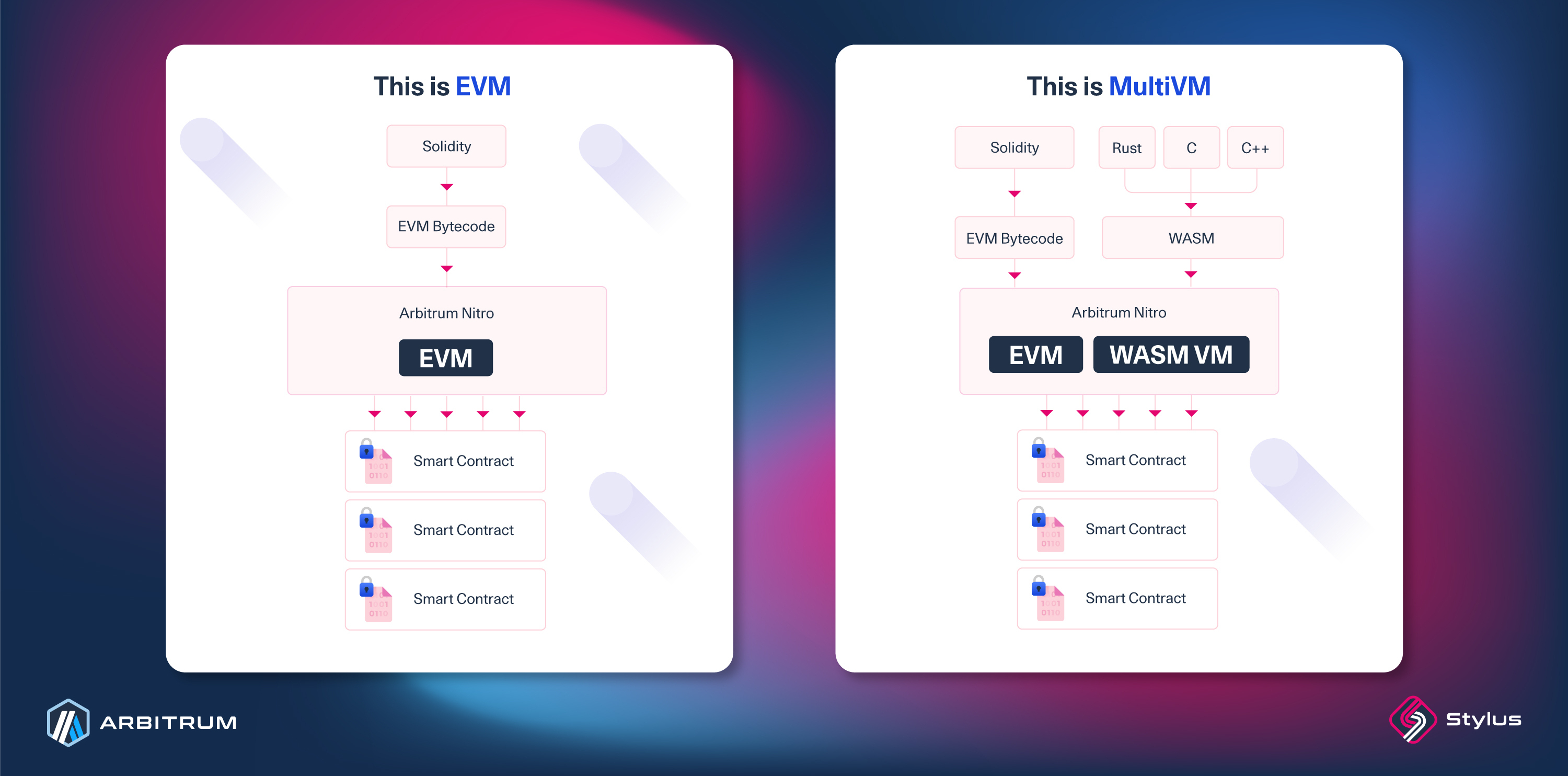
Arbitrum Stylus is a second runtime environment built on top of the Nitro stack. It allows developers to write smart contracts in languages like Rust, C, and C++, which compile to WebAssembly (WASM). This sits alongside the traditional Ethereum Virtual Machine (EVM) rather than replacing it.
Think of Stylus as a parallel lane. The EVM remains the standard for general-purpose smart contracts, while Stylus provides a high-performance path for code that needs speed or access to broader programming libraries. This dual-runtime approach lets projects choose the right tool for the job without forcing a full migration.
The key difference lies in how the code executes. EVM contracts run on a stack-based virtual machine designed for security and simplicity. Stylus contracts run on a WASM runtime, which offers faster execution speeds and access to modern software development practices. This doesn't make one "better" than the other; it makes them suitable for different use cases.
For developers, this means you can keep existing EVM contracts while building new, performance-intensive features in Rust or C++. The Nitro stack handles the translation and execution, ensuring that both environments can interact securely on the same chain.
| Runtime | Languages | Performance |
|---|---|---|
| EVM | Solidity, Vyper | Standard |
| Stylus | Rust, C, C++ | High |
Rust and C++ vs Solidity: The core difference
Arbitrum Stylus changes the programming languages available for smart contracts. Instead of being limited to Solidity, developers can now write in Rust, C, and C++. This shift is significant because it allows teams to use languages they already know, reducing the learning curve and expanding the pool of potential contributors.
The technical difference lies in the execution environment. Traditional EVM contracts run on the Ethereum Virtual Machine, which uses a specific stack-based architecture. Stylus runs on WASM (WebAssembly), a binary instruction format designed for efficient execution. This allows for more complex logic and better performance, particularly for applications that require heavy computation or frequent state changes.
The table below compares the key technical distinctions between the traditional EVM approach and Stylus.
| Feature | EVM (Solidity) | Stylus (Rust/C++) |
|---|---|---|
| Language | Solidity | Rust, C, C++ |
| Execution Model | EVM Stack | WASM |
| Gas Costs | Optimized for simplicity | Lower for complex logic |
| Memory Safety | Manual management | Strong type safety |
| Developer Pool | Ethereum specialists | Broader web dev talent |
| Interoperability | Native EVM | Runs alongside EVM |
Switching to Rust or C++ offers tangible engineering benefits. Rust, for example, provides memory safety guarantees that prevent common bugs like buffer overflows. This reduces the risk of vulnerabilities that have historically plagued smart contracts. Additionally, the performance gains from WASM execution can lower gas costs for complex operations, making high-frequency applications more viable.
However, this flexibility comes with trade-offs. Developers must still understand the underlying blockchain mechanics, even if they are using a different language. The tooling ecosystem for Rust and C++ on Arbitrum is growing but is not yet as mature as the Solidity ecosystem. Teams need to evaluate whether their specific use case justifies the switch based on performance needs and existing team expertise.
When to use Stylus over standard EVM
Choosing between Stylus and standard EVM comes down to the computational demands of your project. While the EVM remains the industry standard for compatibility, Stylus offers significant performance advantages for specific engineering challenges. The decision hinges on whether your application requires high-throughput computation or relies on established ecosystem liquidity.
For high-frequency trading, DeFi protocols, and complex gaming, Stylus provides a clear engineering advantage. The ability to use Rust allows for precise memory management and execution speeds that far exceed Solidity. This efficiency translates directly to lower gas costs for complex calculations, making it viable to run logic on-chain that would otherwise be too expensive or slow on pure EVM.
Complex cryptography and gaming
Applications involving heavy cryptographic proofs or real-time game logic benefit most from Stylus. Rust’s type safety and execution speed allow developers to verify complex state transitions without the overhead of the EVM’s stack. This is particularly valuable for optimistic rollups that need to compress data or verify proofs efficiently. If your protocol involves zero-knowledge proofs or high-frequency order matching, Stylus reduces latency and cost.
When EVM remains the better choice
Standard EVM is still the superior choice for simple token transfers and established DeFi protocols. The EVM benefits from decades of tooling, audits, and library support. If your primary goal is to issue an ERC-20 token or deploy a simple lending pool, the EVM’s maturity outweighs Stylus’s performance gains. The network effects of Solidity mean that integrating with existing wallets, explorers, and third-party services is often more straightforward.
Comparison of use cases
The table below summarizes where each environment excels. Use this as a quick reference for architectural planning.
| Use Case | Preferred Environment | Reason |
|---|---|---|
| Simple token transfers | EVM | Mature tooling and widespread compatibility |
| Established DeFi protocols | EVM | Extensive libraries and audit history |
| High-frequency trading | Stylus | Lower latency and gas costs for complex logic |
| Complex cryptography | Stylus | Rust performance and memory safety |
| Real-time gaming | Stylus | Fast execution for state updates |
How Stylus fits into the Arbitrum ecosystem
Arbitrum Stylus is not a separate chain or a fork. It is a feature of the Nitro stack, the same engine that powers Arbitrum One and Arbitrum Nova. When you deploy a Stylus contract, it runs on the same rollup infrastructure as traditional Solidity contracts. This means you are not building in isolation; you are extending the existing Arbitrum environment with new execution capabilities.
The most critical engineering benefit of this architecture is interoperability. Because Stylus contracts are processed by the same Nitro VM, they can interact directly with ERC-20 tokens, NFTs, and other smart contracts that were written in Solidity. A Rust-based DeFi protocol can call a Solidity-based lending platform without bridges or complex cross-chain messaging layers. This preserves the composability that makes Ethereum so powerful, removing the fragmentation concerns that often arise with alternative execution environments.
This design choice has practical implications for developers. You can choose the best tool for the job—Rust for performance-critical components, Solidity for established integrations—without worrying about whether they can talk to each other. The Move language, for example, can now execute within Stylus while maintaining full access to the broader Arbitrum ecosystem, as demonstrated by recent grant-funded compiler projects.
To see how this compares to standard EVM deployment, consider the following breakdown:
| Feature | Stylus (WASM) | Standard EVM (Solidity) |
|---|---|---|
| Execution Engine | WebAssembly (WASM) | EVM |
| Languages | Rust, C, C++ | Solidity, Vyper |
| Interoperability | Native with EVM contracts | Native with EVM contracts |
| Infrastructure | Nitro Stack | Nitro Stack |
Getting started with Stylus development
Use this section to make the Arbitrum Stylus vs EVM decision easier to compare in real life, not just on paper. Start with the reader's actual constraint, then separate must-have requirements from details that are merely nice to have. A practical choice should survive normal use, maintenance, timing, and budget. If a recommendation only works in an ideal situation, call that out plainly and give the reader a fallback path.
-
Verify the basicsConfirm the core specs, condition, and fit before comparing extras.
-
Price the downsideLook for the repair, maintenance, or replacement cost that would change the decision.
-
Compare alternativesCheck at least two comparable options before treating one listing as the benchmark.
Common questions about Arbitrum Stylus
Developers often ask how Stylus fits into the existing Arbitrum ecosystem. The short answer is that it adds a new lane without replacing the old one.
No comments yet. Be the first to share your thoughts!