Arbitrum Stylus 2026 explained
Arbitrum Stylus is an upgrade to Arbitrum Nitro (specifically ArbOS 32) that enables smart contracts written in Rust, C, and C++ to run alongside Solidity. This addition leverages WebAssembly (WASM) for high-performance logic while maintaining full compatibility with existing Ethereum infrastructure.
The core value proposition for 2026 is performance and flexibility. By running WASM modules directly within the Nitro stack, Stylus bypasses the EVM bytecode interpretation overhead. This allows for faster execution of complex computations, such as cryptographic proofs or heavy data processing, which are often costly or slow in pure Solidity.
This upgrade means developers can choose the right tool for the job. They can use Solidity for standard token logic and user interfaces, while deploying Rust-based WASM modules for computationally intensive tasks. This hybrid approach maximizes efficiency without sacrificing the security and decentralization guarantees of the Arbitrum network.
EVM vs. Stylus performance choices that change the plan
Arbitrum Stylus introduces a parallel execution environment to the Nitro stack, fundamentally changing how developers approach gas efficiency and computational complexity. While traditional Solidity contracts run on the Ethereum Virtual Machine (EVM), Stylus contracts compile to WebAssembly (WASM), allowing for languages like Rust, C, and C++. This shift isn't just about language preference; it is a structural change in how ArbOS processes logic, offering distinct performance tradeoffs for different use cases.
The most immediate difference lies in execution speed and gas costs. EVM opcodes are linear and interpreted, which creates a bottleneck for complex calculations. Stylus WASM modules, by contrast, execute natively on the underlying CPU. This means that computationally heavy tasks—such as zero-knowledge proof verification or complex cryptographic operations—run significantly faster and cost less in gas on Stylus than they would on the EVM. For developers building high-frequency trading bots or complex DeFi primitives, this efficiency gap can determine whether a contract is economically viable.
However, this performance gain comes with a flexibility tradeoff. The EVM offers a mature, standardized ecosystem with extensive tooling and library support via OpenZeppelin. Stylus is newer, meaning the ecosystem of pre-built WASM libraries is still growing. While Stylus maintains full composability with EVM contracts, the developer experience requires managing a different compilation pipeline and debugging environment. You gain raw computational power but lose some of the immediate convenience of the EVM's vast legacy infrastructure.
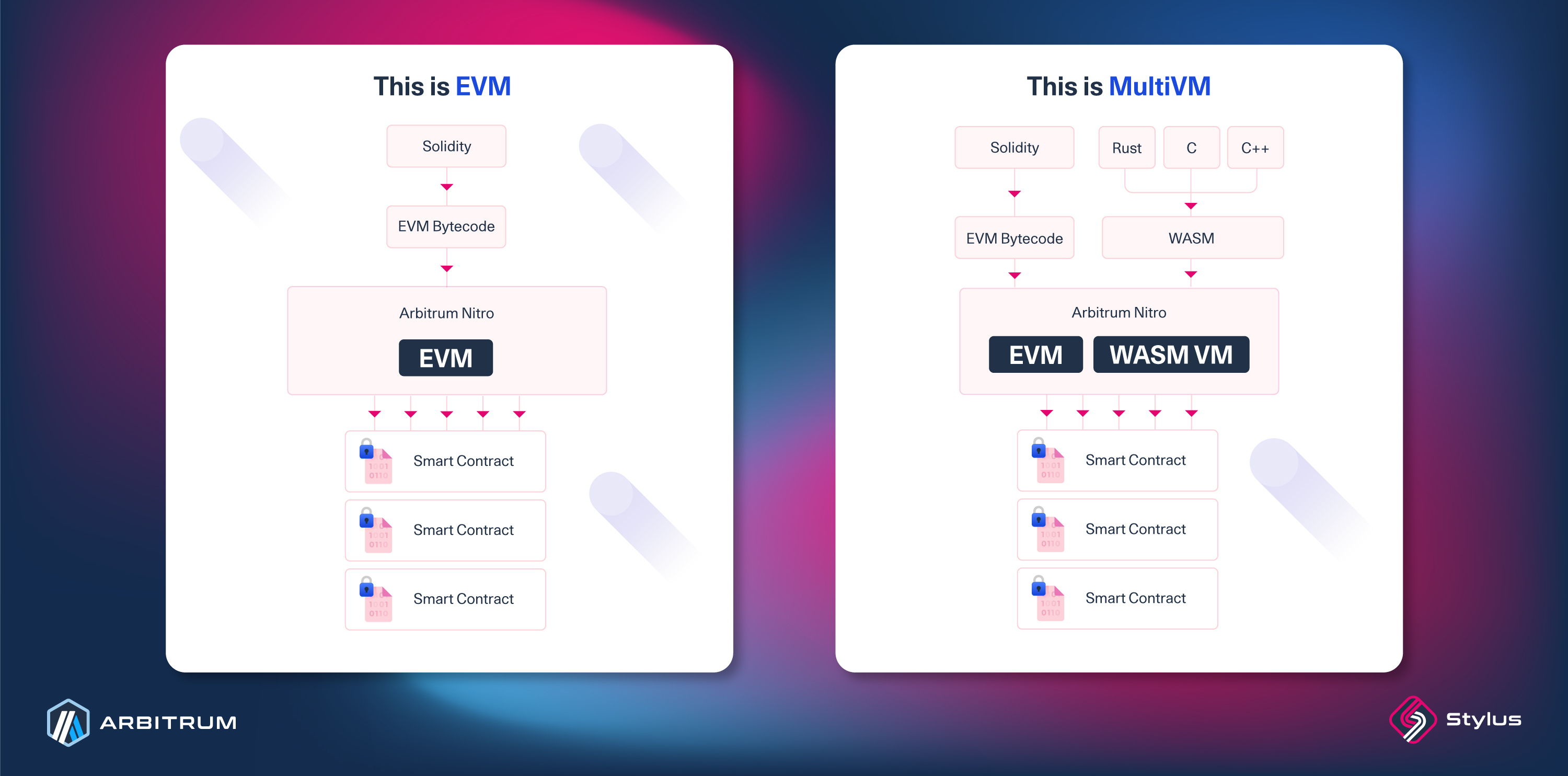
The following table outlines the core technical differences between running Solidity on the EVM versus Rust/C++ on Stylus WASM within the Arbitrum Nitro architecture.
| Feature | EVM (Solidity) | Stylus (WASM) |
|---|---|---|
| Execution Engine | EVM Interpreter | Native WASM CPU |
| Language Support | Solidity, Vyper | Rust, C, C++ |
| Gas Efficiency | Standard EVM gas costs | Lower gas for complex logic |
| Compilation | Bytecode | WASM Module |
| Ecosystem Maturity | High (OpenZeppelin, etc.) | Growing |
| Composability | Native | Full EVM interoperability |
Web2 migration paths for developers
Arbitrum Stylus removes the traditional friction that keeps Web2 engineers out of blockchain development. By enabling smart contracts in Rust, C, and C++, Stylus bypasses the steep learning curve associated with Solidity and the EVM assembly language. This shift transforms blockchain development from a specialized niche into an accessible extension of existing software engineering workflows.
The core of this capability lies in the Nitro technology stack. Stylus contracts run as WebAssembly (WASM) modules within ArbOS, the Arbitrum operating system. This architecture allows high-performance languages to execute directly on the chain while maintaining full composability with existing EVM contracts. Developers can leverage familiar toolchains, debuggers, and libraries, significantly reducing the time required to build and deploy secure decentralized applications.
For teams already proficient in systems programming, this means they can port existing logic or build new high-throughput applications without learning a new language from scratch. The ability to use Rust for memory safety or C for raw performance provides a practical entry point into Web3. This lowers the barrier to entry, enabling a broader range of developers to contribute to the ecosystem while maintaining the security and interoperability standards that Ethereum infrastructure demands.
Ecosystem growth and tooling in 2026
The Arbitrum Stylus ecosystem is maturing rapidly, shifting from experimental adoption to robust production infrastructure. By enabling smart contracts in Rust, C, and C++ via WASM, Stylus has unlocked complex logic that was previously too expensive or difficult to implement in Solidity. This expansion is supported by the Nitro technology stack, which ensures these non-EVM contracts run efficiently alongside traditional EVM operations within ArbOS.
Testing frameworks have been a critical bottleneck for non-EVM adoption, but this gap is closing. OpenZeppelin’s introduction of Motsu provides a dedicated testing environment for Stylus contracts, enabling developers to write unit tests in Rust that mirror the behavior of their on-chain code. This parity is essential for legacy developers transitioning from Solidity, ensuring that security audits and deployment pipelines remain rigorous and reliable.
Stylus SprintAdoption is being accelerated by the Stylus Sprint program, a strategic initiative designed to incentivize early builders. By providing funding and technical support, the program encourages teams to migrate existing logic or build new high-performance applications that leverage the speed and flexibility of Rust. This influx of dApps is transforming the ecosystem, moving it beyond simple DeFi primitives into more complex computational domains.
Choosing Between EVM and Stylus
The decision to use Solidity or Rust on Arbitrum depends on whether your priority is composability or raw performance. Arbitrum Stylus runs on ArbOS 32, leveraging the Nitro stack to execute WebAssembly (WASM) alongside the EVM. This dual-execution environment allows you to pick the right tool for the job without forcing a complete rewrite.
Stick with Solidity if your project relies heavily on existing DeFi primitives. The EVM offers immediate access to the broadest library of open-source contracts, including OpenZeppelin standards. This approach minimizes risk and maximizes interoperability with other Layer 2 solutions and Ethereum mainnet bridges. If your logic is standard token transfers or simple governance, the EVM is the safest and most efficient choice.
Choose Rust or C++ when you need to optimize for high-frequency trading or complex cryptographic operations. Stylus allows you to port existing C++ codebases directly to Arbitrum, bypassing the gas overhead of EVM opcodes. This is ideal for compute-heavy tasks like zero-knowledge proof verification or high-throughput order matching engines where execution speed and lower gas costs are critical.
| Feature | EVM (Solidity) | Stylus (Rust/C++) |
|---|---|---|
| Composability | Maximum (native Ethereum compatibility) | High (can call EVM contracts, but less seamless) |
| Gas Efficiency | Standard | Lower (optimized WASM execution) |
| Library Ecosystem | Extensive (OpenZeppelin, etc.) | Growing (Rust crates, C++ libraries) |
| Development Speed | Fast (familiar syntax, abundant tools) | Moderate (requires WASM compilation, stricter typing) |
Common questions about Arbitrum Stylus
How does Stylus handle gas compared to Solidity?
Stylus uses a gas model based on ArbOS, which generally offers lower gas costs for complex logic than the EVM. Because WASM executes natively on the CPU, computationally intensive tasks like zero-knowledge proof verification are significantly cheaper and faster than their EVM counterparts. However, for simple operations like token transfers, the EVM remains highly efficient and often simpler to deploy.
Can I mix Solidity and Rust contracts in the same application?
Yes. Stylus maintains full composability with EVM contracts. You can deploy a Solidity contract that interacts with a Rust-based WASM module. This allows you to use Solidity for standard token logic and UI interactions while offloading heavy computation to Rust, creating a hybrid architecture that leverages the strengths of both environments.
What tools are available for testing Stylus contracts?
OpenZeppelin’s Motsu is a dedicated testing framework for Stylus, allowing developers to write unit tests in Rust that mirror on-chain behavior. This ensures that security audits and deployment pipelines remain rigorous. For broader integration, standard tools like Hardhat and Foundry continue to support EVM contracts, while Rust-specific toolchains handle WASM compilation and testing.
Is Stylus suitable for high-frequency trading applications?
Yes. Stylus is particularly well-suited for high-frequency trading and complex DeFi primitives due to its native WASM execution. The ability to bypass EVM bytecode interpretation overhead allows for faster execution and lower gas costs, which are critical for high-throughput order matching engines and other latency-sensitive applications.
No comments yet. Be the first to share your thoughts!