Arbitrum One 2026: The Core Choice
Arbitrum One has cemented its position as the primary Layer 2 for serious DeFi and general-purpose applications in 2026. With over $200 million in total value locked (TVL), it serves as the backbone for high-stakes financial infrastructure rather than just another deployment option. For major protocols like Spiko, Arbitrum One isn't merely a chain; it is the primary distribution layer, offering the security and liquidity depth that high-value transactions require. The platform operates as a finance-native blockchain, providing the specialized infrastructure needed for complex tokenization and dedicated blockchain environments. Unlike sidechains that prioritize speed at the expense of security, Arbitrum One leverages Ethereum's base layer for finality, ensuring that capital remains protected. This architecture makes it the preferred choice for applications where downtime or security compromises are not acceptable risks.
While other networks may offer lower fees for casual interactions, the cost of error on Arbitrum One is significantly lower due to its robust security model. In 2026, the distinction is clear: use Nova for niche, high-throughput scenarios like gaming, but rely on Arbitrum One for any application where financial integrity and ecosystem depth are paramount.
Nitro vs Nova: Architecture and Fees
Arbitrum’s infrastructure split into two distinct environments—Arbitrum One and Arbitrum Nova—allows developers to choose between security and speed. Both chains run on the Nitro stack, which replaces the legacy VM with a WASM-based execution layer for better EVM equivalence. However, their design priorities diverge sharply. Arbitrum One prioritizes maximum security and compatibility, while Nova optimizes for low latency and minimal transaction costs by utilizing separate sequencers.
Arbitrum One: Security and Compatibility
Arbitrum One serves as the primary settlement layer for the ecosystem. It inherits Ethereum’s security model through optimistic rollup verification, making it the preferred choice for high-value DeFi protocols, stablecoins, and applications where capital preservation is critical. Transactions on One are sequenced centrally but verified by the broader network, ensuring a high degree of finality. For users and developers, One offers the most robust environment, supporting the widest range of dApps and bridges with the deepest liquidity pools.
Arbitrum Nova: Speed and Low Fees
Arbitrum Nova is designed for high-throughput applications, particularly gaming and social platforms, where transaction volume and cost are decisive factors. Nova achieves lower fees by using a dedicated sequencer and a faster finality mechanism. This architecture allows for near-instant transaction confirmations at a fraction of the cost of One. For example, a complex in-game action that might cost several dollars on One can often be executed for less than a cent on Nova. This makes Nova ideal for micro-transactions and frequent user interactions that would be economically unviable on the main chain.
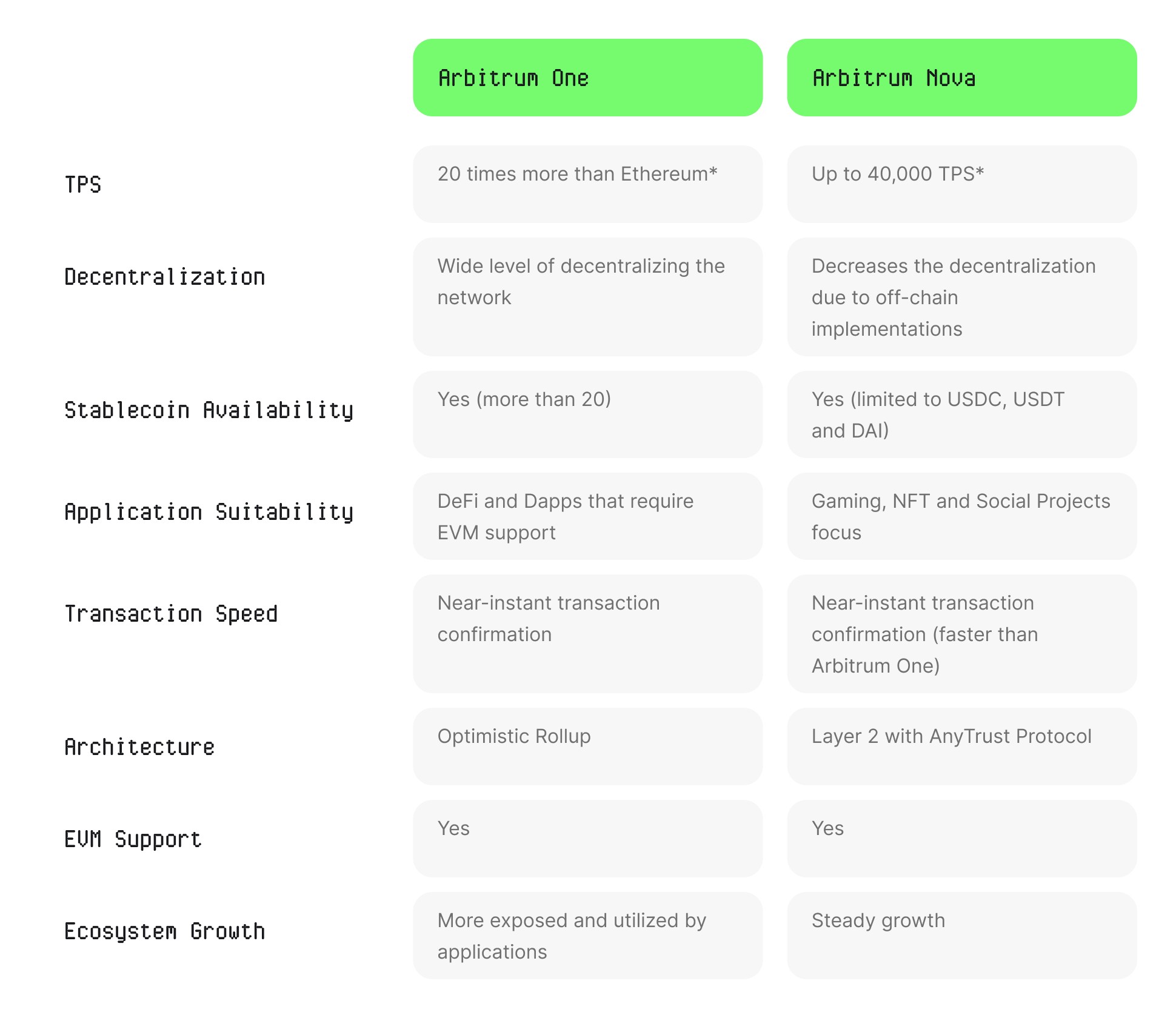
Side-by-Side Comparison
The table below outlines the technical differences between the two chains. Understanding these distinctions is essential for selecting the right environment for your specific use case.
| Feature | Arbitrum One | Nova | Best For |
|---|---|---|---|
| Sequencer | Shared / Centralized | Dedicated / Separate | One: DeFi; Nova: Gaming |
| Finality Time | ~10-15 minutes | ~1-2 minutes | One: High value; Nova: Real-time |
| Gas Fees | Moderate ($0.10-$1.00+) | Very Low (<$0.01) | One: Large txns; Nova: Micro-txns |
| EVM Equivalence | Full | Full | Both: Smart contract compatible |
| Security Model | Optimistic Rollup (Ethereum) | Optimistic Rollup (Ethereum) | Both: Inherited from L1 |
Choosing between One and Nova depends on your application’s needs. If you are building a financial protocol that requires maximum security and compatibility with existing DeFi tools, Arbitrum One is the standard. If you are developing a game or social app that requires high throughput and minimal fees, Nova provides the necessary infrastructure without sacrificing EVM compatibility.
DeFi Liquidity and Ecosystem Maturity
Arbitrum One remains the primary liquidity hub for decentralized finance, a status reinforced by its Total Value Locked (TVL) and the depth of its protocol deployments. While Nova serves as a high-throughput layer for gaming and micro-transactions, Arbitrum One is built for capital efficiency and complex financial interactions. The network’s ability to host major DeFi primitives makes it the default choice for protocols requiring deep liquidity pools and robust security guarantees.
Capital Concentration
The dominance of Arbitrum One is visible in its TVL metrics. Recent data indicates that Arbitrum One holds over $200 million in TVL for key protocols, serving as the primary distribution layer for high-value assets [src-serp-1]. This concentration of capital is not accidental; it is the result of years of infrastructure development and the migration of legacy DeFi giants seeking Ethereum-level security with lower costs. For a user or protocol, this means deeper order books, better slippage protection, and higher yields compared to newer or smaller L2s.
Protocol Deployment Strategy
The ecosystem maturity is further evidenced by the strategic choices of major projects. Protocols like Spiko have designated Arbitrum One not merely as an option, but as their primary distribution layer [src-serp-1]. This signals a broader industry trend: developers prioritize Arbitrum One for their core financial products while using Nova for experimental or high-frequency gaming features. The Arbitrum Foundation’s continued funding, including recent proposals for $16 million in USD and significant ETH allocations, ensures that the underlying infrastructure remains competitive and secure [src-serp-6].
The Liquidity Moat
For traders and liquidity providers, the liquidity moat of Arbitrum One creates a self-reinforcing cycle. Higher TVL attracts more users, which in turn attracts more liquidity. Nova, while faster and cheaper for specific use cases, does not yet offer the same depth of financial instruments. If your strategy involves large-scale trading, yield farming, or lending, Arbitrum One’s established ecosystem provides the necessary stability and volume that Nova’s gaming-focused architecture currently lacks.
Gaming and Microtransactions on Nova
Arbitrum Nova is engineered for high-frequency, low-value interactions where transaction costs can otherwise destroy user experience. While Arbitrum One serves as the general-purpose settlement layer for complex DeFi and high-value applications, Nova operates as a specialized environment optimized for social apps, gaming, and content platforms. The architecture leverages a combination of Optimistic Rollups and Data Availability Sampling (DAS) to achieve significantly lower fees without compromising the security guarantees inherited from Ethereum.
For game developers, this distinction is structural. In a typical on-chain game, a single action—such as moving a character or claiming a small reward—might require multiple transactions. On a standard L1 or general L2, these micro-interactions become economically unviable due to gas costs that exceed the value of the action itself. Nova’s reduced fees, driven by its reliance on cheaper data availability layers like Celestia or Blobspace (depending on the specific implementation phase), allow these interactions to remain frictionless. This makes it the preferred choice for applications where user engagement is measured in thousands of small transactions per day rather than large capital deployments.
The trade-off involves a slight nuance in finality and data availability assumptions compared to the fully Ethereum-data-heavy Arbitrum One. However, for the target use case, the priority is throughput and cost efficiency. Nova effectively decouples the execution layer from the most expensive data availability constraints, allowing gaming studios to build economies based on in-game assets and social rewards that were previously impossible to sustain on-chain.
Arbitrum One vs Nova: The Decision Matrix
Choosing between Arbitrum One and Nova requires aligning your technical needs with the right infrastructure. Arbitrum One is the primary settlement layer, optimized for security and deep liquidity. Nova is a specialized rollup designed for high-frequency interaction, prioritizing speed and minimal cost.
Use Arbitrum One for value transfers, DeFi positions, and assets requiring maximum security. It serves as the main settlement layer where liquidity is deepest. Use Nova for high-volume interactions, such as gaming or social applications, where transaction speed and low fees are critical.
The tradeoff is clear: Nova sacrifices some settlement independence for efficiency. For gaming use cases, this means faster state updates and lower gas costs, enabling micro-transactions that would be prohibitive on One. However, for holding significant value, the security guarantees of One remain the standard.
ARB Token Outlook and Governance
The ARB token serves as the backbone of Arbitrum’s governance, granting holders voting power over critical ecosystem decisions. Unlike simple staking rewards, the token’s utility is tied directly to the network’s operational health and strategic direction. As of mid-2026, the governance model is actively managing large-scale resource allocation, including a recent proposal for $16 million in USD-backed RWAs and 1.7k ETH to fund the Arbitrum Foundation. This level of capital deployment signals a mature, self-sustaining ecosystem rather than one reliant on external venture capital injections.
Market performance for ARB in 2026 has been volatile, with price action reflecting broader Layer 2 competition and macroeconomic pressures. While some analysts view the current valuation as a potential setup for a long-term recovery, the token’s value is increasingly decoupled from speculative hype and more closely linked to on-chain activity. The divergence between Arbitrum One’s high-throughput DeFi volume and Nova’s specialized gaming throughput creates distinct demand dynamics for the ARB token, depending on which chain’s ecosystem expands more rapidly.
Frequently asked: what to check next
Helpful gear
Use these product recommendations as a starting point, then choose the size, material, and price point that fit how you actually use the gear.



As an Amazon Associate, we may earn from qualifying purchases.
No comments yet. Be the first to share your thoughts!