What Arbitrum Stylus actually does
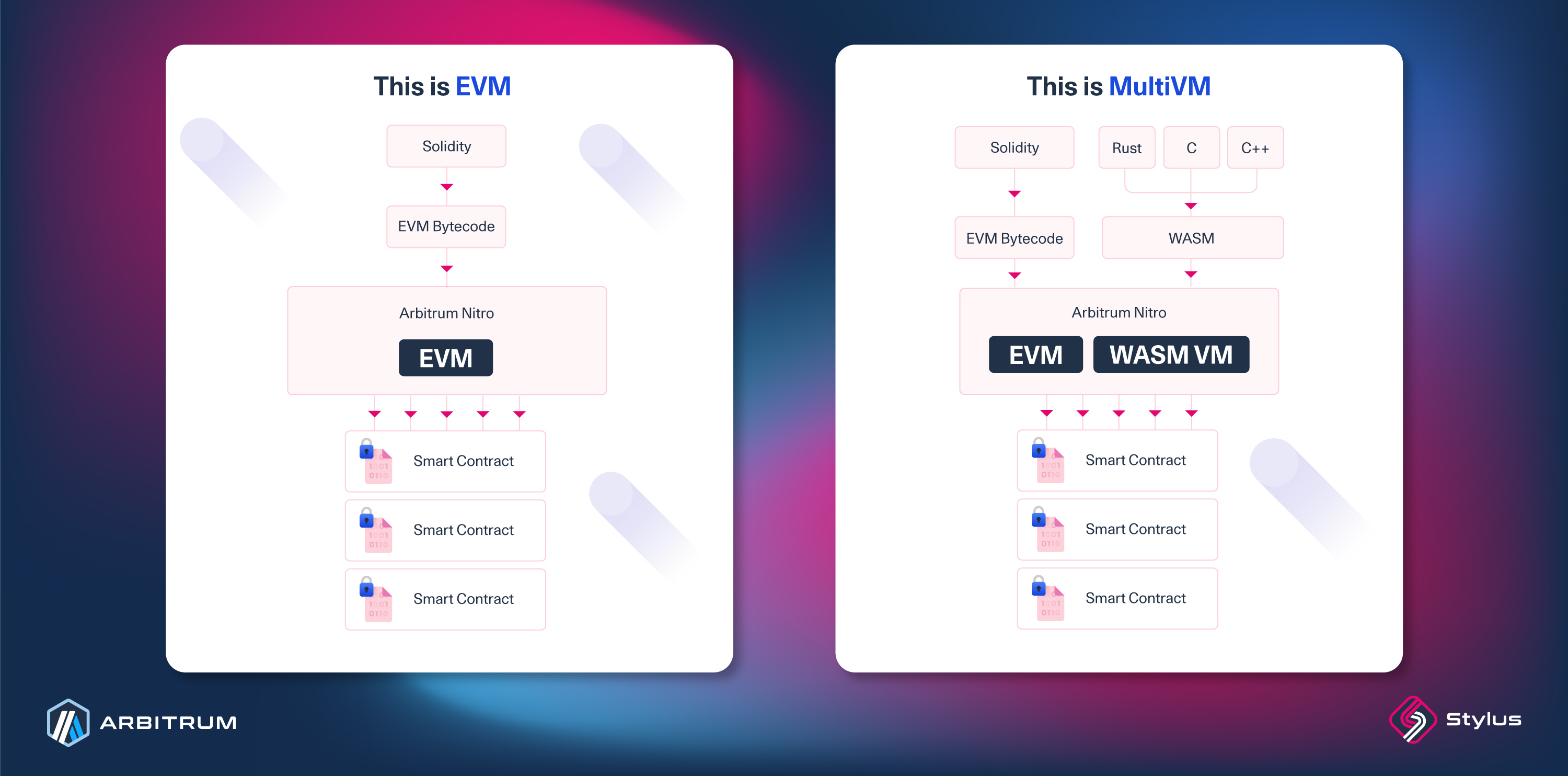
Arbitrum Stylus is not a separate blockchain or a competing layer-two solution. It is a capability within the existing Nitro stack that expands what smart contracts can be written in. Traditionally, Ethereum and its layer-two networks have relied almost exclusively on the Ethereum Virtual Machine (EVM), which requires code to be written in Solidity or Vyper. Stylus breaks this monopoly by allowing developers to write smart contracts in popular, general-purpose languages like Rust, C, and C++.
Under the hood, Stylus works by compiling these high-level languages into WebAssembly (WASM). The Nitro execution engine, which powers Arbitrum One and Arbitrum Nova, is designed to run both EVM bytecode and WASM modules side-by-side. This means you can deploy a contract written in Rust that interacts seamlessly with existing ERC-20 tokens or other EVM-based applications. The result is a hybrid environment where the maturity of the Rust ecosystem meets the liquidity and compatibility of Ethereum.
This shift offers significant technical advantages beyond just language preference. Languages like Rust provide memory safety and advanced tooling that can reduce bugs and security vulnerabilities common in Solidity development. WASM execution is generally faster and more gas-efficient than EVM execution for complex logic. For developers, this means lower transaction costs and the ability to leverage existing libraries and frameworks without learning a new, niche smart contract syntax.
Stylus essentially acts as a bridge, allowing traditional software engineering practices to enter the blockchain space. It does not replace the EVM; instead, it runs alongside it, offering a parallel path for developers who prefer the structure and performance of systems languages. This duality is what makes Stylus a distinct paradigm, offering flexibility without sacrificing the security and interoperability that define the Arbitrum network.
EVM vs Stylus: Core technical differences
Arbitrum’s Nitro stack changed how developers think about execution environments. The EVM remains the standard for Solidity and Vyper contracts, offering deep liquidity and broad tooling support. Stylus introduces a parallel execution path using WebAssembly (WASM), allowing developers to write smart contracts in Rust, C, and C++.
This isn't just a language swap. It fundamentally alters how gas is calculated, how code is compiled, and which developer ecosystems are accessible. Understanding these technical distinctions is essential for choosing the right environment for your specific use case.
Language and Compilation Target
The EVM relies on Solidity or Vyper, languages designed specifically for Ethereum. These compile to EVM bytecode, which the Nitro VM interprets. Stylus, by contrast, compiles to WASM. This allows developers to leverage the mature ecosystems of Rust and C++, including existing libraries and tooling that have nothing to do with blockchain.
The Stylus SDK, built on top of Alloy, provides the necessary bindings to interact with the EVM state from within WASM programs. This means you can use Rust’s type safety and memory management features while still operating within the Arbitrum environment. The result is a development experience that feels more like traditional systems programming than smart contract development.
Gas Model and Performance
Gas calculation differs significantly between the two environments. EVM gas is calculated per opcode, a model that has been refined over years but can be inefficient for complex logic. Stylus uses a more granular gas model based on WASM instructions. This allows for more precise cost accounting, often resulting in lower gas fees for complex operations.
Performance benchmarks show that WASM programs can execute faster than their EVM equivalents for computationally intensive tasks. The Nitro VM’s ability to run both EVM and WASM code side-by-side means you can optimize specific parts of your application without rewriting the entire system. This hybrid approach is a key advantage of Arbitrum’s architecture.
Developer Ecosystem and Tooling
The EVM ecosystem is vast, with extensive documentation, IDE support, and audit firms. Stylus is newer, but it is rapidly gaining traction. The Rust ecosystem offers powerful tools like cargo for dependency management and testing, which many developers find superior to the EVM’s truffle/hardhat workflows. However, the pool of WASM-aware auditors is still smaller.
Tooling for Stylus is evolving quickly. Projects like Motsu are emerging to provide testing and deployment utilities specifically for WASM contracts. While the EVM still has the edge in maturity, Stylus offers a compelling alternative for developers who prioritize performance and language flexibility over immediate ecosystem breadth.
| Feature | EVM (Solidity/Vyper) | Stylus (Rust/C++) |
|---|---|---|
| Language | Solidity, Vyper | Rust, C, C++ |
| Compilation Target | EVM Bytecode | WebAssembly (WASM) |
| Gas Model | Opcode-based | WASM instruction-based |
| Primary SDK | Hardhat, Foundry | Stylus SDK (Alloy) |
| Maturity | High (Mature ecosystem) | Growing (Newer ecosystem) |
Performance gains with Rust and C++
Stylus shifts the computational heavy lifting from the EVM bytecode interpreter to native WebAssembly (WASM) execution. By compiling Rust or C++ code into WASM, Arbitrum’s Nitro stack processes these contracts at near-native speeds. This architectural change removes the overhead of the Ethereum Virtual Machine, allowing developers to leverage mature systems languages for compute-intensive tasks that would otherwise be prohibitively expensive or slow on pure EVM chains.
The performance delta is significant for compute-heavy workloads. While EVM operations are constrained by gas costs that scale linearly with instruction complexity, WASM execution benefits from direct memory access and optimized instruction sets. This means operations like complex cryptographic verifications, large-scale data processing, or intensive game logic can run orders of magnitude faster. For example, a task that might require thousands of EVM opcodes can often be completed in a fraction of the steps using Rust, drastically reducing gas fees and increasing throughput.
Beyond raw speed, systems languages offer superior memory safety and access to a vast ecosystem of libraries. Rust’s ownership model prevents common vulnerabilities like buffer overflows and use-after-free errors at compile time, providing a layer of security that is difficult to achieve in Solidity. Developers can also utilize existing Rust crates for everything from networking to cryptography, avoiding the need to reinvent foundational logic. Tools like Motsu, a testing framework designed specifically for Stylus, help bridge the gap between traditional Web2 development practices and Web3 deployment, ensuring that these high-performance contracts are rigorously validated before going live.
Tooling and testing with Stylus
Developers moving to Arbitrum Stylus don't need to abandon the Ethereum tooling ecosystem they already know. The Stylus Rust SDK is built on top of Alloy, a collection of crates that empowers the broader Rust Ethereum ecosystem. This foundation means you can use familiar libraries and patterns, reducing the friction of learning a completely new stack. You are essentially writing high-performance WASM code, but the surrounding development experience remains deeply rooted in Ethereum standards.
Testing is where the distinction between EVM and non-EVM contracts becomes most apparent. For EVM contracts, Hardhat and Foundry are the industry standards. For Stylus, OpenZeppelin has introduced Motsu, a testing framework specifically designed for Rust-based smart contracts. Motsu allows you to write unit tests and integration tests that interact directly with the Stylus runtime. This is critical because you are no longer testing against the EVM bytecode interpreter; you are testing against the Nitro VM's execution of WASM modules.
The shift from Solidity to Rust introduces a different mental model for safety and performance. While Solidity relies on the EVM's gas metering for every operation, Rust with Stylus allows for more predictable execution costs. However, this requires a stricter approach to memory management and error handling. Tools like the Stylus SDK provide the necessary abstractions to interact with the blockchain state, but the responsibility for gas optimization and security shifts more heavily onto the developer. Understanding this transition is key to leveraging Stylus's performance benefits without introducing vulnerabilities.
When to choose Stylus over Solidity
Stylus is not a replacement for Solidity; it is a specialized tool for specific computational heavy lifting. If your smart contract relies on standard ERC-20 or ERC-721 logic, the EVM remains the most cost-effective and battle-tested environment. However, when your application demands performance that exceeds the EVM’s opcode limitations, Stylus becomes the necessary choice.
Consider Stylus if your project involves complex cryptography, such as zero-knowledge proof verification, or high-frequency trading strategies requiring sub-millisecond latency. Languages like Rust and C++ compile to WASM, allowing you to leverage existing ecosystems like Motsu for advanced data structures. The Nitro stack handles WASM execution efficiently, but you must account for the gas overhead of WASM interpretation versus native EVM opcodes.
Use the following framework to decide:
| Use Case | Recommendation | Reason |
|---|---|---|
| Standard DeFi (Lending, DEXs) | Solidity | Lower gas costs, extensive library support, and simpler security auditing. |
| Complex Cryptography (ZK-Proofs) | Stylus (Rust/C++) | Native libraries for elliptic curve operations and hashing are far more efficient in WASM. |
| High-Frequency Trading | Stylus (Rust/C++) | Lower latency execution and better memory management for complex state transitions. |
| NFT Marketplaces | Solidity | Standardized interfaces and low computational overhead make EVM ideal. |
Frequently asked questions about Stylus
How does Stylus handle gas fees compared to Solidity?
Stylus uses a WASM instruction-based gas model, which is more granular than the EVM's opcode-based model. This often results in lower gas fees for complex logic that would otherwise require many EVM opcodes. However, developers must still carefully optimize their Rust code to minimize execution steps, as WASM interpretation overhead exists.
Can I use existing Solidity libraries in Stylus?
No, you cannot directly import Solidity libraries into a Rust or C++ Stylus contract. However, the Stylus SDK (built on Alloy) provides bindings to interact with the EVM state. You can call existing EVM contracts, including ERC-20 tokens, from your Stylus contract, allowing you to integrate with the broader Ethereum ecosystem while using systems languages for custom logic.
Is Stylus production-ready for high-value applications?
Stylus is production-ready on Arbitrum One and Nova. However, the ecosystem for WASM-aware auditors is smaller than for Solidity. Projects involving high-value assets should prioritize thorough testing using tools like Motsu and consider engaging auditors with specific experience in Rust and WASM smart contracts to mitigate risks associated with the newer technology stack.
No comments yet. Be the first to share your thoughts!