What Arbitrum Stylus actually does
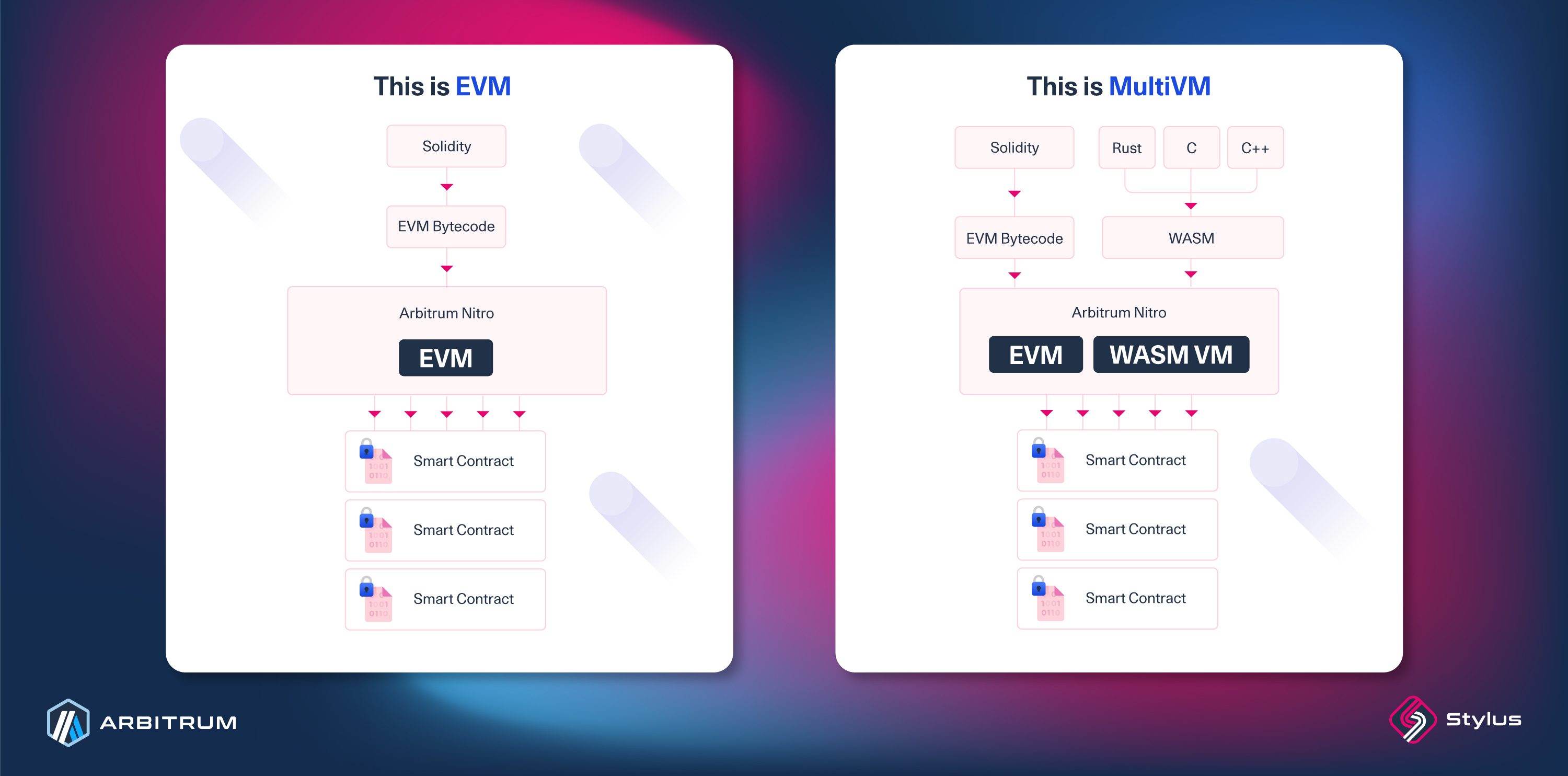
Arbitrum Stylus is a WASM execution layer that runs alongside the EVM, not a replacement for it. This architecture allows developers to write smart contracts in languages like Rust, C, and C++, which compile to WebAssembly. The system executes these WASM programs directly, while the EVM remains active for standard Solidity contracts. This dual-layer approach means you can choose the right tool for the job without migrating away from Ethereum’s established ecosystem.
The core value of Stylus lies in performance and language diversity. By using WASM, you can leverage systems-level languages that offer fine-grained control over memory and computation. This is particularly useful for complex logic or high-frequency trading bots where the overhead of the EVM’s Solidity interpreter becomes a bottleneck. Developers can tap into a broader talent pool familiar with Rust or C++, bringing robust engineering practices to on-chain applications.
It is important to understand that Stylus does not replace the EVM. Both execution environments operate in parallel within the Arbitrum Nitro stack. This means you can deploy a Rust-based contract for heavy computation while keeping your user-facing interface in Solidity. The two can interact, allowing for hybrid architectures that balance performance with compatibility. This flexibility ensures that as you scale, you are not locked into a single programming paradigm.
EVM vs. Stylus performance and costs
The choice between Native EVM and Arbitrum Stylus fundamentally alters how your smart contracts execute and what they cost to run. Native EVM contracts, written in Solidity or Vyper, operate within a standardized virtual machine that prioritizes compatibility and security above all else. Stylus contracts, compiled from Rust or C++ into WebAssembly (WASM), offer a different tradeoff: significantly higher execution efficiency and lower gas costs for compute-heavy operations.
Gas efficiency is the most immediate differentiator. EVM operations are expensive because they consume gas for state changes and complex logic alike. Stylus allows you to perform complex computations in WASM, which is then verified by the EVM. This means you only pay for the final state change in EVM terms, while doing the heavy lifting in cheaper WASM. For applications like rollups or complex data processing, this can reduce gas costs by an order of magnitude compared to equivalent Solidity logic.
Execution speed and developer experience also diverge. The EVM is mature, with extensive tooling, audit libraries, and a large developer base. Stylus introduces a new paradigm where you can leverage Rust’s type safety and performance features. However, this comes with a steeper learning curve and a smaller ecosystem of existing libraries. You are trading the familiarity of Solidity for the raw power and flexibility of a general-purpose programming language.
The following table outlines the core technical distinctions between the two models.
| Feature | Native EVM | Arbitrum Stylus |
|---|---|---|
| Language | Solidity, Vyper | Rust, C++ |
| Runtime | EVM (Ethereum Virtual Machine) | WebAssembly (WASM) |
| Gas Efficiency | Standard | Higher for compute-heavy tasks |
| Execution Speed | Standard | Faster for complex logic |
| Tooling Maturity | High | Growing |
| Verification | Native | EVM-verified WASM |
When to use Rust over Solidity
Choosing Stylus with Rust makes sense when your smart contract demands performance or leverages existing engineering assets. While Solidity remains the standard for general-purpose DeFi, Rust offers tangible advantages in three specific scenarios: complex cryptography, high-frequency trading, and teams with established Rust codebases.
Complex cryptography
Rust’s standard library and mature ecosystem provide robust tools for advanced cryptographic operations. If your protocol requires zero-knowledge proofs, multi-party computation, or heavy elliptic-curve operations, writing these in Rust is often more efficient and less error-prone than implementing them in Solidity. Solidity’s limited standard library forces developers to rely on precompiled contracts or inefficient workarounds for non-standard cryptographic primitives. Rust allows you to use proven, audited crates like ring or arkworks, reducing the attack surface and development time. For protocols where cryptographic integrity is paramount, this native support is a significant architectural benefit.
High-frequency trading
For decentralized exchanges (DEXs) or trading bots, latency is currency. Rust’s fine-grained control over memory and execution speed allows for optimizations that Solidity cannot match. In high-frequency trading environments, even small differences in gas consumption and execution time can mean millions in arbitrage opportunities. Stylus enables Rust contracts to execute logic closer to native machine speed than the EVM’s bytecode interpretation. If your application involves complex order matching engines or real-time price feeds, Rust’s performance characteristics provide a competitive edge that Solidity’s virtual machine overhead cannot easily replicate.
Existing Rust codebases
Many blockchain infrastructure projects, including Solana and Polkadot ecosystems, are built in Rust. If your team already has a mature Rust codebase for off-chain services or cross-chain bridges, Stylus allows you to port that logic directly on-chain. This reduces duplication of effort and leverages existing developer expertise. Instead of hiring Solidity specialists or rewriting complex logic in a new language, you can reuse proven Rust modules. This is particularly advantageous for projects transitioning from other L1s or those requiring seamless integration with off-chain Rust-based data processors.
The decision ultimately hinges on your specific technical requirements. If your project relies on standard tokenomics or simple governance, Solidity’s ecosystem maturity is hard to beat. However, for specialized, performance-critical, or crypto-heavy applications, Rust on Stylus offers a compelling technical upgrade.
Developer tooling and ecosystem maturity
The gap between native EVM and Stylus is widest in developer support. Native EVM benefits from a decade of accumulated tooling, while Stylus SDKs are still maturing. Choosing a model often comes down to whether you prioritize immediate productivity or long-term flexibility.
Native EVM: Battle-Tested Infrastructure
Native EVM development relies on established frameworks like Hardhat and Foundry. These tools offer robust debugging, extensive documentation, and a massive pool of developer knowledge. If you need to deploy quickly using familiar Solidity patterns, the EVM path provides a smoother onboarding experience with fewer integration hurdles.
Stylus: Emerging Rust Toolchain
Stylus introduces a Rust-based SDK that compiles to WebAssembly. This approach offers type safety and performance benefits but requires learning new compilation workflows. The current SDK (v0.10.2) supports Solidity ABI equivalence, allowing some interoperability, but the ecosystem of third-party libraries and debugging utilities is significantly smaller than the EVM counterpart.
Ecosystem Maturity Comparison
The following table highlights the current state of tooling for both models.
| Feature | Native EVM | Stylus |
|---|---|---|
| Primary Language | Solidity | Rust |
| Debugging Tools | Extensive (Hardhat, Foundry) | Limited (Emerging) |
| Documentation | Comprehensive | Basic (Official Docs) |
| Community Support | Large | Small |
Decision Framework
For teams prioritizing speed to market and access to existing libraries, native EVM remains the safer bet. However, if your project demands high-performance computation and you have Rust expertise, Stylus offers a compelling alternative despite the current tooling gaps.
Frequently asked questions about Stylus
What is Stylus on Arbitrum?
Stylus is a new execution environment on Arbitrum that allows developers to write smart contracts in languages like Rust, C, and C++. Instead of compiling to EVM bytecode, these programs compile to WebAssembly (WASM). This enables substantial performance gains and access to a broader pool of developers familiar with systems programming. The Stylus SDK ensures these contracts remain compatible with Solidity ABIs, allowing them to interact seamlessly with existing EVM tools and dApps.
Does Arbitrum have a future with Stylus?
Stylus represents a significant upgrade to Arbitrum’s architecture, addressing the computational limits of the EVM. By supporting WASM, Arbitrum can handle more complex, high-performance applications that were previously too expensive or slow on the EVM. This expansion keeps Arbitrum competitive in the Layer 2 space, offering a path toward higher throughput and lower costs for compute-heavy tasks without abandoning its EVM compatibility.
What are the risks of using Stylus?
The primary risk lies in the novelty of the technology. While the EVM has decades of security auditing, WASM-based contracts are newer and have fewer battle-tested libraries. Developers must carefully manage memory safety and ensure their Rust or C code is free of vulnerabilities. Additionally, the fraud proof mechanism for Stylus contracts is distinct from standard EVM proofs, requiring validators to handle WASM execution, which adds a layer of complexity to the network’s security model.
What is the use case for Stylus?
Stylus is ideal for applications requiring high computational power, such as decentralized finance (DeFi) protocols with complex calculations, gaming, or machine learning inference on-chain. It allows developers to optimize gas costs for heavy logic by using faster, more efficient languages. However, for simple token transfers or basic storage operations, the native EVM remains the more straightforward and cost-effective choice.
No comments yet. Be the first to share your thoughts!