Stylus vs EVM: The Core Difference
Arbitrum Stylus and the Ethereum Virtual Machine (EVM) are not competing replacements; they are distinct execution environments operating within the same Nitro stack. The EVM remains the foundational layer, optimized for the Solidity programming language and the vast existing ecosystem of Ethereum smart contracts. Stylus introduces a second, parallel execution layer that supports WebAssembly (WASM), enabling developers to write contracts in languages like Rust, C, and C++.
This dual-VM architecture allows Arbitrum to handle diverse computational needs without forcing a choice between legacy compatibility and modern performance. The EVM continues to process standard ERC-20 and ERC-721 tokens using Solidity, ensuring broad interoperability with existing wallets and tools. Meanwhile, Stylus processes WASM-based contracts, which offer greater flexibility for complex logic and high-performance applications that exceed the EVM's design constraints.
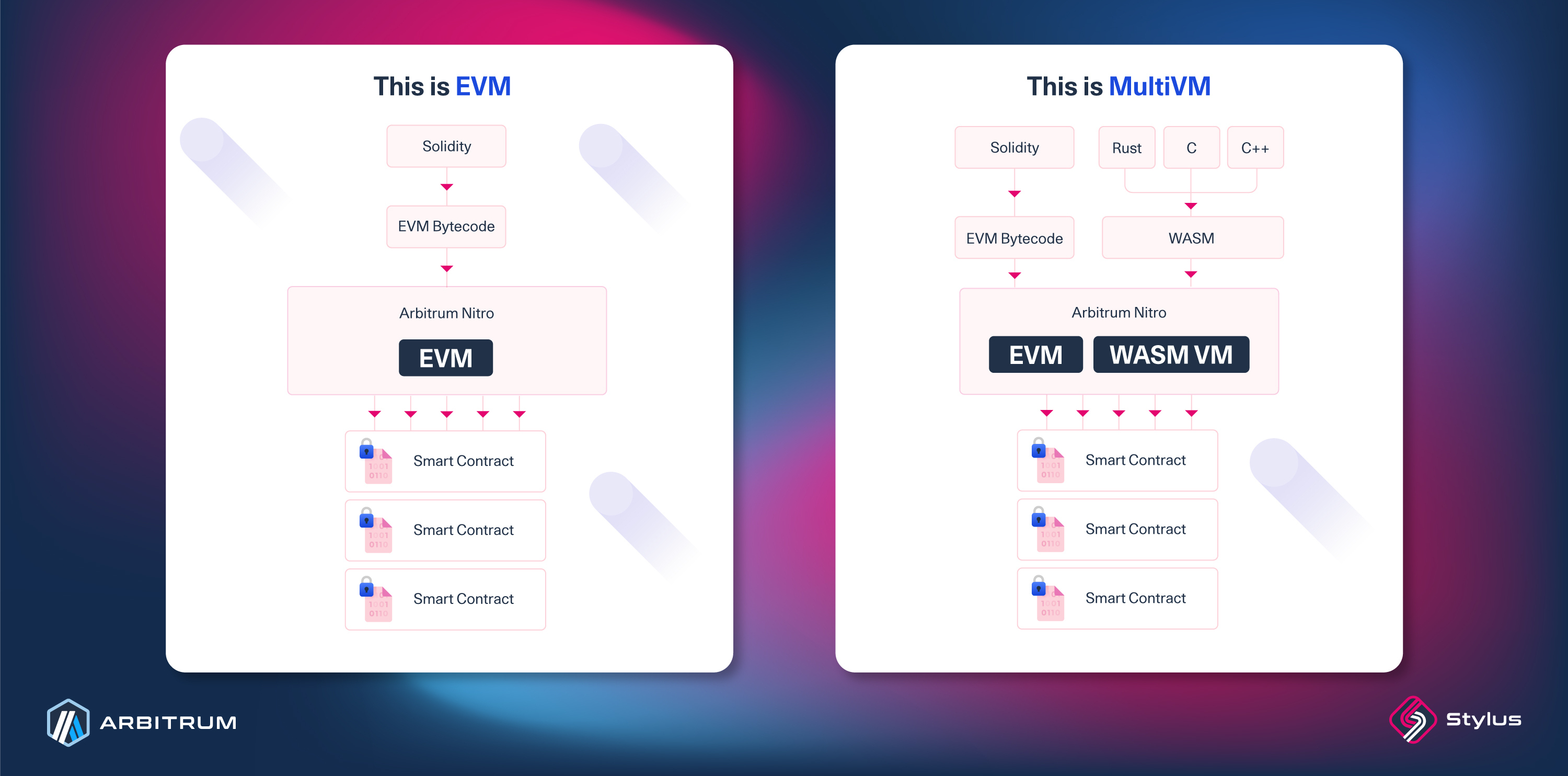
The technical divergence is significant. EVM contracts execute on a stack-based virtual machine with 256-bit word sizes, which prioritizes security and decentralization over raw computational speed. Stylus contracts run on a WASM runtime, which supports standard 64-bit architectures and native system calls. This allows developers to leverage existing libraries and optimize code for specific hardware, resulting in lower gas costs for compute-heavy tasks and faster execution times compared to their EVM equivalents.
Performance and Cost Comparison
When evaluating Arbitrum Stylus against the native EVM, the difference lies in execution efficiency. Stylus runs WebAssembly (WASM) contracts, which allows developers to use languages like Rust, C, and C++. This shift from the EVM’s opcode-based execution to a more traditional compiled model results in significantly lower gas costs and faster processing times for compute-heavy tasks.
While EVM contracts remain the standard for simple value transfers and basic token logic, they become expensive when complex calculations are required. Stylus bridges this gap by offering a performance layer that rivals centralized servers, making it viable for applications that previously could not afford the gas fees on Ethereum Layer 2s. The efficiency gain comes from WASM’s ability to execute code more densely and quickly than the EVM’s sequential instruction set.
The table below outlines the primary technical distinctions between the two stacks.
| Feature | EVM | Stylus (WASM) |
|---|---|---|
| Primary Language | Solidity, Vyper | Rust, C, C++ |
| Execution Model | Opcode-based | WebAssembly (WASM) |
| Gas Efficiency | Standard Layer 2 rates | Up to 10-100x more efficient for compute |
| Best Use Case | Simple value transfers, tokens | High-frequency trading, gaming, complex logic |
For projects requiring high-frequency interactions or complex state updates, Stylus provides a tangible cost advantage. The ability to write in Rust also allows for memory safety and performance optimizations that are difficult to achieve in Solidity. However, for standard ERC-20 or ERC-721 implementations, the EVM remains the most compatible and widely supported option across the broader Ethereum ecosystem.
Developer Experience and Language Support
Arbitrum Stylus fundamentally alters the developer experience by allowing smart contracts to be written in Rust, C, and C++, compiled to WebAssembly (WASM), rather than being limited to Solidity or Vyper. This shift moves Arbitrum beyond the traditional Ethereum Virtual Machine (EVM) constraints, offering a parallel execution environment that is both faster and more flexible. For developers already familiar with systems programming, this means leveraging existing codebases and industry-standard tools rather than learning a domain-specific language designed exclusively for blockchain.
The move to Rust and WASM provides significant advantages in code safety and performance. Rust’s ownership model prevents common memory safety issues like buffer overflows and race conditions at compile time, reducing the risk of critical vulnerabilities in complex DeFi protocols. In contrast, the EVM relies on runtime checks and gas limits to prevent errors, which can lead to unexpected behavior or high costs during execution. Stylus programs run natively on the host machine, bypassing the EVM’s interpreter overhead, which allows for more sophisticated logic and lower transaction fees for compute-intensive tasks.
This expansion of language support also broadens the potential talent pool. Thousands of experienced systems engineers who have not specialized in Solidity can now contribute to the Arbitrum ecosystem. The Stylus SDK for Rust provides the necessary abstractions to bridge these languages with Arbitrum’s infrastructure, making the transition smoother for established teams. As the ecosystem matures in 2026, the ability to reuse existing Rust libraries for cryptography, data structures, and networking becomes a decisive advantage for building robust financial applications.
While the EVM remains dominant for simple value transfers and basic token logic, Stylus is becoming the preferred stack for applications requiring heavy computation, such as zero-knowledge proof verification or complex market-making algorithms. The choice between EVM and Stylus is no longer about compatibility alone, but about matching the right tool to the complexity of the financial instrument being built.
DeFi liquidity and ecosystem impact
Arbitrum’s current DeFi landscape remains dominated by the EVM stack, which hosts the vast majority of Total Value Locked (TVL). Legacy protocols like GMX, Aave, and Camelot rely on Solidity and Vyper for their established security audits and deep liquidity pools. For standard yield farming, lending, and decentralized exchanges, the EVM environment offers a mature, battle-tested infrastructure that minimizes counterparty risk for institutional capital.
Stylus is carving out a distinct niche in high-performance segments where EVM gas constraints create friction. By allowing Rust and C++ compilation to WebAssembly, Stylus enables complex on-chain logic that would be prohibitively expensive or technically unfeasible on pure EVM. This capability is driving initial adoption in specialized derivatives, on-chain gaming, and high-frequency trading bots where execution speed and computational density matter more than simple token swaps.
The migration of liquidity is gradual. Early Stylus deployments, such as those leveraging Move language compilers or custom Rust-based AMMs, demonstrate lower gas costs for complex computations. However, these projects are still building their liquidity depth. The ecosystem is not replacing EVM but rather expanding into use cases that require the computational efficiency of WASM without sacrificing the security guarantees of the Nitro stack.
Developers choosing between stacks should evaluate the specific requirements of their protocol. If the application involves standard token transfers or simple swaps, the EVM remains the safer bet for liquidity aggregation. If the application requires complex state transitions, real-time data processing, or heavy cryptographic operations, Stylus offers a tangible advantage in performance and cost efficiency, attracting a different tier of users and developers.
Security and Fraud Proving Mechanisms
Stylus contracts operate within Arbitrum’s existing fraud-proof infrastructure, meaning they inherit the same security guarantees as native EVM contracts. When a Stylus contract executes, its output is verified against the deterministic state transition. If a node attempts to submit an incorrect state root, anyone can challenge it with a fraud proof. This mechanism ensures that non-EVM code does not introduce new trust assumptions or reduce the chain's finality.
The core difference lies in how the fraud proof is generated. For EVM contracts, the proof involves replaying EVM opcodes. For Stylus, the proof involves replaying the WebAssembly (WASM) module. Arbitrum Nitro uses a unified execution engine that can interpret both EVM bytecode and WASM code. This allows the fraud proof system to handle both contract types without requiring separate verification layers.
This unified approach simplifies the security model. Developers writing in Rust or C++ do not need to worry about compatibility with the fraud proof generator. The Nitro validator handles the translation and verification automatically. However, this also means that any bugs in the WASM interpreter could theoretically impact security. Arbitrum has addressed this by making the interpreter open-source and subject to extensive auditing.
While Stylus offers performance advantages, the security trade-offs are minimal. The fraud proof process remains the same: challenge, verify, and resolve. This ensures that Stylus contracts are as secure as their EVM counterparts, provided the underlying Nitro stack remains secure. The primary risk is not in the fraud proof itself, but in the complexity of the WASM execution environment. Developers must ensure their code is deterministic and free of side effects that could break the proof generation process.
Choosing the Right Stack for Your Project
Selecting between the EVM and Stylus stacks requires matching your team’s existing expertise with the specific performance and cost constraints of your protocol. The decision is not merely about which technology is faster, but which one aligns with your project’s long-term operational reality and liquidity needs.
Your development velocity depends heavily on the languages your engineers already know. If your team consists of Solidity developers, the EVM offers a mature ecosystem with extensive tooling and libraries. Switching to Stylus introduces a learning curve for Rust or C++, which, while powerful, requires a different approach to memory management and system design.
Stylus provides significant computational advantages for complex logic. Rust and C++ compiled to WASM can execute operations much faster and cheaper than Solidity on the EVM. If your protocol involves high-frequency trading, complex cryptography, or heavy data processing, the performance gains of Stylus can drastically reduce gas costs and improve user experience.
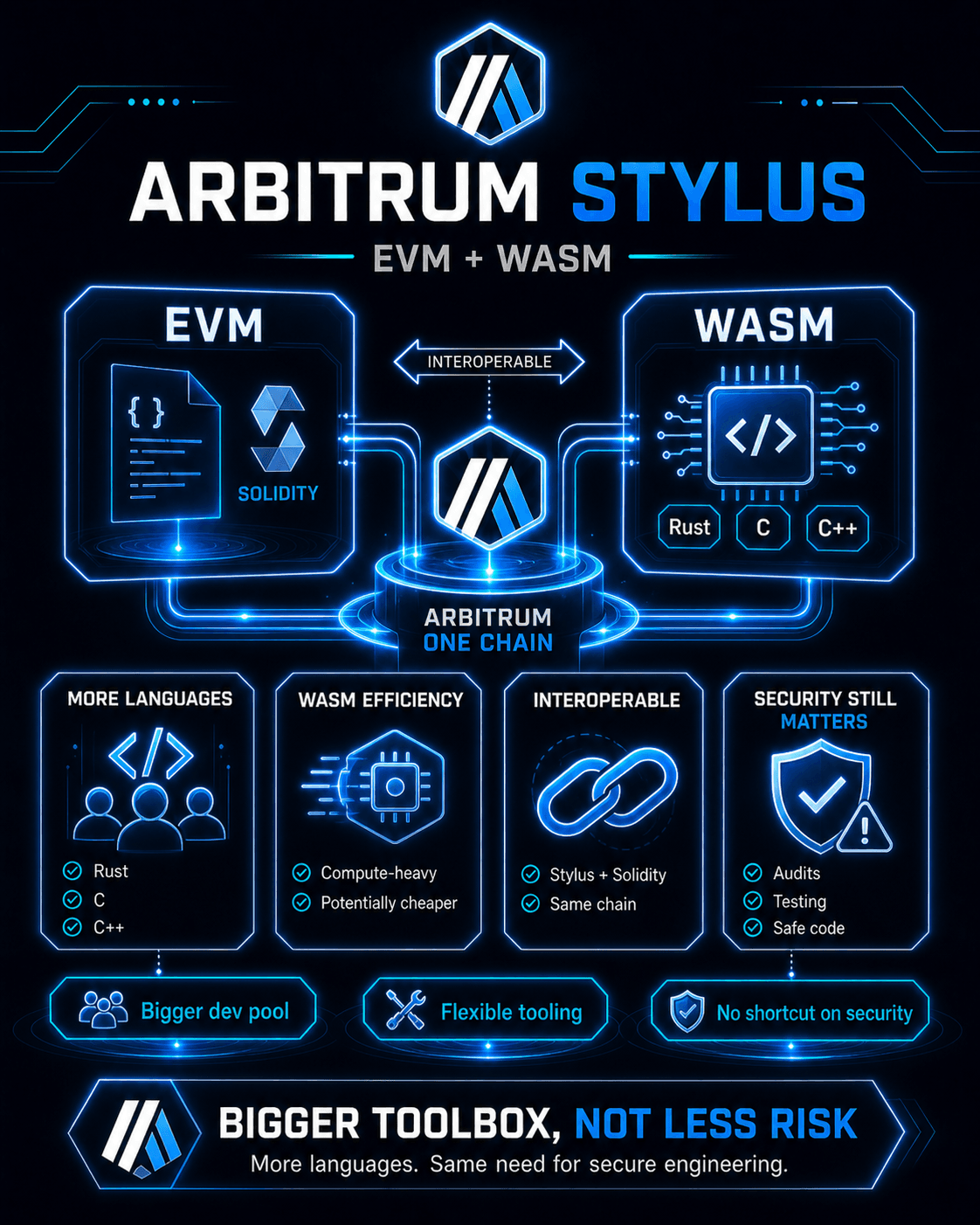
The EVM remains the dominant standard for liquidity. Most DeFi protocols, wallets, and infrastructure tools are built for EVM compatibility. By choosing EVM, you gain immediate access to a vast network of interoperable applications. Stylus is growing but still requires developers to bridge assets and users across different virtual machines, which can create friction for new projects.
Security is paramount in high-stakes finance. The EVM has been battle-tested for years, with a wide range of auditing firms and formal verification tools available. Stylus, while using the robust Rust language, is newer to the blockchain space. If your project handles large sums of capital, the maturity of the EVM’s security landscape may provide a safer foundation despite its higher computational costs.
| Feature | EVM | Stylus |
|---|---|---|
| Language | Solidity | Rust, C, C++ |
| Performance | Standard | High |
| Ecosystem | Large | Growing |
| Learning Curve | Lower | Higher |
No comments yet. Be the first to share your thoughts!