What Arbitrum Stylus 2026 actually is
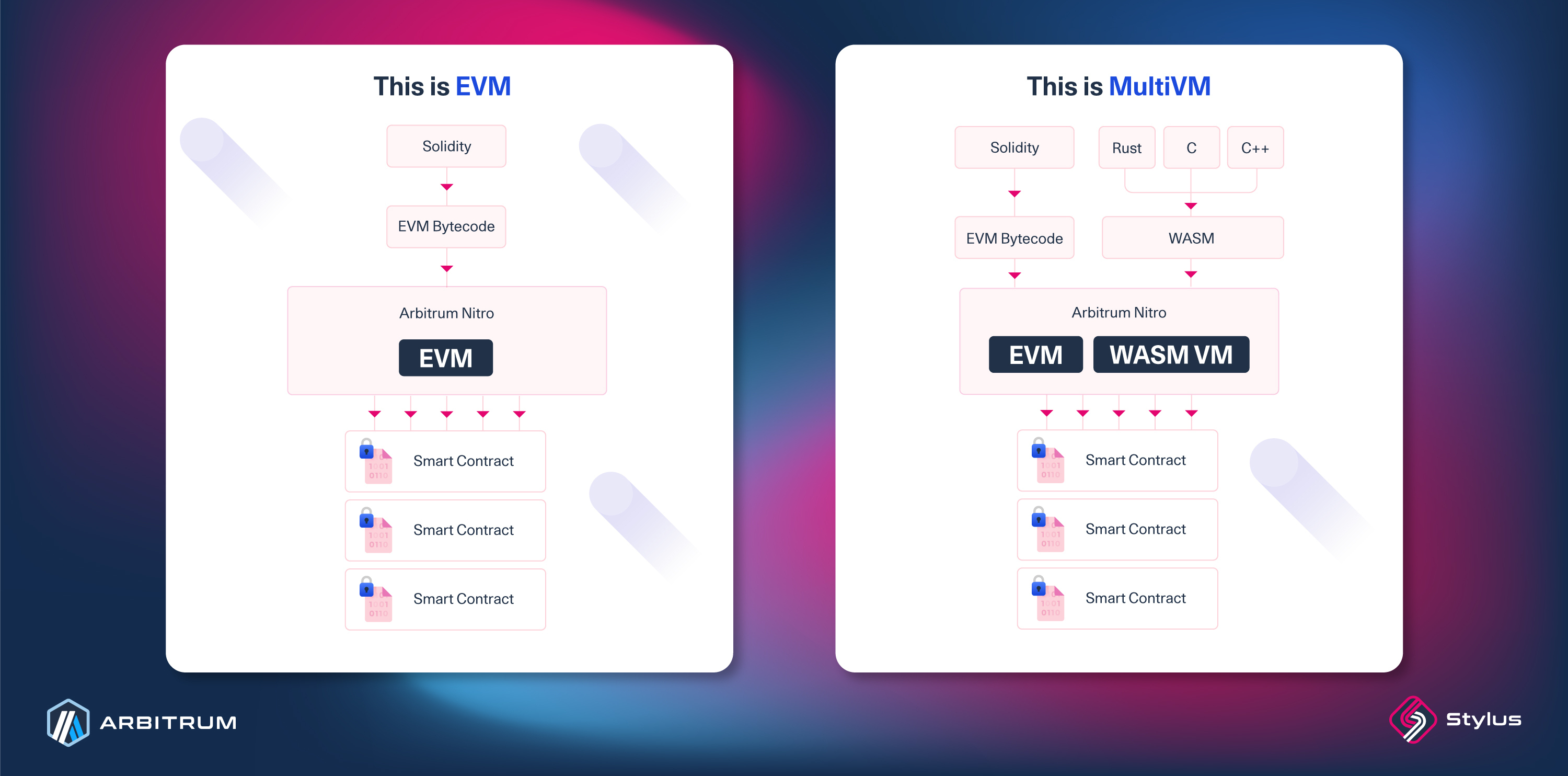
Arbitrum Stylus is a new execution layer that allows developers to write smart contracts in languages like Rust, C, and C++. These contracts compile to WebAssembly (WASM), running alongside the traditional Ethereum Virtual Machine (EVM) on the same network. This setup does not replace the EVM; it expands the ecosystem by offering a second, parallel execution environment.
Before Stylus, Arbitrum was strictly an EVM environment. Every smart contract had to be written in Solidity or Vyper and compiled to EVM bytecode. This limitation meant that developers proficient in systems programming languages could not easily deploy to Arbitrum without learning new tools. Stylus removes this barrier by introducing WASM support, enabling a broader range of programming languages to interact with the network.
The architecture is designed for coexistence. EVM contracts and Stylus contracts can call each other, share state, and interact with the same liquidity pools. This interoperability is critical for maintaining the integrity of the existing Arbitrum ecosystem while introducing new capabilities. Developers do not need to choose between EVM and Stylus; they can use both within the same application.
WASM offers several technical advantages over EVM bytecode. It supports more complex data structures, faster execution speeds, and more flexible memory management. These features make Stylus particularly suitable for applications that require high-performance computations, such as gaming, oracles, and advanced cryptographic protocols. However, the EVM remains the standard for most DeFi applications due to its maturity and extensive tooling.
The decision to adopt Stylus depends on the specific needs of the project. If an application requires complex logic or high-throughput computations, Stylus provides the necessary performance. For simpler applications, the EVM remains the more straightforward and cost-effective option. Understanding this distinction is essential for making informed technical decisions in 2026 and beyond.
Comparing EVM and Stylus execution models
Arbitrum Stylus introduces a dual-execution environment that fundamentally alters how smart contracts interact with the blockchain. While traditional EVM contracts rely on Solidity and a stack-based instruction set, Stylus allows developers to write contracts in languages like Rust, C, and C++ that compile to WebAssembly (WASM). This shift is not merely cosmetic; it changes the underlying mechanics of memory management, instruction execution, and gas accounting.
Execution Environment and Language
The EVM is designed specifically for Ethereum smart contracts, using a bytecode format that is interpreted by the virtual machine. It is Turing-complete but constrained by its stack-based architecture and limited instruction set. Stylus, by contrast, runs WASM modules. WASM is a binary instruction format for a stack-based virtual machine, but it is designed to be a portable compilation target for high-level languages. This means developers can leverage mature ecosystems, tooling, and libraries from the broader WebAssembly community, rather than being limited to the Solidity/Foundry stack.
Memory Management
Memory handling is one of the most significant technical divergences. In the EVM, memory is linear and untyped. Developers must manually manage memory offsets, which often leads to complex and error-prone code when handling dynamic data structures. Gas costs in the EVM are heavily influenced by memory expansion, making complex data manipulation expensive.
Stylus uses WASM’s linear memory model, which is more similar to traditional systems programming languages. This allows for more efficient data structures, such as linked lists or complex trees, without the quadratic gas penalties associated with EVM memory expansion. However, this flexibility requires developers to manage memory explicitly, introducing a different class of potential bugs related to pointer arithmetic and memory safety, which WASM mitigates through its sandboxed execution environment.
Gas and Performance
Gas accounting in Stylus is more granular. Instead of relying on the EVM’s opcode-based gas schedule, Stylus uses a WASM execution cost model that charges based on the actual computational resources consumed. This can lead to significant cost savings for complex logic that is inefficient in the EVM. For example, cryptographic operations or large data processing tasks that require many EVM opcodes can be executed in fewer WASM instructions, reducing the overall gas cost.
Comparison Table
The following table summarizes the key technical differences between the two execution models.
| Feature | EVM (Solidity) | Stylus (WASM) |
|---|---|---|
| Language | Solidity | Rust, C, C++ |
| Bytecode | EVM Bytecode | WebAssembly (WASM) |
| Memory Model | Linear, untyped, gas-heavy expansion | Linear, typed, efficient management |
| Instruction Set | Stack-based, limited opcodes | Stack-based, rich WASM instructions |
| Gas Cost | Fixed opcode costs, high for complex logic | Granular, based on computational resources |
| Ecosystem | Mature, extensive tooling | Emerging, leverages broader WASM ecosystem |
Lower compute costs unlock complex logic
Arbitrum Stylus shifts the economic equation for on-chain computation. By running non-EVM code in WASM, developers pay for memory and compute at rates that pure EVM environments cannot match. This price difference is not merely incremental; it is structural. The EVM was designed for security and simplicity, treating memory as a scarce, expensive resource. Stylus treats memory as abundant and cheap, allowing for logic that would be prohibitively expensive on legacy EVM chains.
The cost reduction stems from how WASM handles state. In the EVM, every memory access and computational step incurs a gas cost proportional to its complexity. Complex algorithms, such as those required for advanced cryptographic proofs or high-frequency trading logic, burn through gas reserves quickly. Stylus decouples this relationship. The underlying Arbitrum Nitro architecture allows WASM programs to execute with near-native efficiency, drastically reducing the gas overhead associated with memory-intensive operations.
This efficiency enables a new class of applications. Developers can now implement complex state machines, sophisticated game engines, or heavy data processing tasks without the gas costs that typically force these applications off-chain or into simplified, less secure forms. The economic barrier to entry for complex on-chain logic has lowered significantly, allowing for richer user experiences and more robust decentralized systems that were previously economically unviable on pure EVM infrastructure.
Security tradeoffs in non-EVM languages
Moving away from Solidity introduces a fundamental shift in how security is managed. Traditional EVM contracts rely on a battle-tested execution environment with decades of accumulated knowledge, static analysis tools, and established attack patterns. Non-EVM languages like Rust or C offered through Arbitrum Stylus bring different strengths and weaknesses to the table.
Rust provides memory safety by default, eliminating entire classes of vulnerabilities common in C or C++, such as buffer overflows and use-after-free errors. This is a significant advantage for complex logic that manipulates large data structures. However, memory safety is only one layer of security. It does not protect against logical errors, reentrancy attacks, or economic exploits, which remain the primary vectors for smart contract hacks.
The tradeoff lies in tooling maturity. Solidity benefits from a vast ecosystem of auditing firms, automated scanners, and community scrutiny. Non-EVM languages in the Stylus environment are newer, meaning fewer specialized security tools exist to catch subtle bugs. Developers must rely more heavily on manual code review and formal verification, which can be resource-intensive. The lack of standardized, battle-tested libraries also means more custom code to audit.
| Feature | Solidity (EVM) | Rust/Move (Stylus) |
|---|---|---|
| Memory Safety | Manual (prone to overflow/underflow) | Guaranteed (Rust) / Safe (Move) |
| Tooling Ecosystem | Mature, extensive | Emerging, specialized |
| Attack Surface | Well-documented, predictable | Newer, less known vectors |
| Audit Complexity | Standardized patterns | Custom logic, higher expertise |
While Stylus offers performance benefits, the security model requires a different approach. Developers cannot assume that a language's safety guarantees replace rigorous auditing. The community is still building the necessary guardrails to match the security confidence level of the EVM.
Choosing the right stack for your dApp
Selecting between Solidity/EVM and Stylus requires weighing composability against raw execution power. There is no universal default; the decision hinges on your specific latency, gas, and integration constraints.
Stick with Solidity and the EVM if your dApp relies heavily on existing DeFi primitives. The EVM environment offers immediate access to established liquidity pools, standard interfaces, and a mature developer ecosystem. If your core value proposition depends on seamless interoperability with Ethereum infrastructure, the EVM remains the most stable foundation.
Choose Stylus when your application demands high-throughput computation or complex algorithms that are prohibitively expensive in EVM. By leveraging Rust or C++ to compile to WASM, you can bypass the EVM’s opcode limitations. This stack is ideal for gaming engines, advanced cryptographic proofs, or data-heavy analytics where gas efficiency and execution speed are critical.
Your team’s existing proficiency significantly impacts development velocity. If your engineers are deeply experienced in Solidity, the learning curve for Stylus may outweigh the performance benefits for a standard application. Conversely, if your team specializes in systems programming, Stylus offers a more natural development environment for complex logic. Always audit the security implications of non-EVM code, as the attack surface differs from traditional smart contract vulnerabilities.
| Feature | Solidity/EVM | Stylus (WASM) |
|---|
Common questions about Arbitrum Stylus
Developers evaluating Stylus often conflate the new WASM execution environment with the underlying Layer-2 infrastructure. Understanding these distinctions is critical for assessing risk and technical fit.
No comments yet. Be the first to share your thoughts!