Arbitrum One vs. Nova at a glance
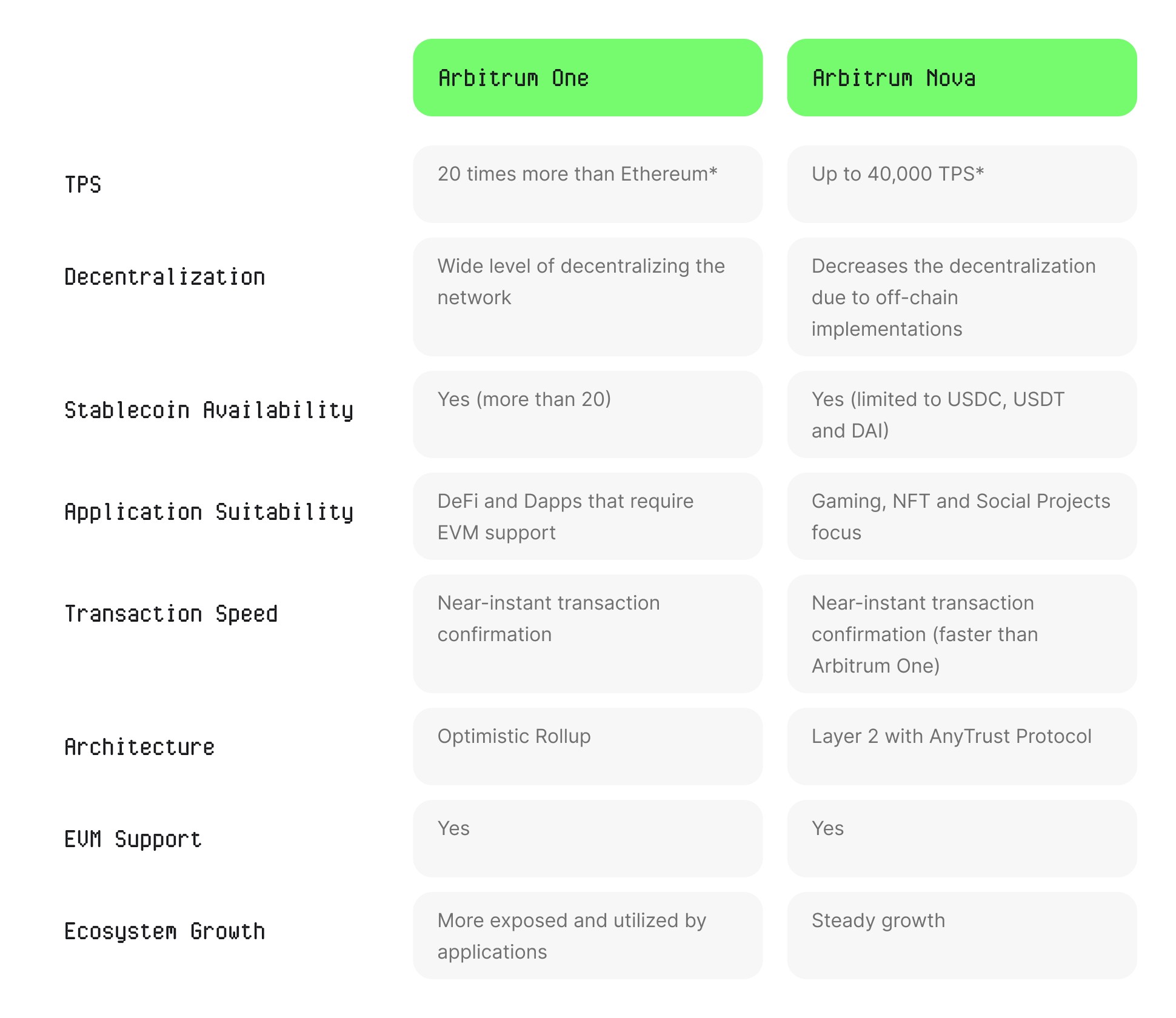
Arbitrum operates as the primary Layer-2 scaling solution for Ethereum, designed to handle high-value financial activity and complex decentralized applications. It achieves this by processing transactions off-chain while inheriting Ethereum's security guarantees through optimistic rollups. This architecture supports deep liquidity and a mature ecosystem of DeFi protocols, making it the standard choice for serious financial interactions.
Arbitrum Nova, by contrast, is built specifically for high-frequency, low-value interactions. It utilizes a different data availability layer that significantly reduces costs, allowing for micro-transactions that would be prohibitively expensive on the main rollup. This makes Nova particularly well-suited for gaming, social applications, and content platforms where users expect near-instant, cheap interactions rather than high-value settlement.
The following comparison highlights the structural differences between the two chains. Understanding these metrics helps determine which environment aligns with your specific use case, whether that is maximizing capital efficiency or minimizing user friction.
| Feature | Arbitrum One | Nova |
|---|---|---|
| Primary Focus | DeFi & High-Value DApps | Gaming & Social Apps |
| Avg. Gas Cost | Low | Ultra-Low |
| Data Availability | Ethereum L1 | Off-chain / Optimized |
| Finality Time | ~7-10 Minutes | Seconds to Minutes |
| TVL (Est.) | High ($Billions) | Moderate |
Why Arbitrum One Leads DeFi
Arbitrum One has become the default environment for serious decentralized finance activity. While Nova offers lower fees for specific use cases, it lacks the deep liquidity and institutional trust that Arbitrum One provides. For applications where capital efficiency and security are paramount, Arbitrum One is the established standard.
Liquidity Depth and Ecosystem Maturity
Liquidity in DeFi is not just about volume; it is about stability. Arbitrum One hosts the deepest pools for major assets, ensuring that large trades do not suffer from significant slippage. This concentration of capital comes from the fact that most major protocols launched on Arbitrum One first, creating a network effect that is difficult for newer or specialized chains to replicate.
The ecosystem includes established leaders in lending, derivatives, and liquid staking. Protocols like Aave, GMX, and Camelot operate at scale here, providing users with a wide array of yield-generating opportunities. This maturity means that smart contracts have undergone extensive real-world auditing and battle-testing, reducing the risk of exploits compared to newer environments.
Security Inheritance from Ethereum
Arbitrum One uses an optimistic rollup architecture, which means it inherits the security model of Ethereum. Transactions are posted to Ethereum’s mainnet, where the data availability and finality are guaranteed by Ethereum’s consensus mechanism. This provides a high level of confidence that funds are safe, even if a layer-2 operator were to act maliciously.
In contrast, Arbitrum Nova uses a different data availability model that, while faster and cheaper, does not offer the same level of security guarantees as Arbitrum One. For DeFi applications managing millions of dollars in value, the stronger security inheritance of Arbitrum One is a non-negotiable requirement for many institutional and retail users.
Tooling and Developer Support
The tooling available for Arbitrum One is comprehensive and mature. Developers can use standard Ethereum development stacks like Hardhat and Foundry with minimal changes. This compatibility lowers the barrier to entry for new projects and ensures that existing Ethereum dApps can migrate or deploy to Arbitrum One with relative ease.
The Arbitrum Portal serves as a central hub for accessing these services, offering a unified interface for staking, lending, and swapping. This level of integrated user experience is critical for mass adoption and is currently more polished on Arbitrum One than on Nova.
Arbitrum One vs. Nova: DeFi Comparison
The following table highlights the key differences between Arbitrum One and Nova specifically in the context of DeFi applications.
| Feature | Arbitrum One | Nova |
|---|---|---|
| Security Model | Ethereum Inherited (Optimistic) | Data Availability Sampling |
| Transaction Speed | ~10-30 seconds | ~1 second |
| Liquidity Depth | Deep (Major Pools) | Moderate |
| Protocol Adoption | High (Leading DeFi Apps) | Lower |
| Best Use Case | High-Value DeFi | Gaming & Micro-Transactions |
Nova’s role in gaming and social apps
Arbitrum Nova targets applications where transaction volume outweighs capital depth. While Arbitrum One remains the primary destination for DeFi and high-value interactions, Nova is designed for on-chain gaming and social platforms that require near-zero gas fees and high throughput. These use cases generate massive numbers of small transactions, which would be cost-prohibitive on standard Layer-2 rollups.
Nova achieves these lower costs through a different sequencer architecture. This design choice prioritizes throughput and affordability over the immediate finality times found on Arbitrum One. For developers building games or social feeds, this means users can interact with the blockchain frequently without worrying about transaction fees eating into their budget or experience.
The trade-off is clear: Nova sacrifices some of the immediate settlement speed of One to deliver cheaper, higher-volume operations. This makes it the preferred choice for games that require constant state updates or social apps that need to process many small actions per user. Arbitrum One remains the anchor for capital-intensive DeFi, while Nova serves the high-frequency, low-value edge of the ecosystem.
| Feature | Arbitrum One | Nova |
|---|---|---|
| Primary Use Case | DeFi & High-Value DApps | Gaming & Social Apps |
| Gas Fees | Low | Near-Zero |
| Throughput | High | Very High |
| Finality Speed | Fast | Slower |
| Sequencer Architecture | Standard Rollup | Optimized for Volume |
Bridging assets between chains
Moving funds between Arbitrum One and Arbitrum Nova requires specific bridge paths because they are distinct networks with separate ledgers. You cannot simply send tokens from one to the other like sending an email. Think of them as two different bank branches that do not share a direct teller line; you must go through the main vault (Ethereum) to transfer value between them.
The official Arbitrum Portal serves as the central hub for these operations. It provides the necessary interface to deposit assets from Ethereum mainnet and withdraw them to either Arbitrum One or Nova. While third-party bridges exist, using the official gateway ensures you are interacting directly with the canonical contract, reducing the risk of smart contract exploits common in the broader DeFi landscape.
| Feature | Arbitrum One Bridge | Arbitrum Nova Bridge |
|---|---|---|
| Primary Use | DeFi, High-value transfers, Gaming | |
| Cost | Moderate (L2 gas fees) | |
| Finality | ~10-20 minutes (challenge period) | |
| Ecosystem | Full Arbitrum DAO governance | |
| Best For | Staking, Lending, Complex DApps |
When bridging, always verify the destination chain in the portal. Sending assets to the wrong network address or chain ID can result in permanent loss, as there is no central authority to reverse these transactions. The process is straightforward but demands attention to detail, especially when moving between the high-security environment of Arbitrum One and the low-cost, high-speed environment of Nova.
When to choose Nova over One
Nova’s lower costs might look tempting on paper, but the chain operates differently than the main Arbitrum One rollup. While One processes transactions through optimistic fraud proofs for maximum security, Nova uses a different validation model that prioritizes speed and low fees over the deepest liquidity. This distinction makes Nova a niche tool rather than a direct replacement for the primary chain.
The trade-off is immediate. Many of the largest DeFi protocols and high-traffic gaming apps have built their user bases on Arbitrum One because that is where the liquidity lives. If you move a complex trade or a large position to Nova, you may find limited depth or fragmented liquidity pools. The ecosystem is still growing, but it lacks the entrenched network effects of One.
Use this comparison to decide if the savings are worth the isolation:
| Feature | Arbitrum One | Nova |
|---|---|---|
| Security Model | Optimistic Rollup (Fraud Proofs) | Different Validation (Faster Finality) |
| Liquidity Depth | Deep (Major DeFi hubs) | Niche (Growing but fragmented) |
| App Availability | Full EVM compatibility | Limited (Fewer major DApps) |
| Transaction Cost | Moderate | Very Low |
Nova fits specific use cases where cost is the only metric that matters. Micro-transactions in gaming, high-frequency testnet interactions, or simple token transfers for users who rarely touch DeFi can benefit from Nova’s cheap fees. However, for anyone serious about yield farming, lending, or trading significant volumes, Arbitrum One remains the standard. The liquidity and app support on One provide a safety net that Nova currently cannot match.
Common questions about Arbitrum chains
This section addresses frequent queries regarding Arbitrum One, the primary Layer-2 scaling solution for Ethereum. It clarifies how the network operates and where it fits within the broader Arbitrum ecosystem, including its relationship with Arbitrum Nova.
To help visualize the trade-offs, refer to the comparison below:
| Feature | Arbitrum One | Arbitrum Nova |
|---|---|---|
| Primary Use Case | DeFi and High-Value Apps | Gaming and Social Apps |
| Security Model | High (Ethereum L1 Security) | Standard (Optimistic Rollup) |
| Transaction Speed | Fast | Very Fast |
| Cost | Low | Ultra-Low |
Understanding these distinctions helps users select the appropriate chain for their specific needs, whether that is secure financial trading or high-volume interactive experiences.
No comments yet. Be the first to share your thoughts!