Why Arbitrum Layer 3 Matters Now
Arbitrum is undergoing a structural shift from a single Layer 2 network to a multi-chain ecosystem. This transition is driven by Orbit, the underlying framework that allows developers to launch dedicated Layer 3 chains. For DeFi participants, this move away from generic scaling solutions addresses the fundamental trade-offs between throughput, customization, and cost that have long constrained yield optimization.
Generic Layer 2s operate as shared environments where all applications compete for the same block space and security resources. While effective for general adoption, this model creates congestion during high-activity periods, driving up transaction fees and introducing latency. Specialized Layer 3 chains decouple these constraints. By building on the Nitro codebase, projects can create chains tailored to specific yield strategies, tokenization needs, or privacy requirements, ensuring that performance bottlenecks in one sector do not impact others [src-serp-1].
This fragmentation is not a drawback; it is a necessary evolution for complex financial markets. Dedicated chains allow protocols to optimize gas structures, customize virtual machines, and manage liquidity pools with precision. The result is a more efficient capital allocation model where yield-generating activities are no longer hindered by the overhead of general-purpose infrastructure.
To understand the current market context for this infrastructure shift, it is essential to monitor the asset supporting the ecosystem.
How Orbit Chains Enable AppChains
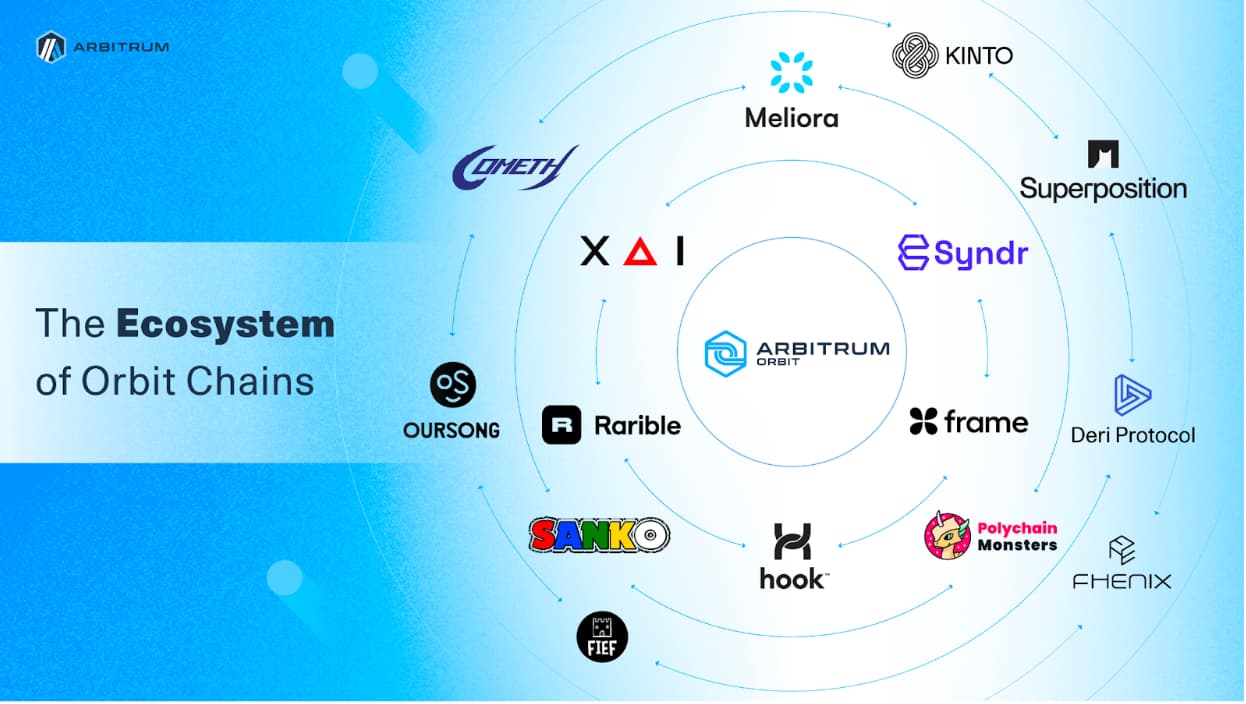
Arbitrum Orbit transforms the Layer 3 narrative by allowing developers to launch permissionless application-specific chains using the Nitro codebase. This architecture grants teams full control over execution logic and economic parameters while relying on the underlying Arbitrum L2 for data availability and security settlement. The result is a modular stack where complex DeFi protocols can operate with the isolation of a Layer 1, backed by the liquidity and security of Ethereum.
The core advantage lies in the removal of validator overhead. Unlike traditional L1s or even some L2s that require maintaining a decentralized set of sequencers and validators, Orbit chains delegate these responsibilities to the parent chain. This structural shift enables higher performance and more flexible margins for developers. By offloading the heavy lifting of consensus to the L2, appchains can focus entirely on optimizing user experience and yield generation without the latency penalties of independent block production.
This permissionless launch capability democratizes access to institutional-grade infrastructure. Projects no longer need to bootstrap their own security model or plan around the complexities of validator distribution. Instead, they can deploy a chain tailored to specific yield strategies, gaming economies, or institutional liquidity pools, settling final state proofs on Arbitrum One. This modularity is reshaping DeFi by allowing specialized chains to coexist, each optimizing for its own use case while contributing to the broader Arbitrum ecosystem.
The Shift to On-Chain Monopolies
Use this section to make the Arbitrum Layer 3 decision easier to compare in real life, not just on paper. Start with the reader's actual constraint, then separate must-have requirements from details that are merely nice to have. A practical choice should survive normal use, maintenance, timing, and budget. If a recommendation only works in an ideal situation, call that out plainly and give the reader a fallback path.
The simplest way to use this section is to write down the must-have criteria first, then compare each option against those criteria before weighing nice-to-have features.
Impact on DeFi Yields in 2026
Use this section to make the Arbitrum Layer 3 decision easier to compare in real life, not just on paper. Start with the reader's actual constraint, then separate must-have requirements from details that are merely nice to have. A practical choice should survive normal use, maintenance, timing, and budget. If a recommendation only works in an ideal situation, call that out plainly and give the reader a fallback path.
| Factor | What to check | Why it matters |
|---|---|---|
| Fit | Match the option to the primary use case. | A good deal still fails if it does not fit the job. |
| Condition | Verify age, wear, and service history. | Hidden condition issues erase upfront savings. |
| Cost | Compare purchase price with likely upkeep. | The cheapest option is not always the lowest-cost option. |
No comments yet. Be the first to share your thoughts!