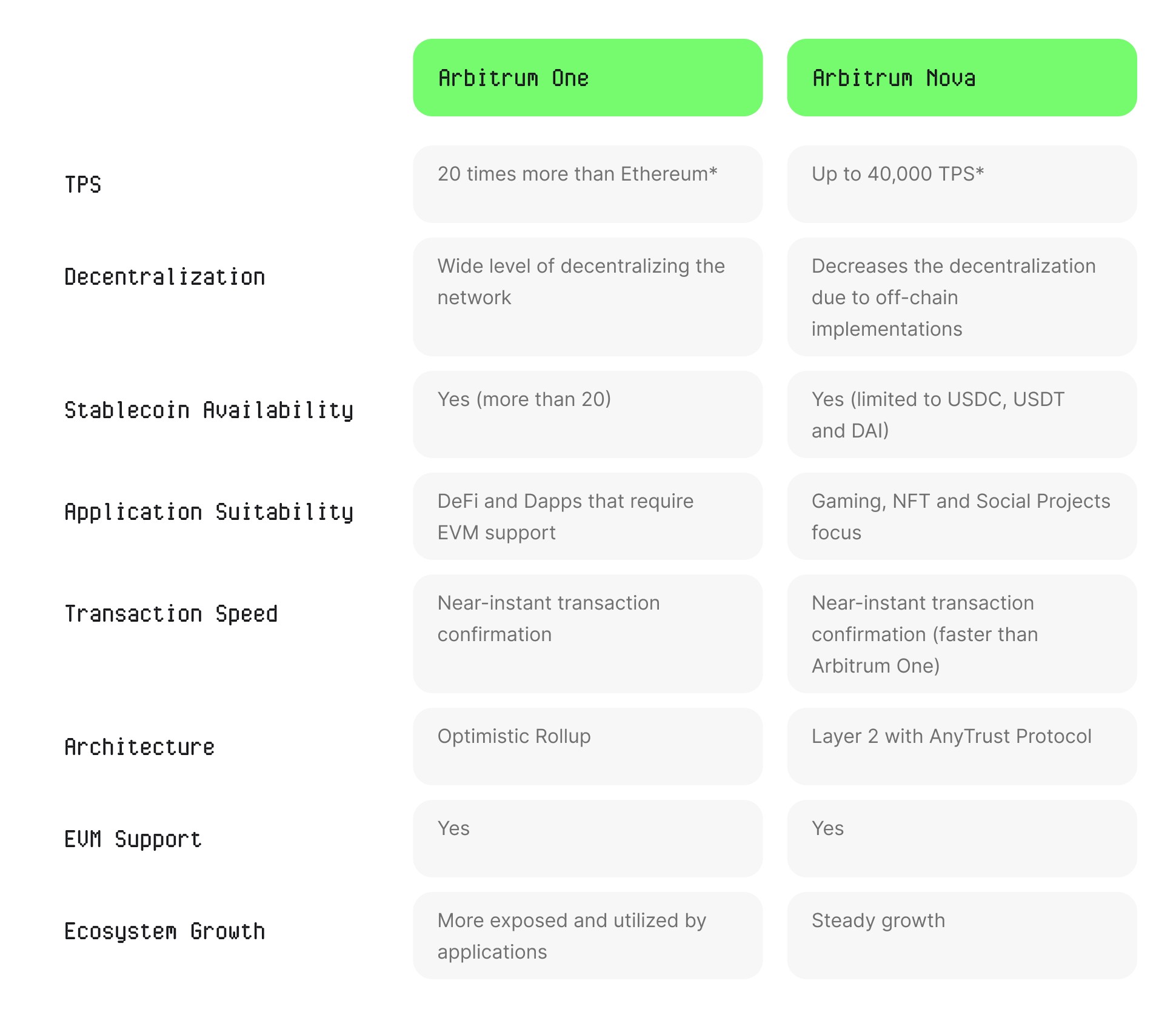
Arbitrum One vs. Nova at a glance
Arbitrum One serves as the flagship Layer 2 solution for Ethereum, designed to handle the broad spectrum of decentralized applications. It prioritizes security and compatibility, offering a development environment that mirrors Ethereum mainnet. This makes it the standard choice for DeFi protocols, tokenization projects, and general-purpose smart contracts that require the highest level of security guarantees from the Ethereum settlement layer.
Arbitrum Nova operates as a distinct chain within the same ecosystem but with a different architectural focus. It is optimized for high-frequency applications, particularly gaming and social media. Nova achieves significantly lower costs by using a different data availability strategy, trading some of the strict security guarantees of One for speed and affordability. This specialization allows developers to run applications with thousands of transactions per second that would be too expensive on the main L2.
The choice between the two comes down to the nature of your application. If your project relies on complex financial logic, high-value asset management, or broad interoperability with the Ethereum ecosystem, Arbitrum One is the appropriate infrastructure. If your application involves real-time interactions, frequent micro-transactions, or user engagement models that prioritize low latency and minimal fees, Nova provides the necessary throughput.
| Feature | Arbitrum One | Nova |
|---|---|---|
| Primary Use Case | DeFi, general apps | Gaming, social |
| Security Model | High (Ethereum L2) | Optimized for cost |
| Transaction Cost | Low | Very low |
| Data Availability | Standard L2 | Optimized for frequency |
Arbitrum One vs. Nova: Side-by-Side Comparison
Choosing between Arbitrum One and Nova depends on whether your application prioritizes maximum security or minimal transaction costs. Arbitrum One is the primary settlement layer, inheriting Ethereum’s security guarantees through optimistic fraud proofs. Nova, by contrast, uses a validity proof model (validium) to achieve significantly lower fees at the expense of slightly different finality characteristics.
The following table outlines the technical distinctions that should guide your decision. Arbitrum One is the standard for high-value DeFi and applications requiring direct Ethereum security. Nova is designed for high-throughput use cases like gaming or social apps where cost efficiency outweighs the need for immediate on-chain data availability.
| Feature | Arbitrum One | Nova |
|---|---|---|
| Security Model | Optimistic Rollup (Fraud Proofs) | Validity Rollup (Validity Proofs) |
| Data Availability | On-chain (Ethereum L1) | Off-chain (DA Provider) |
| Finality Time | ~7 days (challenge period) | ~20 minutes |
| Gas Costs | Low (but higher than Nova) | Very Low (fraction of One) |
| Primary Use Case | DeFi, High-value Transactions | Gaming, Social, High-Frequency Apps |
For most builders, Arbitrum One remains the default choice due to its deep liquidity and established ecosystem. However, if your project requires thousands of transactions per second with negligible fees, Nova’s architecture offers a more efficient path, provided you are comfortable with off-chain data availability.
DeFi security and liquidity depth
Arbitrum One offers a security model that closely mirrors Ethereum Mainnet. It uses the same finality guarantees and fraud proofs, meaning assets on Arbitrum One are protected by the same economic security that secures the largest decentralized finance ecosystem in the world. This direct link to Ethereum’s security layer is a critical advantage for protocols handling significant value, as it minimizes the risk of novel bridge vulnerabilities or weaker consensus mechanisms that have plagued other Layer 2 solutions.
Liquidity depth on Arbitrum One is substantial, creating a network effect that benefits every participant. With total value locked (TVL) significantly higher than Arbitrum Nova, Arbitrum One hosts deep order books and robust liquidity pools for major protocols like Aave, Morpho, and Fluid. This depth reduces slippage for large trades and ensures that yield opportunities are accessible without requiring excessive capital to move the market.
Arbitrum Nova, by contrast, prioritizes speed and low fees over security and liquidity depth. It uses optimistic rollups with different fraud proof verification schedules, which can introduce latency in dispute resolution. While this makes Nova attractive for high-frequency, low-value interactions, it lacks the institutional-grade security and deep liquidity reservoirs that Arbitrum One provides.
For developers and investors focused on DeFi, the choice is clear. Arbitrum One’s combination of Ethereum-equivalent security and deep liquidity creates a more stable and reliable environment for financial applications. Nova’s trade-offs in security and liquidity make it less suitable for protocols where capital safety and market depth are paramount.
Gaming and social app performance
Arbitrum One is the primary settlement layer for high-value DeFi and complex smart contracts, but its architecture is not optimized for the high-frequency, low-latency demands of real-time gaming or social applications. The chain prioritizes security and data availability for large-scale financial instruments, which means transaction throughput is capped to maintain decentralization and robustness. For developers building games that require rapid state updates—such as turn-based strategy or real-time multiplayer interactions—this throughput ceiling can create bottlenecks during peak usage.
Arbitrum Nova addresses this limitation through a specialized sequencer architecture designed for speed and cost efficiency. Unlike Arbitrum One, which relies on a single primary sequencer for ordering transactions before posting to Ethereum, Nova employs a more decentralized sequencer network. This structure allows Nova to process transactions significantly faster and at a fraction of the cost, making it viable for applications that require micro-transactions or constant state synchronization. The trade-off is a slight shift in the trust model, but for gaming and social apps, the performance gain is substantial.
| Feature | Arbitrum One | Nova |
|---|---|---|
| Primary Use Case | DeFi & High-Value Apps | Gaming & Social |
| Sequencer Model | Single Primary Sequencer | Decentralized Sequencer Network |
| Transaction Speed | Standard L2 Speed | High Throughput |
| Gas Costs | Moderate | Very Low |
| Security Model | Maximal Security | Optimized for Performance |
The choice between the two chains depends entirely on the application's interaction model. If your project involves financial trading, NFT marketplaces, or complex governance, Arbitrum One provides the security foundation necessary for high-value assets. However, if you are building a game or social platform where user experience hinges on instant feedback and minimal fees, Nova’s specialized design offers a superior technical fit. The architecture allows developers to scale user interactions without the latency penalties inherent in the general-purpose Arbitrum One environment.
Developer tooling and ecosystem
When building on Arbitrum One, you are working within the most mature Layer-2 ecosystem available. The tooling landscape mirrors Ethereum’s mainnet almost exactly, meaning your existing development stack—Hardhat, Foundry, and standard EVM wallets—works out of the box without modification. Major data providers like The Graph and Covalent index Arbitrum One data natively, and bridge interfaces are standardized across nearly all DeFi protocols. This broad compatibility reduces friction, allowing teams to deploy complex smart contracts with minimal infrastructure overhead.
Nova, by contrast, operates on a distinct architecture that demands specific adaptations. Because it prioritizes low-cost storage and high-throughput sequencing over full EVM equivalence, developers often encounter compatibility gaps with standard Ethereum tooling. Libraries that rely on specific block data formats or gas estimation models may require custom configuration or fallback mechanisms. While this makes development slightly more labor-intensive, it enables specialized use cases that benefit from Nova’s unique sequencing capabilities.
| Feature | Arbitrum One | Nova |
|---|---|---|
| EVM Compatibility | Full EVM equivalence | Partial EVM equivalence |
| Data Indexing | Native support (The Graph, etc.) | Requires custom indexing or adapters |
| Bridge Standards | Standardized across DeFi | Proprietary or limited bridge support |
| Tooling Maturity | High (mainnet parity) | Moderate (requires adaptation) |
The choice between the two often comes down to whether your project benefits from Nova’s specialized architecture or requires the broad compatibility of Arbitrum One. For most general-purpose dApps and DeFi protocols, the extensive tooling support of Arbitrum One provides a safer, faster path to market. However, for niche applications where storage costs are prohibitive on standard L2s, Nova’s tailored environment may offer a competitive advantage despite the additional development effort.
Choosing the right chain for your project
Deciding between Arbitrum One and Nova depends on your application’s primary workload. Think of Arbitrum One as a bustling financial district and Nova as a specialized industrial park. One offers the deepest liquidity and broadest ecosystem, making it the default choice for most builders. Nova provides a low-cost, high-throughput environment tailored for specific verticals.
Arbitrum One: Best for DeFi and General Use
Arbitrum One is the flagship chain, inheriting Ethereum’s security while delivering significantly lower costs and faster finality. It is the natural home for decentralized finance (DeFi), tokenization, and general-purpose dApps that require access to the widest range of tools and liquidity.
If your project involves lending, trading, or complex smart contracts that rely on deep liquidity pools, Arbitrum One is the right choice. The ecosystem supports major protocols like Aave and GMX, ensuring that your users have access to established infrastructure. The network handles high transaction volumes efficiently, maintaining stability even during peak market activity. For most developers, starting on One minimizes friction and maximizes potential reach.
Nova: Best for Gaming and Social
Nova is designed for applications that prioritize throughput over broad liquidity. It offers extremely low transaction fees and high speed, making it ideal for gaming, social media platforms, and applications with high-frequency interactions. The chain achieves this by using a different data availability layer, which reduces costs but changes the security model slightly compared to One.
If your project involves microtransactions, frequent state updates, or requires a user experience that feels instant, Nova provides the necessary infrastructure. It is not intended to replace One for general DeFi but rather to serve as a complementary environment for niche use cases. Builders should choose Nova if their application logic benefits from scale and low cost more than access to deep financial liquidity.
Common questions about Arbitrum chains
Developers and investors often conflate the token with the infrastructure or confuse the two distinct networks. Here are the technical and economic facts.
No comments yet. Be the first to share your thoughts!