
Arbitrum One vs Nova: The Core Difference
Arbitrum One and Arbitrum Nova serve distinct roles within the same ecosystem. Arbitrum One functions as the primary Layer 2 network, designed to mirror Ethereum’s security model while offering significantly lower transaction costs. It is the standard choice for decentralized finance (DeFi) applications that require the highest level of trustlessness and data availability.
Arbitrum Nova, by contrast, is a specialized chain built for high-throughput applications like gaming and social platforms. It achieves lower fees by storing data off-chain and relying on a committee of validators rather than posting all data directly to Ethereum. This trade-off reduces costs but introduces a different security assumption compared to the primary chain.
The fundamental difference lies in how each chain handles data availability. Arbitrum One posts compressed transaction data to Ethereum, ensuring that the network remains as secure and decentralized as the base layer. This makes it suitable for high-value transactions where users cannot afford to trust a smaller set of validators.
Nova optimizes for speed and cost by using a smaller set of trusted validators to store data. This approach allows for much lower fees, making it ideal for applications that generate thousands of transactions per second, such as on-chain games or social feeds, where the cost per transaction must be near zero.
| Feature | Arbitrum One | Arbitrum Nova |
|---|---|---|
| Primary Use Case | DeFi, high-value transactions | Gaming, social, high-frequency apps |
| Security Model | Ethereum-equivalent (L1 data posting) | Committee of validators (off-chain storage) |
| Transaction Costs | Low (compared to Ethereum L1) | Very Low (significantly cheaper than One) |
| Data Availability | Posted to Ethereum L1 | Stored off-chain by the committee |
For developers and users, the choice depends on the application's needs. If the priority is maximum security and compatibility with the broader Ethereum ecosystem, Arbitrum One is the standard. If the priority is minimizing costs for high-volume, low-value interactions, Nova provides the necessary throughput.
Security and decentralization trade-offs
Arbitrum One and Arbitrum Nova serve different purposes because they make different security choices. Arbitrum One is a full-fledged Layer 2 that prioritizes security above all else. It posts all transaction data to Ethereum and uses an optimistic fraud proof mechanism to ensure validity. This means anyone can verify that the chain is operating correctly by checking the data on Ethereum mainnet. If a validator tries to cheat, anyone can submit a fraud proof to revert the state. This model provides the same security guarantees as Ethereum itself, making it suitable for high-value DeFi applications where trust minimization is critical.
Arbitrum Nova, by contrast, accepts a different security model to achieve higher throughput and lower costs. It uses a Data Availability Committee (DAC) to store transaction data off-chain rather than posting everything directly to Ethereum. This reduces the burden on Ethereum's data layer, allowing for faster transactions and significantly lower fees. However, this comes with a trade-off: users must trust the committee of approved validators to make the data available. While the committee is designed to be robust, it does not offer the same level of censorship resistance or finality as Arbitrum One.
For gaming and social applications, where speed and low cost are paramount and individual transaction values are typically lower, Nova's model is often sufficient. The trust assumption is acceptable because the risk is manageable and the user experience is superior. However, for DeFi protocols handling significant capital, Arbitrum One remains the preferred choice. Its full data availability and fraud proof mechanism ensure that even in the event of a validator compromise, funds can be recovered by relying on the Ethereum mainnet. This distinction is fundamental when choosing between the two chains for high-stakes financial decisions.
Fee Structures and Transaction Costs
Arbitrum One and Nova share the same EVM compatibility, but their underlying data availability models create distinct fee profiles. Arbitrum One posts compressed transaction data directly to Ethereum, a process that ensures maximum decentralization but incurs higher base costs. Nova stores this data off-chain using a committee of approved validators, a trade-off that significantly reduces the gas required for each transaction.
For high-frequency gaming applications, Nova’s architecture is purpose-built to handle micro-transactions that would be economically unviable on Arbitrum One. The cost difference is stark: while Arbitrum One remains competitive compared to Ethereum mainnet, its fees are generally higher than Nova’s. This makes Nova the preferred choice for games requiring constant state updates, whereas Arbitrum One is better suited for complex DeFi transactions where the higher security guarantee justifies the additional cost.
The table below outlines the structural differences that drive these fee disparities.
| Metric | Arbitrum One | Nova |
|---|---|---|
| Data Availability | On-chain (Ethereum) | Off-chain (Committee) |
| Security Model | Maximal decentralization | Optimized for low latency |
| Typical Gas Fee | Low (relative to L1) | Minimal |
| Best Use Case | DeFi, complex smart contracts | Gaming, social apps |
Best Use Cases for DeFi and Gaming
Arbitrum One and Arbitrum Nova serve distinct purposes within the same ecosystem. Choosing between them depends on whether your priority is maximum security for financial assets or ultra-low latency for interactive applications. Arbitrum One functions as a settlement layer, while Nova acts as an execution layer optimized for volume.
DeFi: Arbitrum One for Complex Protocols
Arbitrum One is the appropriate choice for decentralized finance applications that handle significant value. It posts transaction data directly to Ethereum, ensuring the highest level of decentralization and security. This architecture is essential for complex DeFi protocols where trust minimization is paramount. If you are building or using high-stakes financial tools, Arbitrum One provides the necessary guarantees.
Gaming: Arbitrum Nova for Speed and Cost
Arbitrum Nova is designed for Web3 gaming and social applications where transaction frequency is high. It stores data off-chain using a committee of approved validators, which drastically reduces fees compared to posting data on Ethereum. This model supports the rapid, low-cost interactions required by gaming and social apps. For developers prioritizing user experience and scalability over maximum decentralization, Nova is the better fit.
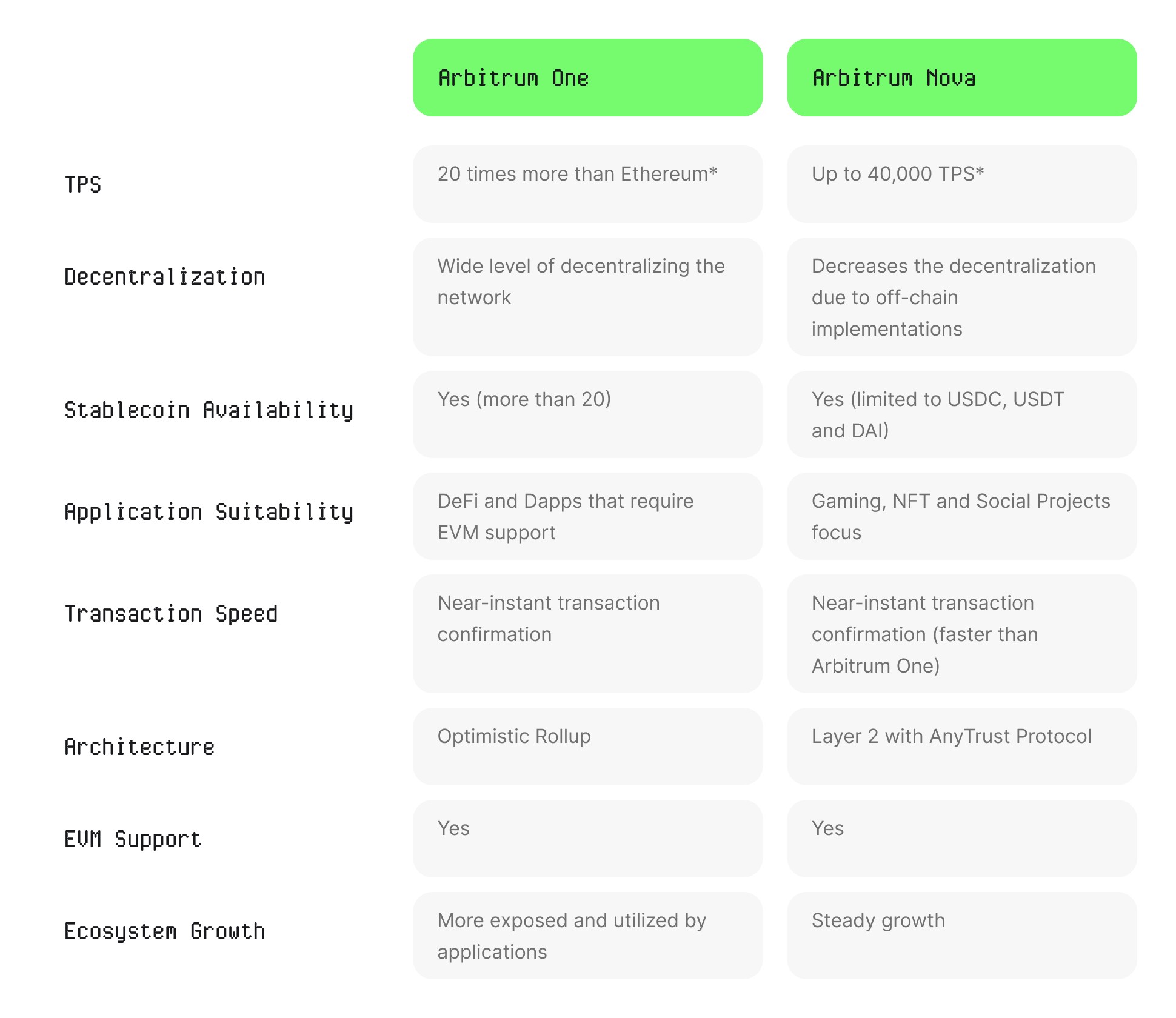
How to Choose Your Arbitrum Chain
The choice between Arbitrum One and Arbitrum Nova depends on whether you prioritize security or speed. Arbitrum One posts all transaction data to Ethereum, prioritizing decentralization and trustlessness. This makes it the standard for value storage and complex smart contracts. Arbitrum Nova stores data off-chain with a committee of approved validators, reducing fees significantly. This architecture suits high-frequency, low-value interactions.
Use Arbitrum One for DeFi protocols, NFTs, and applications requiring Ethereum-level security. If your users are moving significant value, the full data availability on Ethereum is essential. Use Arbitrum Nova for gaming, social apps, or microtransactions where speed matters more than absolute decentralization. The lower fees allow for interactions that would be too expensive on One.
| Feature | Arbitrum One | Arbitrum Nova |
|---|---|---|
| Data Availability | Ethereum Mainnet | Off-chain (Nitro) |
| Security Model | High (Ethereum-backed) | Medium (Committee) |
| Best For | DeFi, High-value apps | Gaming, Social, Micro-transactions |
| Gas Fees | Standard L2 costs | Significantly lower |
Choose the chain that matches your application's risk profile. For high-stakes financial transactions, stick with One. For high-volume, low-stakes interactions, Nova offers better economics.
Common Questions About Arbitrum Chains
Users frequently seek clarification on Arbitrum's technical structure and its relationship with the broader Ethereum ecosystem. Understanding these distinctions is necessary for choosing the right chain for specific applications, whether that is high-throughput gaming or capital-intensive DeFi.
These clarifications address the most common points of confusion regarding Arbitrum's architecture. For developers and users, the key takeaway is that Arbitrum One provides Ethereum compatibility with enhanced performance, while Nova offers a specialized environment for specific use cases.
No comments yet. Be the first to share your thoughts!