Arbitrum One vs. Nova at a glance
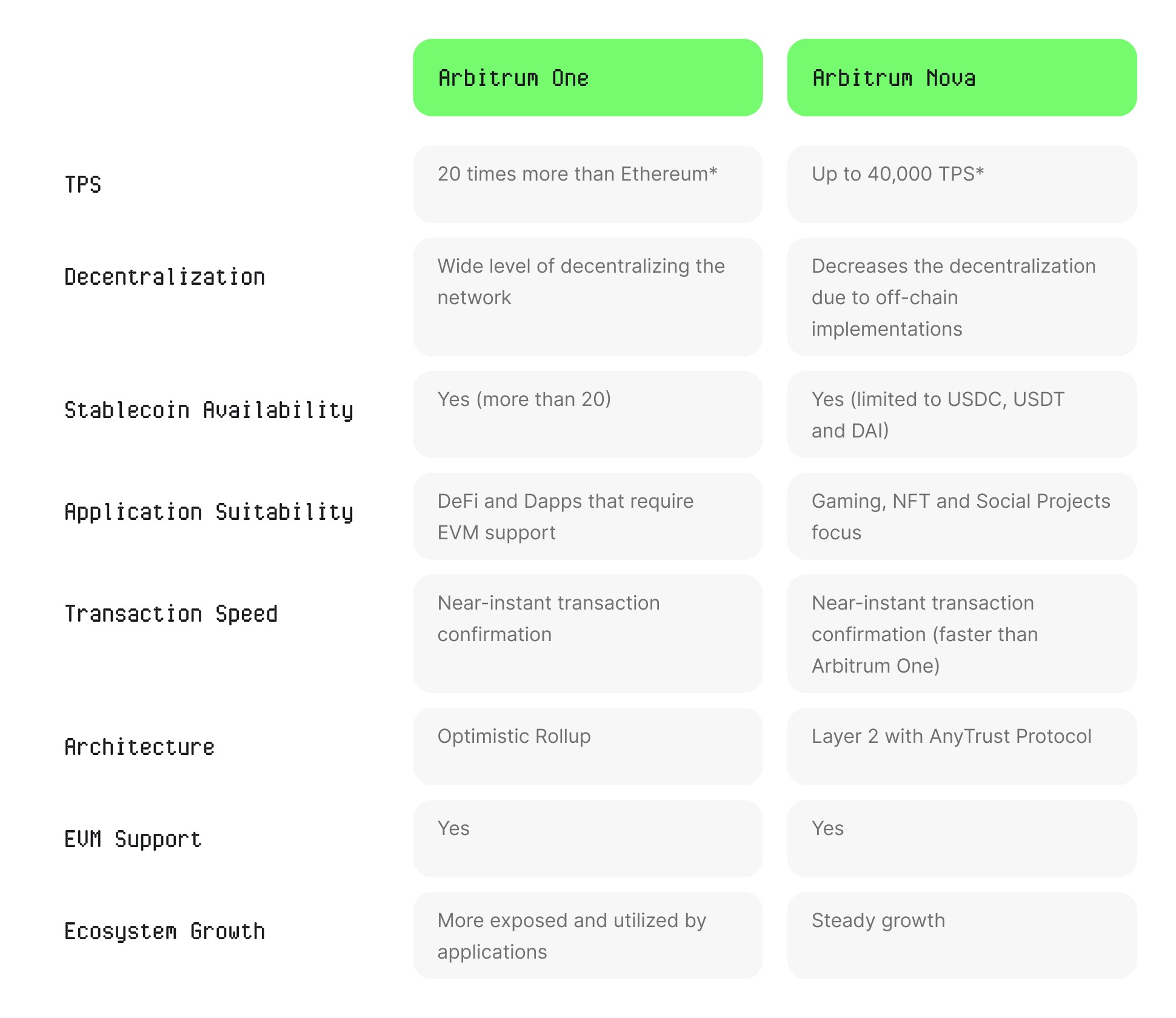
Arbitrum One and Arbitrum Nova serve distinct roles within the broader Arbitrum ecosystem. While both operate as Layer 2 scaling solutions on Ethereum, they are engineered for different types of workloads. Arbitrum One is a general-purpose optimistic rollup designed for high-security DeFi and complex smart contracts. Arbitrum Nova is a specialized chain optimized for high-throughput, low-cost applications like social networks, gaming, and micro-transactions.
The primary difference lies in their security models and finality. Arbitrum One inherits Ethereum's full security guarantees through its optimistic rollup mechanism, making it the default choice for large-value transactions and institutional DeFi. Nova prioritizes speed and cost efficiency, utilizing a different fraud proof system that allows for faster finality but with a slightly different trust assumption compared to the main chain.
| Feature | Arbitrum One | Arbitrum Nova |
|---|---|---|
| Security Model | Optimistic Rollup (Ethereum Security) | Optimistic Rollup (Fast Finality) |
| Primary Use Case | DeFi, High-value Transactions, General DApps | Gaming, Social Apps, Micro-payments |
| Transaction Cost | Moderate | Very Low |
| Finality Time | ~7 Days (Challenge Period) | ~10-20 Seconds |
| Throughput | High | Very High |
Choosing between them depends on your application's requirements. If you are building a decentralized exchange or handling significant liquidity, Arbitrum One provides the necessary security and decentralization. For applications requiring thousands of transactions per second with minimal fees, Nova offers a more efficient infrastructure.
| Feature | Arbitrum One | Arbitrum Nova |
|---|---|---|
| Security | High (Ethereum L1) | Medium (Fast Finality) |
| Cost | Moderate | Very Low |
| Best For | DeFi, Finance | Gaming, Social |
How Arbitrum One scales Ethereum
Arbitrum One functions as an Optimistic Rollup, a Layer 2 scaling solution designed to increase Ethereum's transaction throughput while inheriting the mainnet's security guarantees. Unlike networks that rely on zero-knowledge proofs, Arbitrum One operates on the premise that transactions are valid by default, only requiring verification if a malicious actor challenges them. This approach allows for near-instant finality for most interactions while keeping data availability anchored to Ethereum.
The technical foundation relies on off-chain computation with on-chain verification. When users interact with dApps on Arbitrum One, state transitions occur off-chain. If no one disputes the outcome within a challenge window, the results are committed to Ethereum. This mechanism preserves the EVM (Ethereum Virtual Machine) environment, meaning developers can deploy existing Ethereum smart contracts with minimal modification. The result is a network that feels identical to Ethereum but offers significantly lower gas fees and higher speed.
For institutional participants and high-value DeFi protocols, this architecture provides the necessary balance of security and efficiency. Arbitrum One has become the preferred environment for large-scale liquidity pools and complex financial instruments because it maintains the same trust assumptions as Ethereum. By securing assets through the mainnet's consensus, Arbitrum One offers a robust infrastructure for financial activity that prioritizes capital preservation over speculative speed.
Nova for gaming and social apps
Arbitrum Nova operates as a specialized Layer-2 chain designed specifically for latency-sensitive applications. While Arbitrum One prioritizes maximum security and Ethereum mainnet finality, Nova optimizes for speed and low costs, making it the preferred infrastructure for high-frequency interactions like gaming and social media platforms. This specialization comes with a distinct architectural trade-off regarding how quickly transactions are finalized on the Ethereum mainnet.
The chain utilizes Optimistic Rollup technology, similar to Arbitrum One, but employs a different sequencer and data availability strategy to achieve faster throughput. For developers building real-time applications, this means near-instant user feedback. A player can make a move in a game or send a message in a social app and see the result immediately, rather than waiting for the longer confirmation windows typical of standard Ethereum scaling solutions. This responsiveness is critical for maintaining user engagement in interactive environments where delay breaks the experience.
However, this speed requires a compromise on finality. Nova transactions are not finalized on Ethereum as quickly as those on Arbitrum One. For high-stakes financial transactions, such as large DeFi swaps or bridge withdrawals, this delay can be a risk. Users must trust the sequencer to process transactions correctly during the wait period. Consequently, Nova is best suited for applications where speed matters more than immediate cryptographic certainty, such as in-game assets or social feeds, where the cost of a failed transaction is low and reversible.
Security and finality differences
Use this section to make the Arbitrum One vs. Nova decision easier to compare in real life, not just on paper. Start with the reader's actual constraint, then separate must-have requirements from details that are merely nice to have. A practical choice should survive normal use, maintenance, timing, and budget. If a recommendation only works in an ideal situation, call that out plainly and give the reader a fallback path.
The simplest way to use this section is to write down the must-have criteria first, then compare each option against those criteria before weighing nice-to-have features.
Choosing the right chain for your strategy
Arbitrum One and Arbitrum Nova serve distinct purposes within the ecosystem, requiring you to align your choice with your specific operational needs. Arbitrum One is the primary optimistic rollup, designed to replicate the Ethereum Virtual Machine (EVM) environment with high security and deep liquidity. It is the standard for high-value DeFi interactions, ensuring that transactions benefit from Ethereum’s robust settlement layer.
Nova, by contrast, is a data availability-focused chain optimized for speed and cost efficiency. It achieves lower fees by using different data availability mechanisms, making it ideal for applications that prioritize high throughput over maximum security guarantees. This includes gaming, social applications, and micro-transactions where transaction costs would otherwise be prohibitive on a standard rollup.
| Feature | Arbitrum One | Arbitrum Nova |
|---|---|---|
| Primary Use Case | DeFi and high-value transactions | Gaming and high-throughput apps |
| Security Model | Optimistic Rollup (Ethereum settlement) | Data Availability sampling |
| Transaction Cost | Standard L2 fees | Significantly lower fees |
| Liquidity Depth | Deep, native Ethereum liquidity | Ecosystem-specific liquidity |
For most DeFi strategies, Arbitrum One remains the default choice due to its security posture and liquidity depth. Only consider Nova if your application’s success depends on extreme cost efficiency and high transaction velocity, and you are willing to accept a different security model.
Arbitrum One: What is it and is it good?
Arbitrum One is a Layer-2 scaling solution built on top of Ethereum. It functions as a secondary blockchain that processes transactions off the main Ethereum network, then settles the results back on the mainnet. This architecture allows it to maintain Ethereum’s high security standards while significantly increasing transaction speed and lowering costs. For users and developers, it behaves like Ethereum but with much lower fees, making it a practical home for decentralized finance (DeFi) applications.
The network uses optimistic rollup technology, meaning it assumes transactions are valid unless challenged. This approach allows for high throughput without compromising the security guarantees of the Ethereum base layer. As a result, Arbitrum One has become one of the leading environments for DeFi liquidity, offering a robust ecosystem for EVM-compatible decentralized applications (DApps). It is widely regarded as a reliable and secure option for users seeking efficiency without sacrificing the decentralized trust model of Ethereum.
No comments yet. Be the first to share your thoughts!