Arbitrum One vs Nova at a glance
Arbitrum One and Arbitrum Nova serve different roles within the same ecosystem. Arbitrum One is the primary Layer-2 scaling solution for Ethereum, designed as a security-focused environment for high-value applications. It is the main hub for DeFi liquidity and complex smart contracts, offering a balance of security and throughput that mirrors Ethereum’s mainnet Arbitrum.
Nova is a specialized alternative rollup optimized for latency and cost. It sacrifices some of the strict security guarantees of One to deliver faster finality and lower fees. This makes Nova ideal for applications where speed matters more than capital preservation, such as social gaming or high-frequency interactions.
Choosing between them depends on your application's risk profile. Use the comparison below to see how they differ in security model, target audience, and typical use cases.
| Feature | Arbitrum One | Nova |
|---|---|---|
| Primary Goal | Security & Scale | Low Latency & Cost |
| Security Model | Optimistic Rollup (Ethereum) | Optimistic Rollup (Modified) |
| Finality Speed | ~7 days (challenge period) | ~10 seconds |
| Best For | DeFi, High-Value DApps | Gaming, Social, NFTs |
| Transaction Cost | Low | Very Low |
| EVM Compatibility | Full EVM | Full EVM |
Security and Ethereum alignment
Arbitrum One and Arbitrum Nova share the same underlying technology but diverge on how they handle data security. Arbitrum One is an optimistic rollup that posts transaction data to Ethereum mainnet. This means every transaction is anchored to Ethereum, inheriting its security guarantees. If a dispute arises, the system can prove the validity of any transaction using the data stored on Ethereum.
Arbitrum Nova, however, prioritizes speed and low cost over maximum data availability. It uses a different fraud-proof mechanism that does not post all data to Ethereum mainnet. Instead, it relies on a data availability committee. This committee signs off on the data, allowing Nova to process transactions much faster, but it introduces a different security assumption. Users must trust the committee to release the data if a fraud proof is needed.
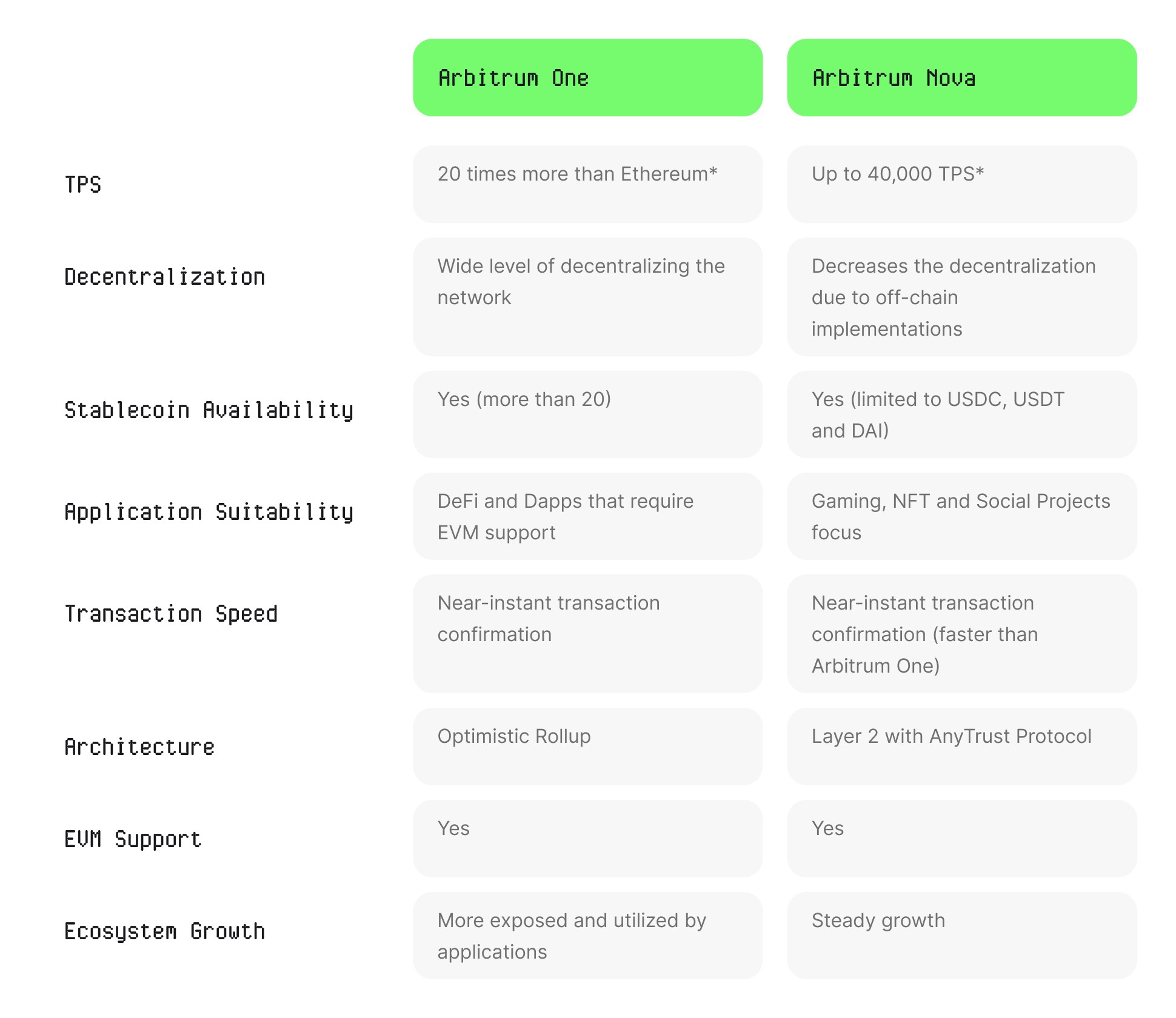
The trade-off is clear. Arbitrum One offers the highest level of security by fully aligning with Ethereum’s decentralization model. Nova offers lower latency and cheaper fees by relaxing the data availability requirement. For applications that require maximum security, such as DeFi protocols holding significant value, Arbitrum One is the standard choice. For high-frequency applications like gaming or social media, where speed matters more than absolute decentralization, Nova is often preferred.
DeFi liquidity and ecosystem depth
Arbitrum One is the primary destination for decentralized finance on the Arbitrum network, acting as the main rollup where the majority of value and activity concentrates. It serves as the finance-native core of the ecosystem, hosting the deepest liquidity pools and the widest variety of established protocols. For users seeking complex financial instruments, high-volume trading, or yield strategies, Arbitrum One is the default environment.
The network effect keeps liquidity concentrated here. Major decentralized exchanges (DEXs) like Uniswap, SushiSwap, and Curve operate their largest pools on Arbitrum One. Lending protocols such as Aave and GMX rely on this critical mass of assets to function efficiently. This density creates a virtuous cycle: more liquidity attracts more protocols, which in turn attracts more users and capital. While Arbitrum Nova offers lower fees, it lacks the depth required for large-scale DeFi interactions without suffering from slippage or fragmented liquidity.
Arbitrum’s design as an optimistic rollup ensures that this liquidity remains secure and compatible with Ethereum. By inheriting Ethereum’s security model while offering lower costs, Arbitrum One provides the best of both worlds for DeFi participants. The ecosystem continues to grow, with new protocols launching exclusively on Arbitrum One to capture the existing user base. This focus on DeFi makes it the most robust option for serious financial applications.
Nova for Gaming and Real-Time Apps
Arbitrum Nova is built for speed. It uses a two-chain architecture to handle high-frequency interactions without clogging the main network. This design makes it the better choice for gaming and real-time applications where sub-second finality matters more than standalone security.
Sub-Second Finality
Nova achieves faster transaction times by using a two-chain system. The first chain, Nitro, processes transactions quickly. The second chain, Offchain, handles the heavy lifting of dispute resolution. This separation allows users to see results almost instantly, a critical feature for gaming where lag ruins the experience.
Lower Costs for Micro-Transactions
Gaming often requires many small transactions, such as buying in-game items or updating player stats. Nova keeps fees low by batching these interactions. This makes micro-transactions viable, allowing developers to create more engaging gameplay loops without charging players significant fees.
Better User Experience
For players, speed and low cost mean a smoother experience. Nova’s architecture ensures that actions feel responsive, keeping players engaged. This focus on user experience makes Nova a strong contender for games that prioritize real-time interaction over complex financial settlements.
Arbitrum One vs Nova: Cost and Speed
Choosing between Arbitrum One and Arbitrum Nova comes down to a trade-off between security guarantees and transaction throughput. Arbitrum One prioritizes Ethereum security, resulting in higher fees and slower finality compared to Nova. Nova, designed for high-frequency applications, offers significantly cheaper and faster transactions but with different security assumptions.
Gas Fees and Throughput
Arbitrum One operates as a general-purpose Layer 2, meaning its gas fees are higher but still substantially lower than Ethereum mainnet. Transactions typically cost a few cents to a few dollars, depending on network congestion. Nova reduces these costs further by optimizing for data availability, making micro-transactions economically viable.
In terms of speed, Arbitrum One processes transactions in seconds, with a theoretical maximum throughput of around 6,000 TPS. Nova achieves higher effective throughput for its specific use cases by batching data more efficiently. This makes Nova ideal for social apps, gaming, and high-frequency trading, where latency and cost are critical.
Choosing the right Arbitrum chain
Arbitrum operates as a dual-rollup ecosystem, but the two networks serve fundamentally different purposes. Arbitrum One is the primary network, designed for maximum security and compatibility with Ethereum’s mainnet. It is the standard choice for decentralized finance (DeFi) protocols, high-value transactions, and applications that require the strongest possible security guarantees. Because it inherits Ethereum’s final settlement layer, it is the backbone of the ecosystem’s liquidity and trust.
Arbitrum Nova, by contrast, is optimized for throughput rather than maximum security. It uses a more aggressive data availability model to achieve significantly lower gas fees and higher transaction speeds. This makes it ideal for applications that require high-frequency interactions, such as on-chain gaming, social apps, and micro-transactions. While still secure, Nova prioritizes user experience and cost-efficiency over the rigorous finality of Arbitrum One.
To decide which chain fits your use case, consider the value and frequency of your transactions. If you are building a DeFi protocol handling significant capital, Arbitrum One is the necessary foundation. If you are launching a game or social platform where users send dozens of small transactions per session, Nova’s low fees and speed will provide a far better experience. The Arbitrum team officially positions One as the finance-native hub and Nova as the home for high-throughput applications Arbitrum.io. Aligning your project with the correct rollup ensures you are not paying for security you don’t need, nor sacrificing security you do.
No comments yet. Be the first to share your thoughts!