What makes Stylus different
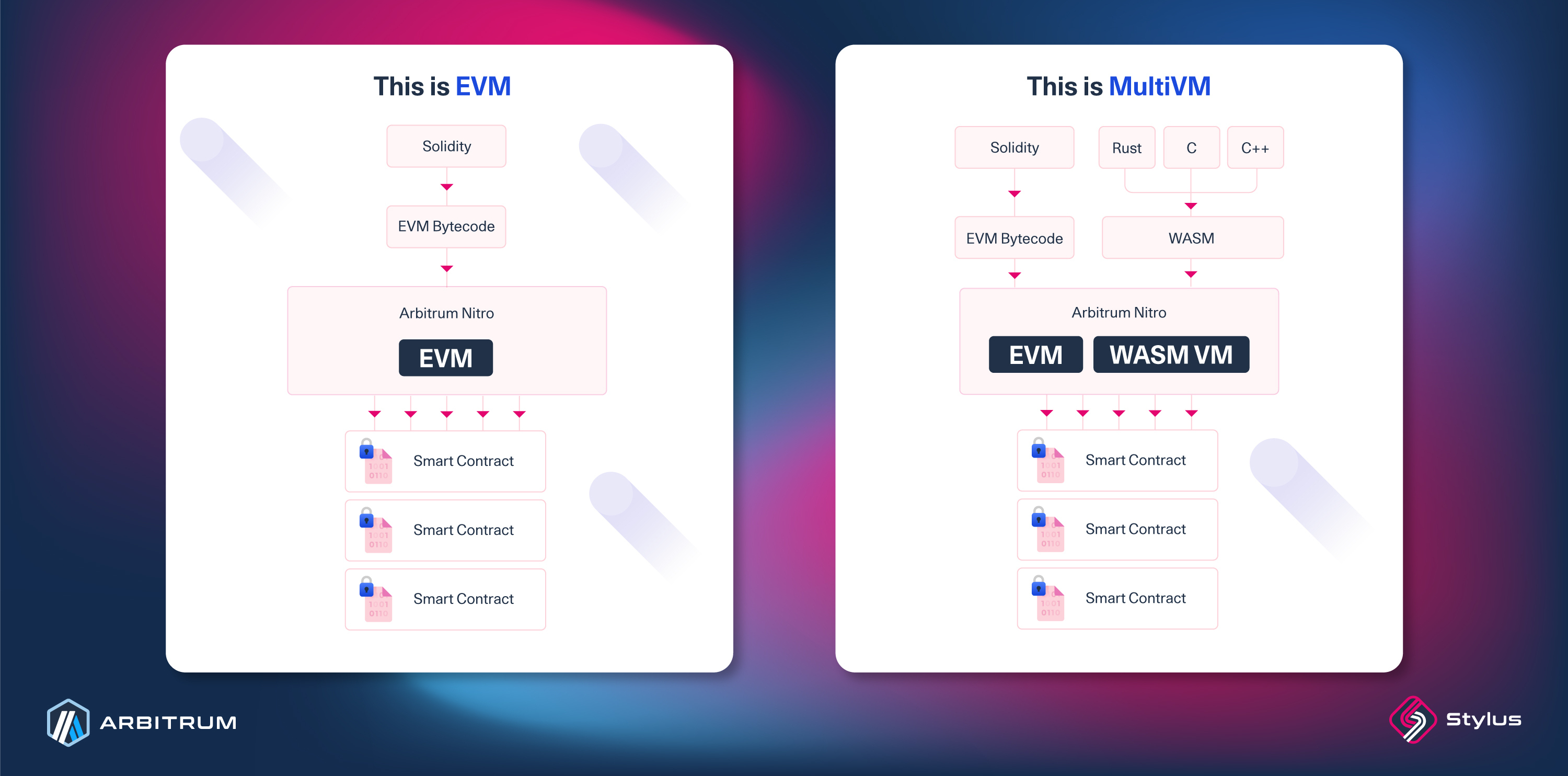
Arbitrum Stylus expands the network beyond Solidity and Vyper by supporting any language that compiles to WebAssembly (WASM). This architectural shift allows smart contracts in Rust, C, and C++ to run on a separate WASM execution engine within the Nitro stack, distinct from the standard EVM. While standard EVM contracts rely on Ethereum Virtual Machine bytecode, Stylus contracts leverage native-like execution capabilities.
The primary advantage is performance. WASM modules can execute complex logic much faster than EVM bytecode because they avoid the overhead of the Ethereum instruction set. For developers familiar with systems programming, this means accessing low-level memory management and optimized algorithms without sacrificing the security guarantees of the underlying Layer 2 network.
This duality creates a hybrid environment. Your application can use Solidity for standard token interactions and Rust for high-frequency trading logic or heavy cryptographic computations, all within the same deployment. This flexibility allows teams to choose the right tool for each part of their protocol rather than being locked into a single virtual machine.
Performance and cost choices that change the plan
Developers choose Arbitrum Stylus when they need to run complex logic without hitting the gas limits that constrain standard Solidity contracts. By compiling Rust and C++ code into WASM, Stylus bypasses the EVM's instruction-heavy execution model. This architectural shift delivers two distinct advantages: significantly lower gas costs for compute-heavy operations and higher throughput for applications that require rapid state updates.
Standard EVM execution remains the baseline for most DeFi protocols due to its maturity and widespread tooling support. However, it treats every operation as a uniform gas expense, which penalizes algorithms that require many small steps. Stylus, by contrast, enables optimized native code execution. A calculation that might cost hundreds of gas units in Solidity can often be executed for a fraction of that cost in Rust, provided the logic doesn't rely heavily on heavy EVM precompiles.
The tradeoff lies in tooling maturity. While Solidity has decades of accumulated libraries and auditing experience, the Rust and C++ ecosystems for blockchain are newer. Developers must weigh the immediate cost savings and performance gains of Stylus against the potential overhead of working with less mature smart contract frameworks. For high-frequency trading bots or data-intensive indexing tasks, the performance delta usually justifies the migration effort.
| Metric | Stylus (Rust/C++) | Standard EVM (Solidity) |
|---|---|---|
| Execution Model | WASM (native-like) | EVM bytecode |
| Gas Cost for Compute | Lower (optimized native ops) | Higher (uniform gas schedule) |
| Language Support | Rust, C, C++ | Solidity, Vyper |
| Tooling Maturity | Growing ecosystem | Highly mature |
| Best Use Case | Compute-heavy logic, high throughput | General DeFi, established protocols |
Developer experience and tooling
Moving from Solidity to Rust or C++ on Arbitrum Stylus requires shifting from a managed, memory-safe environment to one where you manage memory and compilation manually. The primary SDK is the official Rust SDK (stylus-sdk-rs), which allows developers to write Solidity ABI-equivalent smart contracts in Rust. These contracts are compiled to WebAssembly (WASM) and executed on Arbitrum, offering a significant performance boost over standard EVM bytecode but demanding a steeper learning curve for those accustomed to the EVM's simplicity.
The tooling ecosystem is maturing, with OpenZeppelin introducing Motsu, a testing framework designed specifically for Stylus. Motsu helps bridge the gap by allowing developers to write tests in Solidity while interacting with WASM-based contracts, mitigating some of the friction of testing non-EVM code. However, the broader developer experience still lags behind the mature tooling available for Solidity. Debugging WASM errors is generally more complex than tracing EVM opcodes, and the lack of standardized IDE support means developers often rely on command-line tools and manual verification.
For developers considering this transition, the trade-off is clear: you gain performance and language flexibility at the cost of tooling maturity. If your team is already proficient in Rust, the Stylus SDK provides a straightforward path to high-performance contracts. For those new to systems programming, the initial setup and compilation steps require more discipline than the standard hardhat or foundry workflows used for Solidity.
Best use cases for each approach
Choosing between Arbitrum Stylus and the Standard EVM depends on your application’s specific performance requirements and language preferences. While both run on the same underlying layer-2 infrastructure, they serve different developer workflows and operational needs. The Standard EVM remains the default for most applications due to its maturity and tooling, while Stylus offers a compelling alternative for compute-heavy workloads.
Standard EVM: Stability and Ecosystem Fit
The Standard EVM is the best choice for applications that prioritize compatibility and established security patterns. It supports Solidity and Vyper, the two dominant languages in the Ethereum ecosystem. If your project involves standard ERC-20 or ERC-721 tokens, or relies on existing DeFi protocols like Uniswap or Aave, the Standard EVM is the logical path.
Its primary advantage is the depth of available tooling. Developers can leverage familiar IDEs, extensive libraries, and a vast pool of audited contracts. This reduces development time and risk, making it ideal for straightforward financial applications, NFT marketplaces, and governance systems where complex computational logic is not the primary driver.
Stylus: High-Performance and Non-Crypto Logic
Stylus shines when your application requires high throughput, low latency, or complex computational logic that exceeds EVM efficiency. By allowing smart contracts to be written in Rust, C, or C++, Stylus enables developers to use highly optimized native code. This is particularly beneficial for gaming applications, real-time data feeds, or complex mathematical models that would be prohibitively expensive on the standard EVM.
For example, a decentralized exchange requiring advanced order-matching engines or a gaming platform with frequent state updates can significantly reduce gas costs and improve user experience with Stylus. The ability to use familiar systems programming languages also allows developers to leverage existing libraries and best practices from the broader software engineering world, not just the blockchain space.
No comments yet. Be the first to share your thoughts!