
What is Arbitrum Orbit?
Arbitrum Orbit is a framework that allows developers to launch their own Layer 2 or Layer 3 blockchains using the Nitro codebase. Unlike Arbitrum One, which is a shared public network where many projects compete for block space and security resources, Orbit provides the tools to build a custom chain tailored to specific needs.
Think of Arbitrum One as a busy public highway where everyone shares the same lanes, while Arbitrum Orbit is the blueprint for building your own private road. This distinction is critical for projects that require isolated environments, specific economic models, or dedicated throughput that a shared chain cannot guarantee.
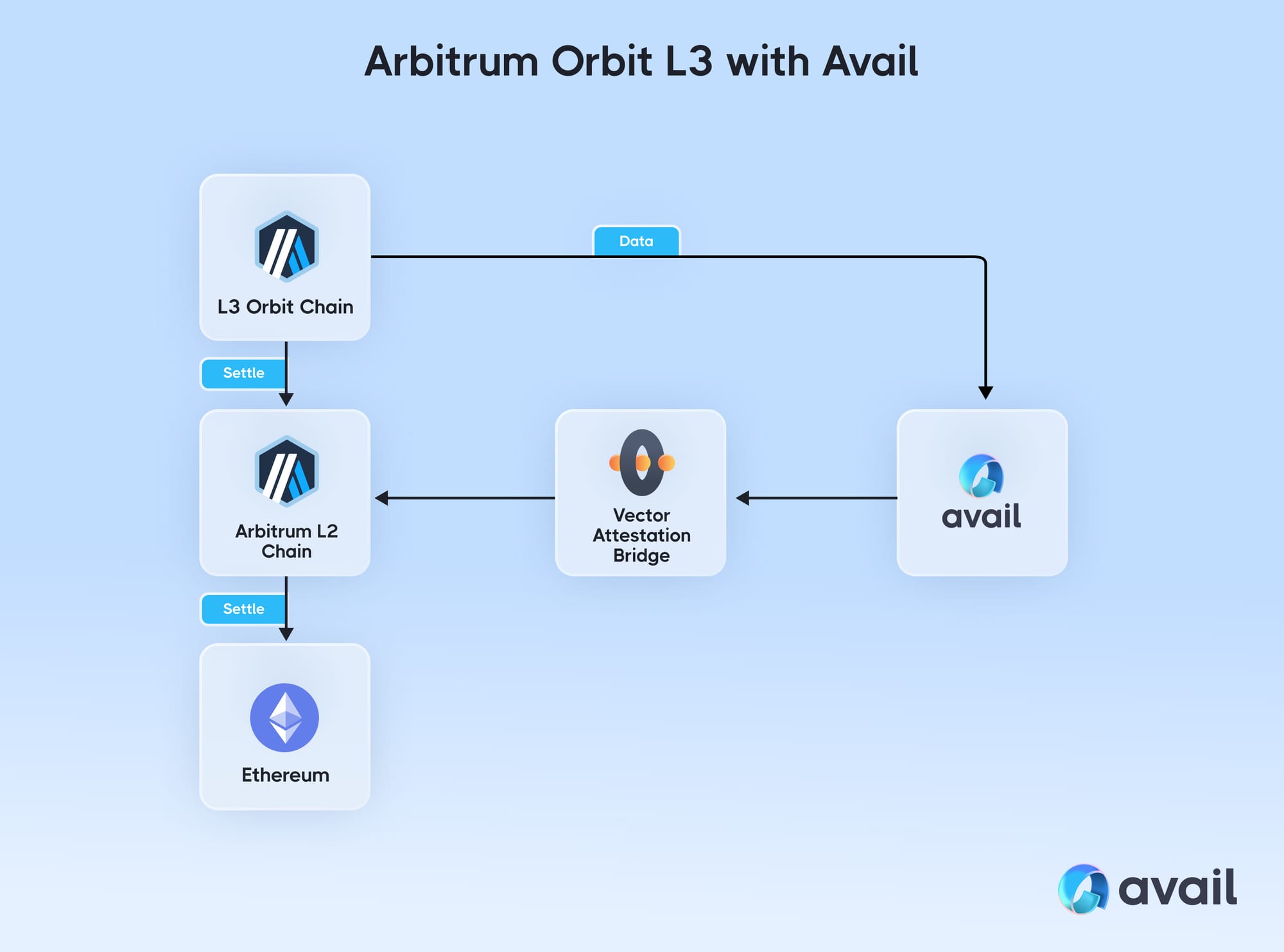
These custom chains are Optimistic rollups, meaning they post transaction data to Ethereum for security but process transactions off-chain. This approach offers the flexibility to adjust parameters like gas tokens, sequencer locations, and data availability strategies, giving projects full control over their infrastructure without sacrificing the security guarantees of the Ethereum mainnet.
For many teams, this means they aren't starting from scratch. They are leveraging a proven, battle-tested codebase to create a chain that fits their exact use case, whether that is a high-throughput gaming network, a private enterprise solution, or a specialized DeFi ecosystem.
Arbitrum One vs. Orbit Chains
Arbitrum One and Orbit chains share the same underlying technology but serve different purposes. Arbitrum One is a public Layer 2 network that processes transactions for a broad community of users and developers. Orbit chains are customizable rollups built on the Nitro stack, allowing teams to launch their own dedicated blockchains.
Both architectures rely on the same security model. Orbit chains inherit security from the base layer, meaning you do not need to manage your own validator set. This shared security model reduces operational complexity while maintaining the integrity of the Arbitrum ecosystem.
The primary difference lies in customization and control. Arbitrum One offers a standardized experience for all users. Orbit chains provide granular control over gas tokens, sequencing, and data availability. This flexibility allows projects to tailor their chain to specific business needs, such as enterprise privacy or specialized tokenomics.
Choosing between the two depends on your project's goals. If you need a public network with immediate liquidity, Arbitrum One is the standard choice. If you require specific operational controls or dedicated performance, an Orbit chain provides the necessary infrastructure.
When to choose Arbitrum Orbit for your project
Arbitrum One serves as the general-purpose hub for the ecosystem, offering shared security and deep liquidity. However, it is not the right fit for every project. When your application requires granular control over its economic or technical environment, Arbitrum Orbit becomes the necessary choice. Orbit allows you to launch a custom chain that inherits Arbitrum’s security model while granting you administrative power over tokenomics, gas mechanics, and precompiles.
The decision to use Orbit typically hinges on the need for custom tokenomics. On Arbitrum One, the gas token is fixed as ETH. If your project requires a different native asset to pay for gas—such as a stablecoin or a project-specific governance token—you cannot achieve this on the main chain. Orbit enables you to configure the gas token, allowing you to align transaction costs directly with your ecosystem’s economic incentives. This flexibility is essential for platforms that want to subsidize user activity or create closed-loop economies.
Beyond economics, Orbit provides technical control through custom precompiles and sequencer selection. Projects with specialized computational needs, such as zero-knowledge proof verification or specific cryptographic requirements, can integrate custom precompiles directly into their Orbit chain. This avoids the overhead of complex smart contract workarounds. Additionally, Orbit allows you to select your own sequencer, giving you direct control over transaction ordering and throughput. This is critical for applications where latency or censorship resistance is a primary concern.
This level of control comes with operational overhead. You are responsible for the maintenance and security of your custom chain’s infrastructure. Therefore, Orbit is best suited for projects that have the technical resources to manage a standalone node or rollup and require the specific freedoms that Arbitrum One simply cannot provide.
Why Arbitrum One remains the default
Arbitrum One continues to serve as the primary settlement layer for the ecosystem, functioning as the shared security backbone for most decentralized applications. Unlike Orbit chains, which operate as independent environments, Arbitrum One aggregates liquidity and user activity into a single, high-throughput network. This concentration makes it the natural choice for projects that prioritize immediate access to deep liquidity pools and established user bases.
The network’s dominance is driven by its ability to handle complex DeFi interactions with lower operational friction. Developers deploying to Arbitrum One benefit from a mature ecosystem where contracts, oracles, and bridge infrastructure are already integrated. This reduces the burden of building custom tooling or managing cross-chain liquidity routing, allowing teams to focus on product development rather than infrastructure maintenance.
Shared security is another critical advantage. By anchoring directly to Ethereum, Arbitrum One inherits the security guarantees of the base layer without requiring each application to establish its own validator set. This model minimizes the risk profile for general-purpose dApps, offering a balance of scalability and safety that is difficult to replicate on standalone Orbit chains without significant additional overhead.
No comments yet. Be the first to share your thoughts!