Arbitrum One vs Nova at a glance
The choice between Arbitrum One and Arbitrum Nova hinges on the nature of the transaction and the required security model. Arbitrum One is the flagship optimistic rollup, built to replicate Ethereum’s security guarantees while significantly reducing costs. It is the default environment for DeFi protocols, where capital preservation and trustless settlement are paramount. As the mainnet, it supports the full Ethereum Virtual Machine (EVM), ensuring broad compatibility with existing decentralized applications and wallets.
In contrast, Arbitrum Nova is optimized for throughput rather than maximum decentralization. It utilizes the AnyTrust protocol, which relies on a set of data availability committees to publish transaction data off-chain. This architectural difference allows Nova to achieve much lower fees and higher transaction speeds, making it ideal for gaming, social apps, and other use cases where users expect instant, cheap interactions. While still secure, Nova’s security model is "mostly trustless," meaning it depends on the honesty of the data availability committee, a trade-off necessary for its performance gains.
For developers and users, this distinction creates two distinct lanes. If you are moving significant value or interacting with complex financial instruments, Arbitrum One provides the robust security framework of Ethereum. If you are playing a blockchain game, minting low-cost NFTs, or engaging in high-frequency social interactions, Nova offers the efficiency needed to maintain a smooth user experience without prohibitive gas fees.
Technical Differences and Security Models
Arbitrum One and Arbitrum Nova share the same EVM-compatible codebase but diverge fundamentally in how they handle data availability and fraud proofs. This architectural split dictates their security guarantees, making one suitable for high-value DeFi and the other for high-frequency gaming.
Arbitrum One operates as a pure Optimistic Rollup. It assumes transactions are valid by default and posts full calldata to Ethereum L1. This model offers the highest security level, as it inherits Ethereum's full decentralization and censorship resistance. However, this reliance on L1 data availability results in higher costs and slower finality compared to newer rollup variants.
Arbitrum Nova uses the AnyTrust protocol. Instead of posting full data on L1, it relies on a decentralized Data Availability Committee (DAC) to sign off on data availability. This significantly reduces costs and increases throughput. The tradeoff is a shift in trust assumptions: users must trust the DAC not to withhold data, though fraud proofs remain available if the committee acts maliciously.
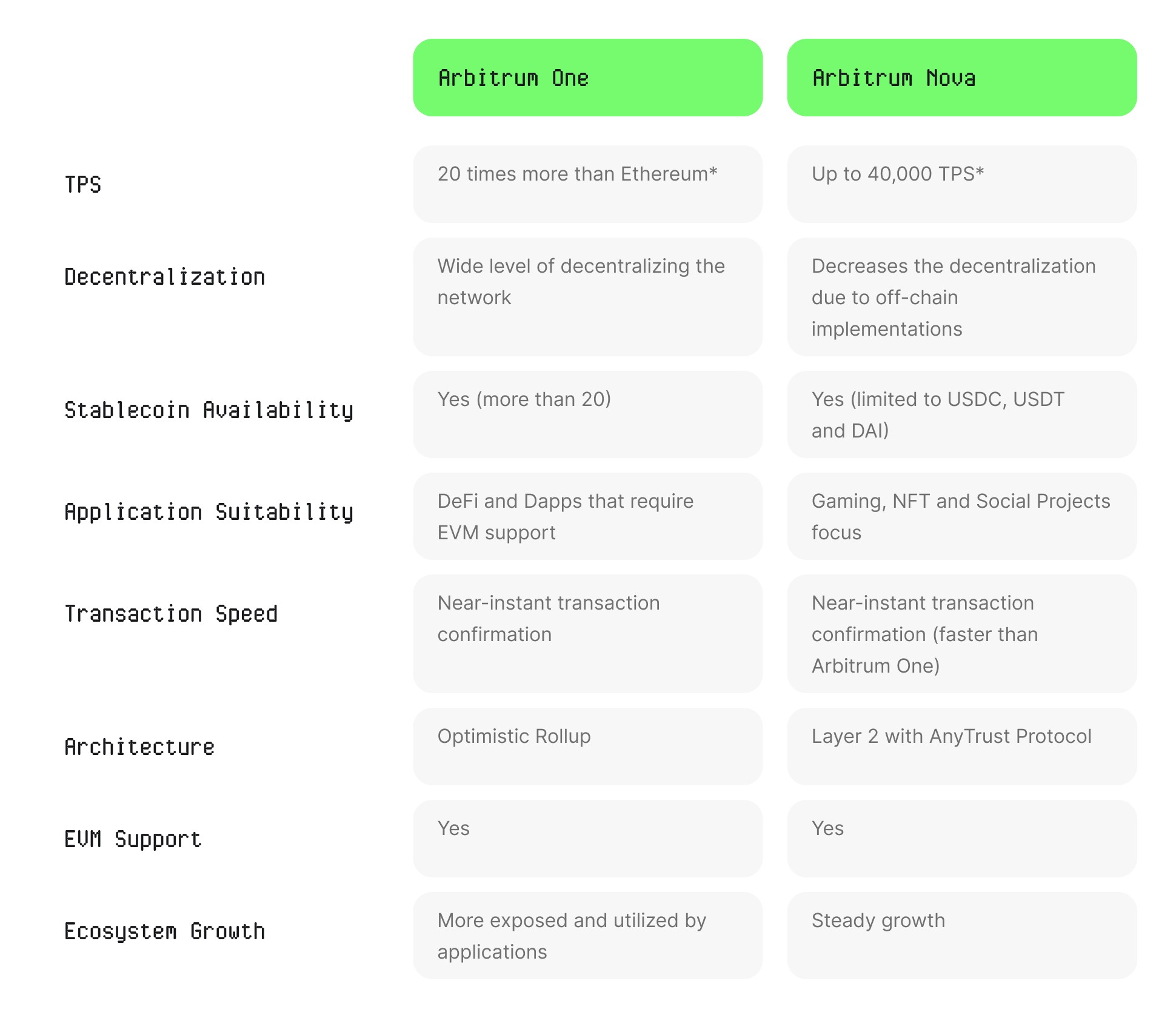
The following table contrasts the core technical distinctions that influence risk profiles for different use cases.
For DeFi applications managing significant liquidity, Arbitrum One's trustless model is the industry standard. The ability to dispute any state transition via a fraud proof ensures that the chain remains secure even if off-chain actors collude. In contrast, Nova's faster finality and lower fees make it ideal for gaming and social applications where speed matters more than absolute decentralization. As noted in official documentation, Nova is designed as a high-performance alternative for applications that do not require the highest level of censorship resistance.
DeFi liquidity and ecosystem depth
Arbitrum One has established itself as the primary destination for decentralized finance on Ethereum. It supports the highest total value locked (TVL) among Layer 2 solutions, driven by deep liquidity pools and a robust suite of established protocols. For serious DeFi activities, this ecosystem depth translates to better capital efficiency, lower slippage, and greater security through network effects.
The chain hosts the majority of Ethereum's leading DeFi applications, including Aave, Uniswap, and Curve. These protocols leverage Arbitrum One's EVM equivalence to offer seamless user experiences while benefiting from significantly lower transaction costs compared to the mainnet. This concentration of liquidity makes it the preferred choice for complex financial operations that require multiple on-chain interactions.
Institutional adoption further reinforces Arbitrum One's position. Major financial entities and DAOs have deployed significant capital on the chain, attracted by its proven track record of uptime and security. The Arbitrum Portal serves as a central hub for these activities, allowing users to access yields across lending and staking protocols with a unified interface. This institutional backing provides a layer of stability and trust that is critical for high-stakes financial decisions.
| Feature | Arbitrum One | Arbitrum Nova |
|---|---|---|
| Primary Use Case | DeFi & General DApps | Gaming & Social Apps |
| Consensus Model | Optimistic Rollup | AnyTrust |
| TVL & Liquidity | Highest | Moderate |
While Arbitrum Nova offers faster finality for specific use cases like gaming, it lacks the extensive liquidity and institutional infrastructure of Arbitrum One. For DeFi participants, the choice is clear: Arbitrum One provides the depth and security necessary for serious financial engagement.
Gaming and social app performance
Arbitrum Nova is engineered specifically for applications where high throughput and minimal latency take precedence over the maximum decentralization guarantees of Arbitrum One. By utilizing the AnyTrust protocol, Nova reduces the data availability burden compared to the standard optimistic rollup model, allowing for significantly faster block times and lower transaction costs. This architectural choice makes it a strong candidate for gaming and social platforms that require frequent, micro-transactions.
For developers, this translates to a smoother user experience. In gaming, where players expect instant feedback for every action, the reduced latency on Nova prevents the friction that can occur during peak congestion on Arbitrum One. Similarly, social applications benefit from the ability to process high volumes of small interactions without the fee structures that typically deter casual users on more security-focused chains.
| Feature | Arbitrum One | Nova |
|---|---|---|
| Protocol | Optimistic Rollup | AnyTrust |
| Data Availability | On-chain (Ethereum) | Off-chain (DA Committees) |
| Latency | Standard L2 speed | Lower latency |
| Cost per Tx | Low | Very Low |
The trade-off lies in the security model. Arbitrum One relies on Ethereum for data availability, ensuring a higher degree of trustlessness. Nova, by contrast, uses Data Availability Committees (DACs) to store data off-chain. While this enables superior performance for gaming and social use cases, it introduces a different trust assumption. For high-stakes DeFi, Arbitrum One remains the preferred choice; for interactive consumer apps, Nova’s performance advantages often outweigh the slight reduction in decentralization guarantees.
Which chain suits your 2026 strategy
Choosing between Arbitrum One and Arbitrum Nova requires aligning your application’s security needs with its performance demands. The decision hinges on whether your users prioritize the highest level of cryptographic finality or require the lowest possible latency for frequent interactions.
Arbitrum One is the primary optimistic rollup, inheriting Ethereum’s security model. It is the standard choice for high-value DeFi protocols where capital preservation and trustless execution are non-negotiable. The bridge to Arbitrum One officially supports standard ERC-20 transfers and ETH, ensuring a secure path for significant liquidity migration.
Arbitrum Nova utilizes the AnyTrust protocol, trading some decentralization guarantees for significantly higher throughput and lower costs. This makes it ideal for gaming, social applications, and high-frequency trading where speed is critical. While it remains secure, it relies on a different data availability committee structure than One.
For 2026 strategies, use Arbitrum One for core treasury management and high-stakes DeFi interactions. Reserve Arbitrum Nova for user-facing layers, such as gaming interfaces or social feeds, where transaction volume outweighs the need for maximum settlement finality.
Common questions about Arbitrum chains
Addressing specific user queries clarifies the technical distinctions between Arbitrum One and Nova, helping you choose the right Layer 2 for your DeFi or gaming needs.
Is there a difference between Arbitrum and Arbitrum One?
"Arbitrum" is the broader ecosystem name, while Arbitrum One is the primary Layer 2 rollup. Arbitrum Nova is a separate chain within the same ecosystem, optimized for gaming and social applications. While Arbitrum One uses a purely trustless optimistic rollup protocol, Nova employs the AnyTrust protocol, which relies on a data availability committee for faster, cheaper transactions. Source: Arbitrum Documentation
Is Arbitrum One good?
Arbitrum One is widely considered one of Ethereum's strongest scaling solutions for DeFi liquidity and EVM-compatible DApps. It offers robust security properties similar to Ethereum while providing significantly lower fees and higher throughput. It serves as the main rollup for the Arbitrum ecosystem, supported by the ARB governance token. Source: Coin Bureau
Does Arbitrum One have a bridge?
Yes, the official Arbitrum Bridge is the primary method for moving assets between Ethereum and Arbitrum One. It allows users to deposit and withdraw ETH and ERC-20 tokens securely. The bridge is integrated directly into the Arbitrum interface, ensuring a streamlined experience for transferring funds across the Layer 2 network.
No comments yet. Be the first to share your thoughts!