Arbitrum One vs Nova at a glance
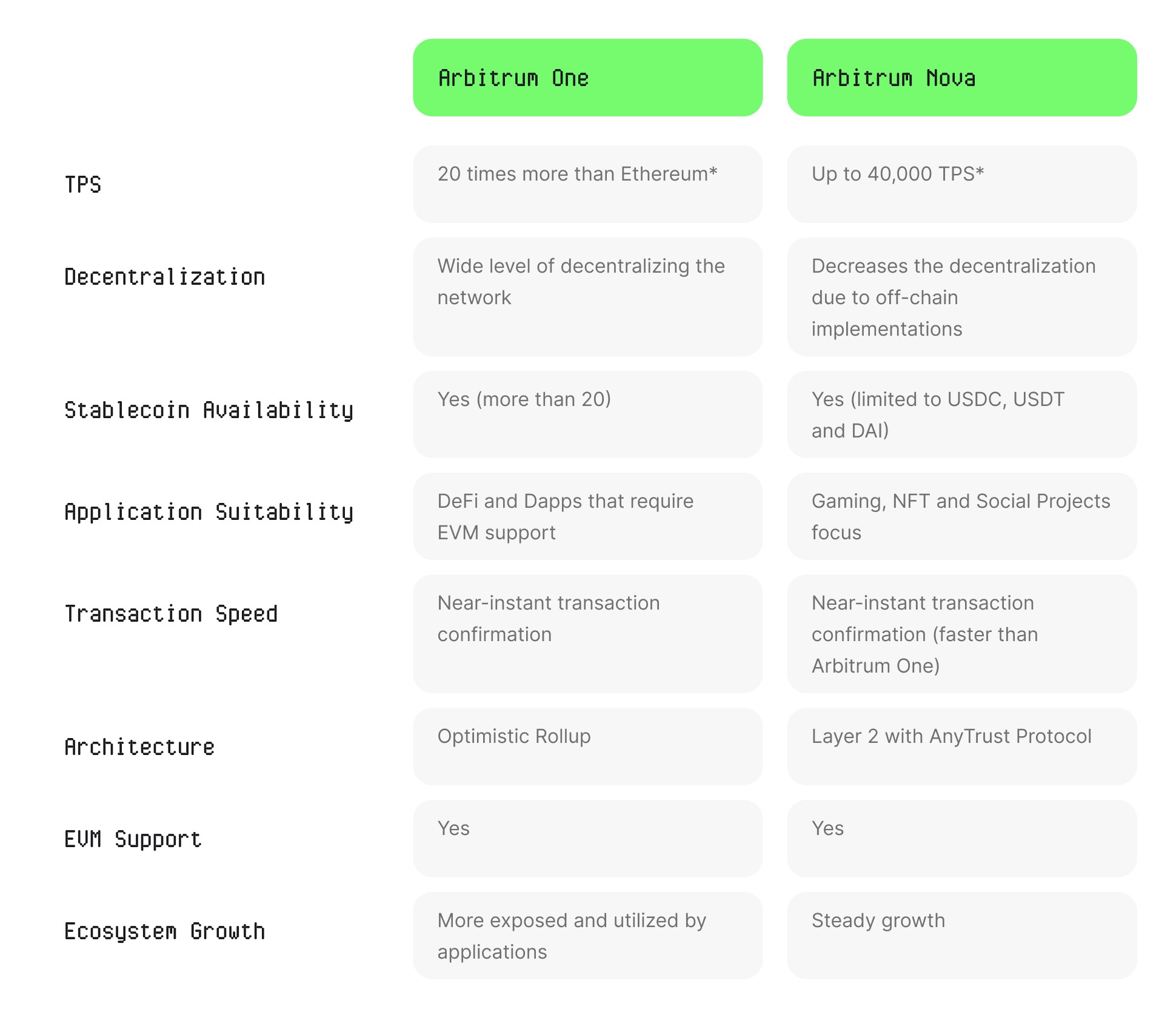
Arbitrum One and Arbitrum Nova are both Layer 2 scaling solutions for Ethereum, but they serve different purposes. Arbitrum One is a general-purpose rollup designed for high security and DeFi, while Nova is an AnyTrust chain optimized for high throughput and low costs. This distinction makes Nova particularly suitable for applications requiring frequent, low-value interactions, such as gaming and social platforms.
The main difference lies in their security models. Arbitrum One inherits Ethereum's security directly, which is critical for financial applications. Nova uses a data availability committee, which reduces costs but introduces a different trust assumption. Choose Arbitrum One for security-critical DeFi; choose Nova for high-frequency interactions where cost efficiency is paramount.
| Feature | Arbitrum One | Nova |
|---|---|---|
| Consensus | Optimistic Rollup | AnyTrust |
| Security Model | Ethereum Mainnet | Data Availability Committee |
| Target Use Case | DeFi, High-Value Apps | Gaming, Social, NFTs |
| Gas Fees | Low | Very Low |
| Finality Time | ~7 Days (Challenge Period) | ~10 Minutes |
How Arbitrum One secures DeFi
Arbitrum One remains the dominant choice for high-value DeFi applications because it offers Ethereum-equivalent security. Unlike Arbitrum Nova, which uses a lighter data availability model, Arbitrum One posts transaction data directly to Ethereum. This approach ensures that every transaction is verifiable on the mainnet, providing the highest level of trust for institutions and users handling significant capital.
The network operates as a fully EVM-compatible Layer-2 rollup. This means developers can deploy existing Ethereum smart contracts without modification, while users interact with a familiar environment. The security model relies on optimistic validation, where transactions are assumed valid unless challenged. This design allows Arbitrum One to handle complex DeFi operations—such as lending, borrowing, and automated market making—with the same security guarantees as Ethereum mainnet.
For DeFi protocols, this security is non-negotiable. High-value applications cannot compromise on data availability or finality. Arbitrum One’s direct data posting to Ethereum ensures that even in the event of a network failure, funds remain safe and accessible. This makes it the preferred chain for major DeFi protocols that prioritize capital preservation over ultra-low latency.
Arbitrum Nova’s role in high-throughput applications
Arbitrum One handles the heavy lifting for high-value DeFi, but Arbitrum Nova is built for a different kind of traffic. While One prioritizes maximum security by anchoring heavily to Ethereum, Nova optimizes for throughput and cost. It achieves this through an "AnyTrust" model, which uses a data availability committee to publish transaction data more cheaply than a standard rollup. This trade-off means slightly less decentralization than Arbitrum One, but it opens the door for applications where speed and low fees are the primary requirements.
This architecture makes Nova the natural home for high-frequency interactions. In blockchain gaming, every millisecond of latency matters. Players expect instant feedback when moving characters or trading in-game assets. Social media applications face similar demands, where thousands of micro-transactions—likes, posts, shares—need to happen without clogging the network or draining user wallets with gas fees. Nova’s higher throughput allows these apps to run smoothly without the congestion that can plague other Layer-2s during peak usage.
For developers, the choice often comes down to the application’s core value proposition. If the app involves moving significant value or requires institutional-grade security, Arbitrum One remains the safer bet. But for gaming, social feeds, or other consumer-facing apps where transaction costs can kill engagement, Nova provides the necessary infrastructure. It allows developers to build experiences that feel as responsive as Web2 apps while still leveraging the security benefits of the Arbitrum ecosystem.
Gas fees and transaction speed
When choosing between Arbitrum One and Arbitrum Nova, the decision often comes down to your tolerance for cost versus your need for speed. Both networks are Layer-2 scaling solutions built on Ethereum, but they achieve their goals through different technical approaches. Arbitrum One prioritizes maximum security and EVM equivalence, while Nova sacrifices some data availability for significantly lower costs and higher throughput.
Arbitrum One operates as an Optimistic Rollup. It processes transactions off-chain but posts compressed data to Ethereum for security. This model ensures that your transactions are as secure as Ethereum mainnet, but it means you still pay for that data availability. Gas fees on Arbitrum One are generally 10 to 100 times lower than Ethereum mainnet, making it highly economical for DeFi interactions, NFT trading, and complex smart contracts that require the highest level of security assurance.
Arbitrum Nova uses AnyTrust, a different model that relies on a Data Availability Committee (DAC) to store transaction data off-chain. This reduces the burden on Ethereum, resulting in even lower gas fees than Arbitrum One. Nova is designed for high-frequency applications like gaming, social networks, and micro-transactions where speed and cost are more critical than the absolute highest security guarantees. While the security model is slightly different, it remains robust for most consumer-facing applications.
Transaction speeds also differ. Nova typically offers faster finality for user-facing actions due to its optimized data structure. If you are building a game or an app with thousands of micro-transactions, Nova’s throughput will feel significantly snappier. For standard DeFi swaps or contract interactions, Arbitrum One’s speed is already excellent and indistinguishable from traditional web experiences for most users.
| Feature | Arbitrum One | Arbitrum Nova |
|---|---|---|
| Technology | Optimistic Rollup | AnyTrust |
| Primary Use Case | DeFi, NFTs, Complex Apps | Gaming, Social, High-Frequency |
| Gas Fees | Low | Very Low |
| Security Model | Ethereum Data Availability | Data Availability Committee (DAC) |
Ultimately, if your priority is security and you are moving significant value, Arbitrum One is the standard. If you are building or using an application that requires high volume and minimal cost per transaction, Nova is the more efficient choice.
Which Arbitrum network should you use?
Choosing between Arbitrum One and Arbitrum Nova depends on what you are building or trading. Arbitrum One is the primary Layer-2 rollup, designed for high security and deep liquidity. Arbitrum Nova is an AnyTrust chain optimized for high throughput and ultra-low costs. Think of Arbitrum One as the main highway for serious DeFi, while Nova is the express lane for gaming and social apps.
For DeFi and High-Value Transactions
If you are managing significant capital, staking, or trading on decentralized exchanges, Arbitrum One is the standard choice. It inherits Ethereum’s security model directly, meaning your assets are protected by the same consensus mechanism as the mainnet. The ecosystem is mature, with the deepest liquidity pools and the most audited smart contracts. While gas fees are slightly higher than Nova, the trade-off is worth it for the assurance that your funds are as secure as possible.
For Gaming and Social Apps
Nova is built for applications that require frequent, cheap interactions. If you are playing an on-chain game, minting low-value NFTs, or using a social platform, Nova’s AnyTrust technology reduces data availability costs by committing data to Ethereum only periodically. This results in gas fees that are often a fraction of a cent. However, this comes with a slight compromise in finality speed and a different security model. For high-frequency, low-stakes interactions, Nova offers a smoother experience without the friction of higher fees.
Making the Decision
Start by assessing your risk tolerance and transaction volume. For core treasury management or large swaps, stick to Arbitrum One. For experimental apps, gaming, or content creation where speed and cost matter more than maximum security, Nova is the better fit. Many users maintain wallets on both networks to leverage the strengths of each.


As an Amazon Associate, we may earn from qualifying purchases.
Common questions about Arbitrum
Arbitrum is a suite of Ethereum scaling technologies, but the terms are often used interchangeably in casual conversation. The suite includes Arbitrum One (a rollup chain), Arbitrum Nova (an AnyTrust chain), and customizable Orbit chains. When people ask about "Arbitrum," they are usually referring to Arbitrum One, which serves as the primary network for decentralized finance (DeFi) and gaming applications.
Arbitrum One is a Layer-2 scaling solution that processes transactions off the Ethereum mainnet before settling the results on-chain. This architecture significantly reduces gas fees and increases throughput while maintaining the same security guarantees as Ethereum. It is not a separate blockchain with its own consensus mechanism but rather a smart contract chain that operates as an extension of Ethereum.
Is Arbitrum One good for DeFi and gaming?
Arbitrum One is widely considered one of the strongest scaling ecosystems for Ethereum. It hosts a deep liquidity pool for DeFi protocols and supports a wide range of EVM-compatible DApps and games. Arbitrum Nova is better suited for high-frequency gaming and social apps due to its lower costs, but Arbitrum One remains the preferred choice for serious financial applications where security and liquidity are paramount.
What is the difference between Arbitrum and Arbitrum One?
Arbitrum is the overarching brand for the technology stack, while Arbitrum One is the specific mainnet chain. Think of Arbitrum as the company and Arbitrum One as its flagship product. The ecosystem also includes Arbitrum Nova for gaming and Orbit chains for custom networks. For most users interacting with DeFi protocols, they are using Arbitrum One.
Where can I buy ARB tokens?
You can purchase ARB tokens on major centralized exchanges like Coinbase or Binance. Alternatively, you can buy them directly within MetaMask using a debit card, credit card, or bank transfer. Once purchased, you can bridge the tokens to the Arbitrum One network to interact with dApps.
No comments yet. Be the first to share your thoughts!