What Arbitrum Stylus actually does
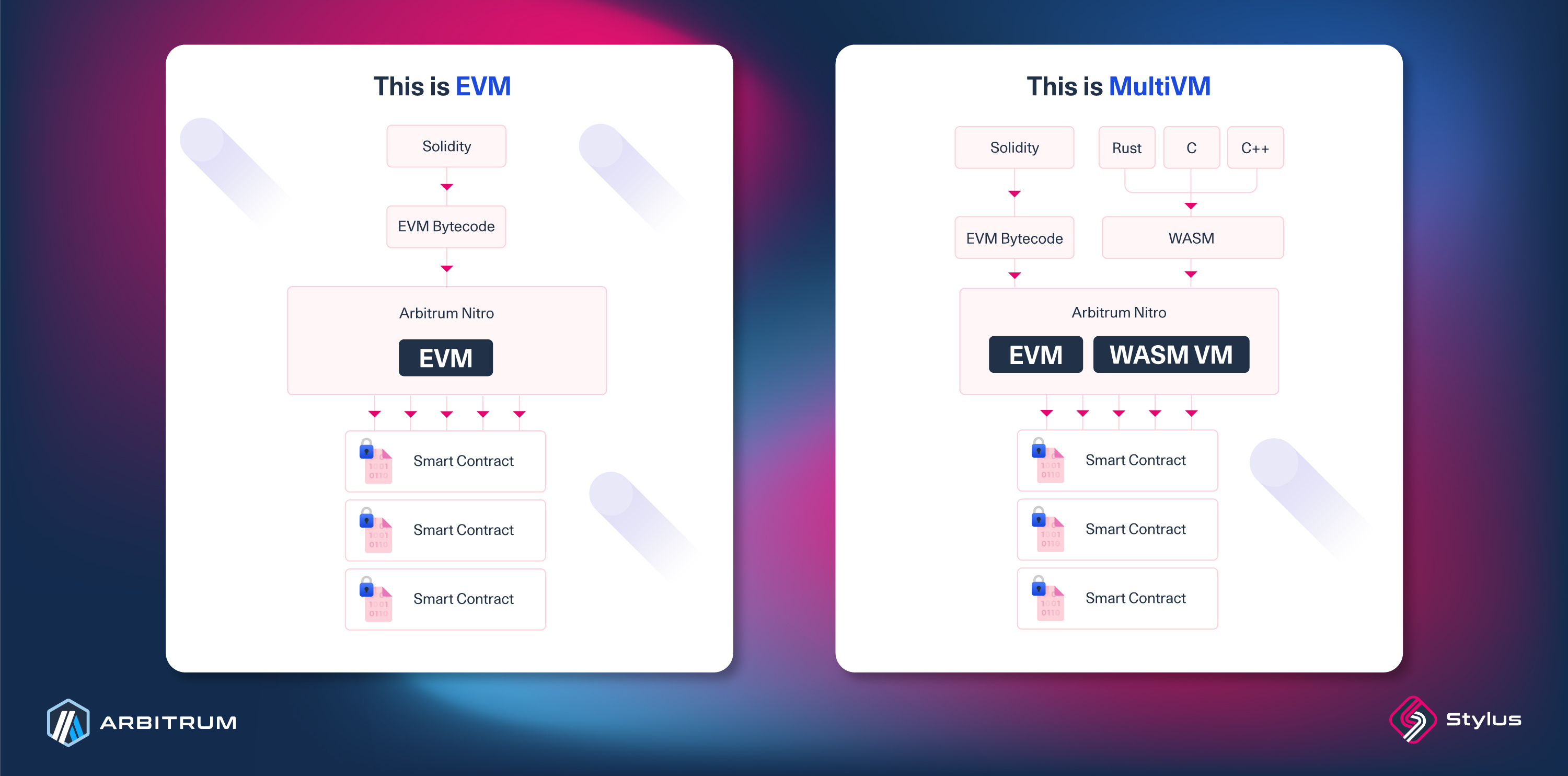
Arbitrum Stylus is an execution environment that allows smart contracts to be written in Rust, C, and C++. Instead of forcing developers to use Solidity, Stylus compiles these programs into WebAssembly (WASM). This WASM code runs alongside the traditional Ethereum Virtual Machine (EVM) on Arbitrum, meaning you can deploy a Rust library or a C++ game engine directly on the same chain as your Solidity DeFi protocols.
This architecture creates a hybrid environment. The EVM remains the standard for Ethereum-compatible smart contracts, ensuring broad tooling support and ecosystem maturity. Stylus adds a parallel lane for high-performance applications that need the speed and memory management of native languages. Developers can choose the right tool for the job: Solidity for standard financial logic, or Rust for complex computations that would be too expensive or slow in EVM bytecode.
By supporting multiple languages, Stylus taps into existing ecosystems. A developer who already knows Rust can leverage its vast library of crates without learning a new syntax. This reduces the barrier to entry for teams building data-heavy or compute-intensive applications on Arbitrum, while still maintaining full compatibility with the Ethereum security model.
Performance and cost differences
The gap between native EVM and Stylus comes down to how each stack handles computation. Native EVM relies on the Ethereum Virtual Machine, a sandboxed environment designed for security and uniformity. While this ensures every node can verify transactions identically, it imposes strict limits on efficiency. Complex logic in Solidity often requires multiple steps, each consuming gas, which drives up costs for intricate operations.
Stylus changes this by allowing developers to write contracts in Rust, C, and C++. These languages compile to WebAssembly (WASM), which runs closer to the hardware. WASM is faster and more memory-efficient than EVM bytecode. This means complex calculations—like those needed for DeFi derivatives or gaming logic—execute quicker and cheaper. You are no longer bound by the EVM's rigid instruction set.
| Feature | Native EVM (Solidity) | Stylus (Rust/C) |
|---|---|---|
| Compilation Target | EVM Bytecode | WebAssembly (WASM) |
| Execution Speed | Standard | Up to 1000x faster |
| Gas Efficiency | Higher costs for complex logic | Lower gas for same logic |
| Memory Management | Limited, stack-based | Flexible, heap-allocated |
| Developer Pool | Solidity specialists | General-purpose engineers |
The performance advantage is not just theoretical. Because WASM executes more instructions per second, you can fit more logic into a single transaction. This reduces the total gas required for complex workflows. For developers, this means you can build sophisticated applications without the prohibitive costs that often plague EVM-native projects.
However, this efficiency comes with a tradeoff. The EVM ecosystem is mature, with extensive tooling and a large community of Solidity developers. Stylus is newer, offering access to a broader pool of general-purpose programmers but requiring adaptation to the WASM environment. If your project demands maximum performance for heavy computation, Stylus is the clear winner. If you prioritize ecosystem maturity and simplicity, EVM remains a strong choice.
The choice between these stacks is not just about code; it is about the kind of application you are building. Stylus opens the door to high-performance use cases that were previously too expensive on-chain. Native EVM remains the standard for simple, widely adopted contracts. Understanding these differences helps you pick the right tool for your specific needs.
Developer experience and tooling
The choice between native EVM and Arbitrum Stylus often comes down to a tradeoff between ecosystem maturity and language flexibility. Native EVM development relies on Solidity, a language with a decade of accumulated tooling, libraries, and community support. For developers familiar with Ethereum, the path is well-worn. Every major wallet, indexer, and security audit firm has built-in support for Solidity-based contracts. This maturity reduces friction during deployment and debugging, as errors are often well-documented and solutions are readily available.
Stylus introduces a different experience by allowing developers to write smart contracts in Rust, C, and C++. This opens the door to using existing libraries from the broader software engineering world, rather than reinventing them for the blockchain. The Stylus SDK provides the necessary bridge to compile these languages to WebAssembly (WASM), enabling high-performance logic that would be prohibitively expensive or complex in Solidity. However, this flexibility comes with a steeper learning curve. The tooling ecosystem for Stylus is younger, meaning developers may encounter more obscure bugs or lack the breadth of third-party resources available for Solidity.
Testing is another area where the two stacks diverge significantly. While Solidity benefits from standardized testing frameworks like Hardhat and Foundry, Stylus requires specialized tools. Projects like Motsu have emerged to help developers test Stylus contracts, but the ecosystem is still maturing. This means teams opting for Stylus must invest more time in setting up their development pipelines and verifying their testing infrastructure. The decision often hinges on whether the performance gains from Rust or C outweigh the productivity costs of navigating a less mature tooling landscape.
Security and fraud proofs
Arbitrum Stylus does not introduce a new security model; it inherits Arbitrum’s optimistic rollup architecture and its reliance on interactive fraud proofs. This design choice is critical because it allows developers to write in Rust, C, or C++ without sacrificing the security guarantees that make Ethereum Layer 2 solutions viable.
When a transaction is submitted on-chain, it is assumed valid. If a challenger believes a WASM execution produced an incorrect state root, they can initiate a fraud proof. The Arbitrum node verifies the WASM bytecode execution step-by-step against the deterministic rules of the WebAssembly standard. If the challenger proves the execution was flawed, the fraudulent state is reverted, and the challenger is rewarded.
This mechanism ensures that Stylus contracts are subject to the same rigorous verification as native EVM contracts. Whether the code is Solidity compiled to EVM bytecode or Rust compiled to WASM, the underlying security assumption remains identical: the network will catch and correct any invalid state transitions during the challenge period. This parity means developers gain performance and language flexibility without entering a "wild west" security environment.
When to choose Stylus over Solidity
The choice between Stylus and native Solidity isn't about which language is "better"; it's about matching the tool to the workload. Solidity remains the default for standard DeFi protocols and NFTs where ecosystem maturity, liquidity depth, and library support are paramount. If your project relies on established patterns like Uniswap forks or standard ERC-20/721 implementations, sticking with Solidity minimizes development risk and ensures immediate compatibility with the broader Ethereum ecosystem.
Stylus becomes the superior choice when you hit the performance ceiling of the EVM. If your application requires high-frequency trading logic, complex on-chain gaming mechanics, or heavy cryptographic computations, the speed and memory efficiency of WebAssembly (WASM) through Rust or C provide a tangible advantage. You should also consider Stylus if you already have an existing codebase in Rust or C, as it allows you to leverage mature, battle-tested libraries without rewriting logic in Solidity.
Ultimately, the decision rests on your specific constraints. For maximum interoperability and access to deep liquidity pools, native EVM is the safer bet. For raw compute performance or leveraging existing non-EVM engineering teams, Stylus offers a distinct competitive edge.
Common questions about Arbitrum Stylus
Developers often encounter specific questions when evaluating whether to adopt Stylus for their next project. Below are direct answers to the most frequent queries regarding language support, core definitions, and the relationship between Stylus and Ethereum scaling.
No comments yet. Be the first to share your thoughts!