Arbitrum One vs Nova: Quick Answer
Arbitrum One and Arbitrum Nova are two distinct Layer 2 networks built on the same core technology, but they serve different purposes in the Ethereum ecosystem. Choosing the right chain depends entirely on your specific needs for security versus speed.
Arbitrum One is the mainnet. It is a finance-native blockchain platform designed to be a direct, scalable extension of Ethereum. It inherits Ethereum’s security model, meaning it offers the same high level of decentralization and safety for your assets. This makes it the ideal choice for high-stakes DeFi applications, complex financial protocols, and any smart contract where security is the top priority. Transactions are significantly cheaper and faster than on Ethereum mainnet, but the focus remains on maintaining a robust, secure environment for value transfer.
Arbitrum Nova, on the other hand, is a specialized chain built for high-throughput applications. It prioritizes speed and low costs over the maximum level of decentralization found in Arbitrum One. This makes it a cost-effective solution for gaming, social media apps, and other use cases that require thousands of transactions per second. If you are building a game that needs instant, cheap interactions or a social platform with high user activity, Nova is the better fit.
In short, use Arbitrum One for DeFi and serious financial applications where security is paramount. Use Arbitrum Nova for gaming and social apps where speed and low cost are more important than maximum decentralization.
| Feature | Arbitrum One | Arbitrum Nova |
|---|---|---|
| Primary Use Case | DeFi & Finance | Gaming & Social |
| Security Model | Full Ethereum Security | Optimized for Speed |
| Transaction Cost | Low | Very Low |
| Throughput | High | Very High |
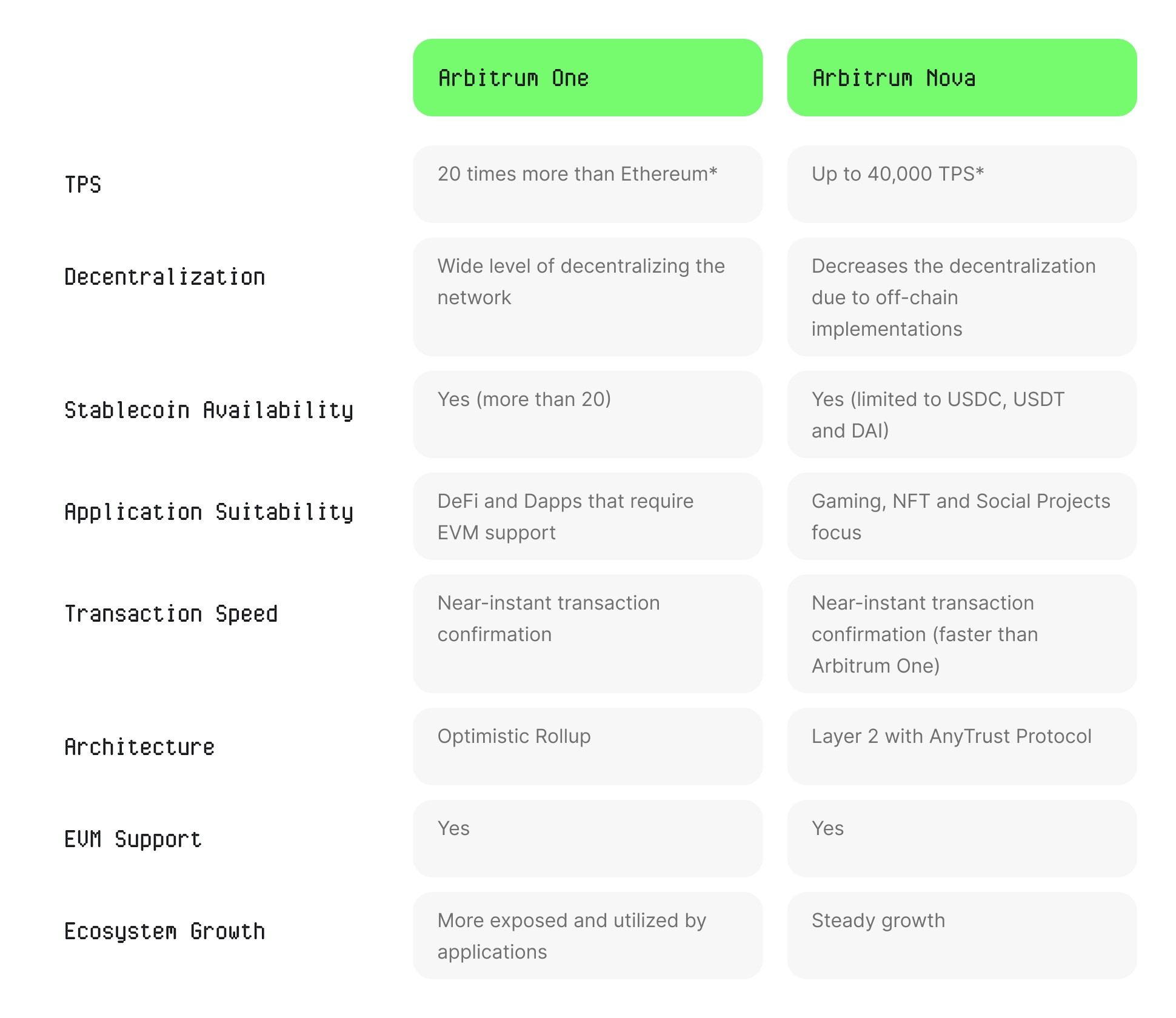
Side by Side: Network Specs
Arbitrum One and Arbitrum Nova serve distinct roles within the ecosystem, and choosing between them depends on whether you prioritize security or speed. Arbitrum One is the primary finance-native blockchain platform, inheriting Ethereum’s full security model while offering 10x lower costs than the mainnet. It is the go-to environment for DeFi protocols, tokenization, and applications that require robust decentralization.
Arbitrum Nova, by contrast, is designed for applications that demand high transaction throughput without the overhead of full rollup decentralization. It is optimized for gaming, social apps, and content-sharing platforms where speed and near-zero fees are more critical than the highest tier of security guarantees. Understanding these technical differences helps developers and users select the right chain for their specific DeFi or gaming needs.
| Feature | Arbitrum One | Arbitrum Nova |
|---|---|---|
| Security Model | Inherits Ethereum’s full security | Optimized for speed, lower decentralization |
| Primary Use Case | DeFi, tokenization, general smart contracts | Gaming, social apps, high-throughput content |
| Transaction Cost | Cost-effective (10x lower than Ethereum L1) | Near-zero fees for high volume |
| Throughput | High scalability for complex transactions | Maximum throughput for simple operations |
The choice ultimately comes down to your application’s risk profile. If you are building a financial protocol where user funds are at stake, Arbitrum One’s inheritance of Ethereum’s security is non-negotiable. For gaming or social experiences where millions of micro-transactions occur, Nova’s efficiency provides a better user experience at a fraction of the cost.
Arbitrum One for DeFi and Security
Arbitrum One is the primary choice for decentralized finance applications that prioritize capital preservation and protocol stability. Unlike lighter rollups designed for high-frequency gaming, Arbitrum One inherits the security model of Ethereum. This means that smart contracts deployed on Arbitrum One are protected by the same cryptographic guarantees and economic security that underpin the Ethereum mainnet.
The chain operates as a general-purpose smart contract platform. It allows developers to deploy Ethereum-compatible code without modification, while significantly reducing transaction costs and increasing throughput. For DeFi protocols like Aave, Morpho, and Pendle, this architecture provides a scalable environment where users can lend, borrow, and earn yields with the confidence that their assets are secured by Ethereum’s consensus layer.
This security inheritance is not just a technical feature; it is the foundation of trust for institutional and retail participants alike. By settling dispute resolution on Ethereum, Arbitrum One ensures that the chain remains decentralized and resistant to censorship. For financial applications where the stakes are high, this level of security is non-negotiable.
Arbitrum Nova for Gaming and Social
Arbitrum Nova is a dedicated blockchain environment built for applications that prioritize high throughput and low latency over the maximum decentralization provided by standard rollups. It is a finance-native blockchain platform that inherits Ethereum's security, ensuring that while transaction speeds are optimized for interactive experiences, the underlying safety guarantees remain robust.
For developers building social platforms or blockchain games, Nova offers a cost-effective solution that removes the friction of high fees. Unlike Arbitrum One, which is designed for general-purpose DeFi and complex smart contracts, Nova is engineered to handle the rapid-fire transaction volume typical of gaming and social interactions. This makes it possible to offer micro-transactions and frequent state updates that would be prohibitively expensive on other layers.
The architecture of Nova allows it to process transactions significantly faster than its sibling chain. This performance boost is essential for maintaining a seamless user experience in real-time applications. By offloading the heavy lifting of frequent interactions to Nova, developers can keep their users engaged without worrying about network congestion or rising gas costs.
How to bridge and choose the right Arbitrum chain
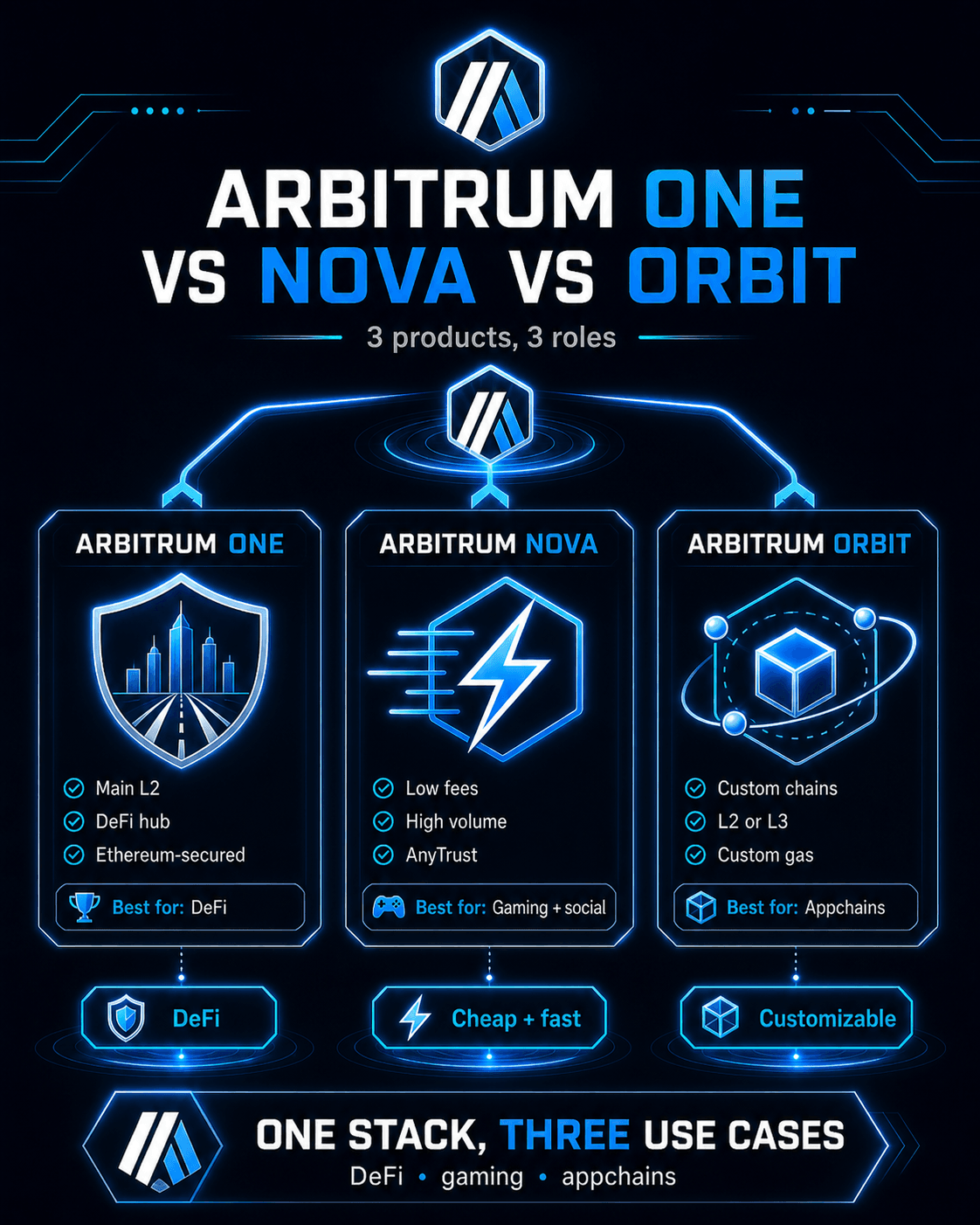
Selecting between Arbitrum One and Arbitrum Nova depends on whether you prioritize broad ecosystem compatibility or ultra-low latency. Arbitrum One is the flagship smart contract chain, inheriting Ethereum's security while offering a cost-effective solution for DeFi. Arbitrum Nova, built on Orbit technology, sacrifices some decentralization for high transaction throughput, making it ideal for gaming and social applications.


As an Amazon Associate, we may earn from qualifying purchases.
Common Questions About Arbitrum
Users frequently confuse the broader Arbitrum ecosystem with its specific chains. Arbitrum One is the primary smart contract chain, designed for general-purpose DeFi and dApps. It inherits Ethereum’s security while offering significantly higher throughput and lower costs. Arbitrum Nova, by contrast, is optimized for high-frequency applications like social gaming, prioritizing speed over the full decentralization guarantees of a standard rollup.
The long-term viability of Arbitrum depends on its adoption as a foundational layer for Ethereum scaling. As more developers migrate to its cost-effective infrastructure, the network’s utility grows. While price predictions vary, the fundamental value lies in its ability to process transactions efficiently without compromising the security model that makes Ethereum trusted.
No comments yet. Be the first to share your thoughts!