What Arbitrum Stylus actually does
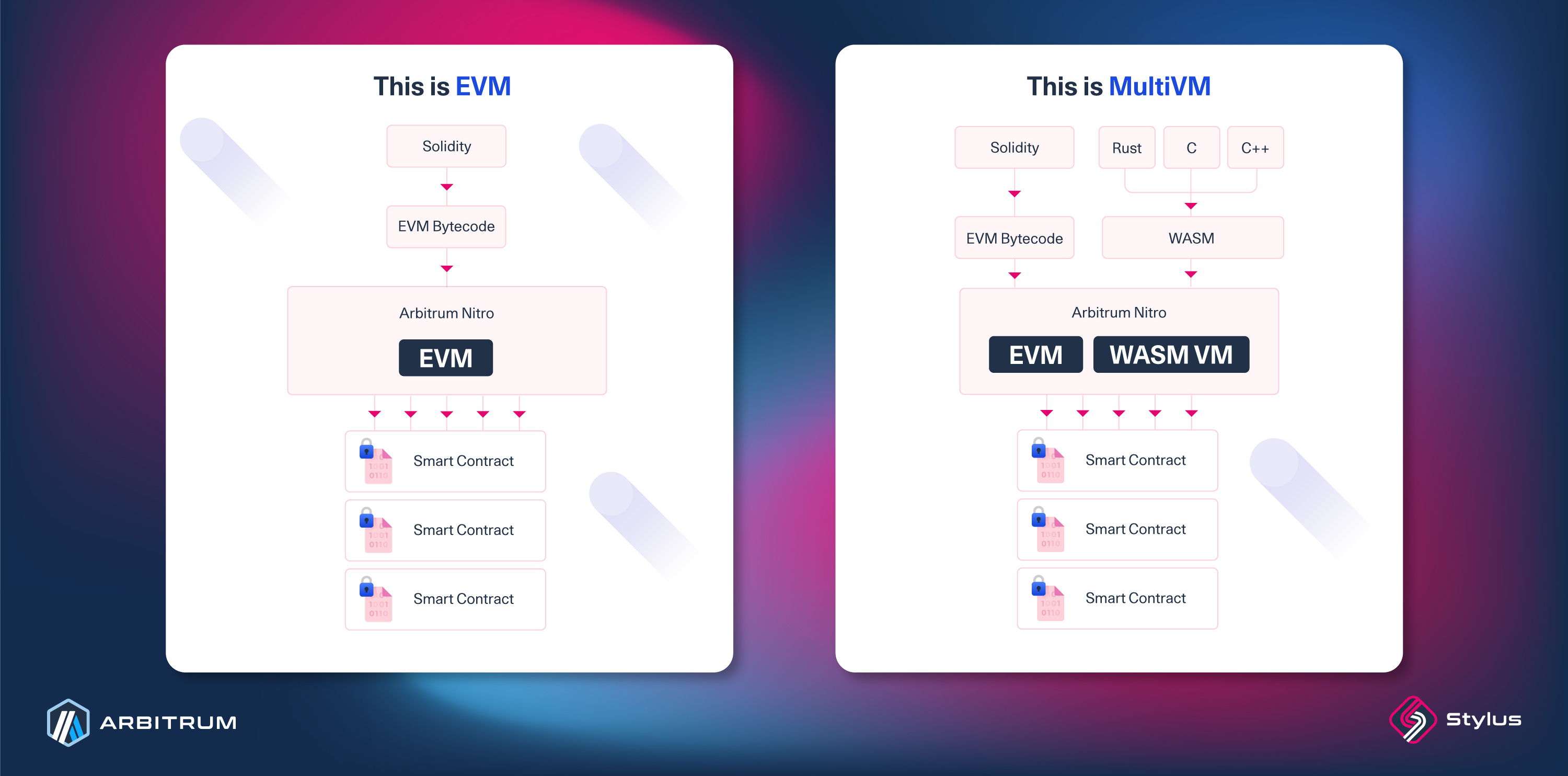
Arbitrum Stylus is a WASM execution layer that runs alongside the EVM on the Arbitrum One chain. It does not replace Ethereum Virtual Machine (EVM) compatibility; instead, it expands the available tooling by allowing smart contracts written in Rust, C, and C++ to compile to WebAssembly (WASM).
This architecture means developers can leverage the performance benefits of native languages while maintaining full interoperability with existing EVM dApps. A Stylus contract can call EVM contracts, and vice versa, creating a unified environment where high-performance logic can coexist with established DeFi primitives.
The primary advantage lies in execution efficiency. WASM offers faster compilation and execution times compared to the EVM’s bytecode, enabling more complex computations at a lower gas cost. This opens the door for applications that were previously too expensive or slow to deploy on-chain, such as high-frequency trading bots or complex on-chain games, without sacrificing the security model of the underlying layer 2.
EVM vs. Stylus performance differences
When moving from Solidity on the EVM to Rust on Stylus, the shift is not merely about language preference; it is a fundamental change in how computation is priced and executed. The EVM was designed for security and consensus in an era where computational power was expensive and scarce. Stylus, by contrast, leverages WebAssembly (WASM) to offer execution speeds and gas efficiency that align with modern hardware capabilities.
Execution Speed
The most immediate difference lies in raw throughput. EVM opcodes are linear and interpreted, meaning complex operations like elliptic curve cryptography or heavy mathematical loops consume significant gas and time. WASM, however, is a binary instruction format designed for near-native execution speeds. Benchmarks from early Stylus deployments show that complex logic, such as zero-knowledge proof verification or large-scale data processing, can run orders of magnitude faster than their Solidity equivalents. This speed allows for more complex DeFi primitives that were previously too gas-prohibitive to deploy on-chain.
Gas Efficiency
Gas costs on Arbitrum are calculated based on the resources consumed during execution. Because WASM is more efficient than the EVM bytecode, it requires fewer computational steps to achieve the same result. For example, a simple integer addition in Solidity consumes more gas than the equivalent operation in Rust compiled to WASM. This efficiency scales with complexity; operations that are quadratic or exponential in the EVM become linear or constant-time in WASM, drastically reducing the gas bill for users and making high-frequency trading or complex yield strategies more economically viable.
Computational Limits
The EVM has strict limits on stack depth and memory access to prevent DoS attacks, which forces developers to write inefficient workarounds for complex data structures. Stylus removes many of these artificial constraints. Developers can use standard Rust data structures like vectors, hashes, and trees, and even leverage the broader Rust ecosystem of libraries. This means you are no longer limited by the EVM’s 256-bit word size for every operation, allowing for more natural and efficient code that mirrors traditional software engineering practices.
| Metric | EVM (Solidity) | Stylus (WASM) | Developer Impact |
|---|---|---|---|
| Execution Speed | Interpreted, linear opcode execution | Near-native WASM execution | Complex logic runs faster |
| Gas Costs | Higher due to opcode overhead | Lower due to efficient bytecode | Cheaper transactions for users |
| Data Structures | Limited by 256-bit words and stack | Full Rust standard library support | No need for inefficient workarounds |
| Library Ecosystem | Limited to Solidity-specific libraries | Access to Rust crates and tools | Faster development cycles |
| Language Paradigm | Contract-centric, limited typing | Systems programming, strong typing | More robust and secure code |
The transition to Stylus does not just offer incremental improvements; it opens the door to entirely new classes of decentralized applications. By removing the computational bottlenecks of the EVM, developers can build DeFi protocols that are faster, cheaper, and more complex, bridging the gap between traditional software performance and blockchain security.
Rust Tooling and Developer Experience
Arbitrum Stylus lowers the barrier to entry for non-EVM developers by leveraging Rust’s mature ecosystem. The Stylus Rust SDK (v0.10.2) allows developers to write smart contracts that compile to WebAssembly (WASM) while maintaining Solidity ABI compatibility. This means you can use familiar Rust crates like ethers-rs or serde directly, rather than learning a new, isolated set of patterns.
The SDK acts as a bridge between Rust’s type safety and the EVM’s execution environment. You write standard Rust code, and the compiler produces a WASM module that Arbitrum executes natively. This approach eliminates the need for manual bytecode generation or complex Solidity workarounds. Developers benefit from Rust’s borrow checker, which catches memory safety errors at compile time—a significant advantage over Solidity’s runtime-only error checking.
Existing libraries and tooling reduce friction further. Because Stylus supports standard Rust toolchains, you can use cargo for building, testing, and linting. This familiarity accelerates onboarding for developers who already know Rust but are new to blockchain development. The result is a smoother transition from traditional software engineering to smart contract development, with fewer quirks to navigate.
The integration with existing Rust ecosystems means you don’t have to rebuild basic functionality. Whether you need cryptographic primitives, data serialization, or networking libraries, Rust’s crates.io offers battle-tested solutions. Stylus allows you to import these directly, speeding up development and reducing the attack surface by relying on audited, community-vetted code rather than custom implementations.
When to choose Stylus over Solidity
Arbitrum Stylus and the EVM serve different parts of the developer stack. Solidity remains the standard for most DeFi applications, but Stylus (WASM) unlocks capabilities that the EVM simply cannot handle efficiently. Your choice depends on whether your project needs raw computational power or broad ecosystem compatibility.
Choose Stylus for Heavy Computation
If your contract requires complex cryptographic operations, zero-knowledge proof verification, or heavy data processing, Stylus is the superior choice. The EVM is limited by its byte-code execution model, which becomes prohibitively expensive for compute-heavy tasks. WASM, used by Stylus, offers native multi-threading support and significantly lower gas costs for these operations.
For example, a DeFi protocol needing to verify thousands of ZK-proof batches per block would face insurmountable gas costs on EVM. Stylus allows you to write this logic in Rust or C++, leveraging existing libraries and achieving performance gains that make such complex DeFi primitives viable.
Choose Stylus for Language Familiarity
Stylus allows you to write smart contracts in Rust, C, C++, and other systems programming languages. If your team has deep expertise in these languages but limited Solidity experience, Stylus lowers the barrier to entry. You can reuse existing codebases and leverage the mature tooling ecosystems of these languages, such as Cargo for Rust.
This is particularly useful for teams building infrastructure or cross-chain bridges where security and performance are paramount. Rust’s memory safety features can reduce certain classes of bugs common in Solidity, provided the team is proficient in the language.
Choose EVM for Ecosystem Compatibility
Stick with Solidity if your priority is seamless integration with existing DeFi protocols, wallets, and indexers. The EVM has a mature ecosystem with established standards, extensive documentation, and a large pool of developers. Most DeFi primitives like lending protocols, DEXs, and staking mechanisms are built on EVM standards.
Using EVM ensures your contract can interact with the widest range of tools and services without custom adapters. If your application is a standard financial instrument rather than a compute-intensive novelty, the EVM’s network effects provide a significant advantage in adoption and liquidity.
Risks and limitations to watch
Stylus introduces a new fraud prover compatible with Arbitrum's interactive proof system, but audit standards are still evolving compared to the mature EVM ecosystem. While the underlying security model remains robust, developers must navigate immature tooling and a smaller pool of audited contracts.
The introduction of WebAssembly (WASM) contracts expands the attack surface beyond traditional Solidity patterns. Security teams must understand memory management and pointer safety in Rust or C++ to effectively audit Stylus contracts. The ecosystem is currently catching up, with fewer established security firms offering specialized Stylus audit services compared to standard EVM deployments.
Additionally, the lack of a unified debugging environment can slow down incident response. When an EVM contract fails, the revert reason is standardized. In Stylus, error handling depends on the language and SDK implementation, potentially complicating post-deployment troubleshooting. Developers should treat Stylus contracts as higher-risk deployments until broader industry standards for testing and verification are established.
No comments yet. Be the first to share your thoughts!