What is Arbitrum Stylus?
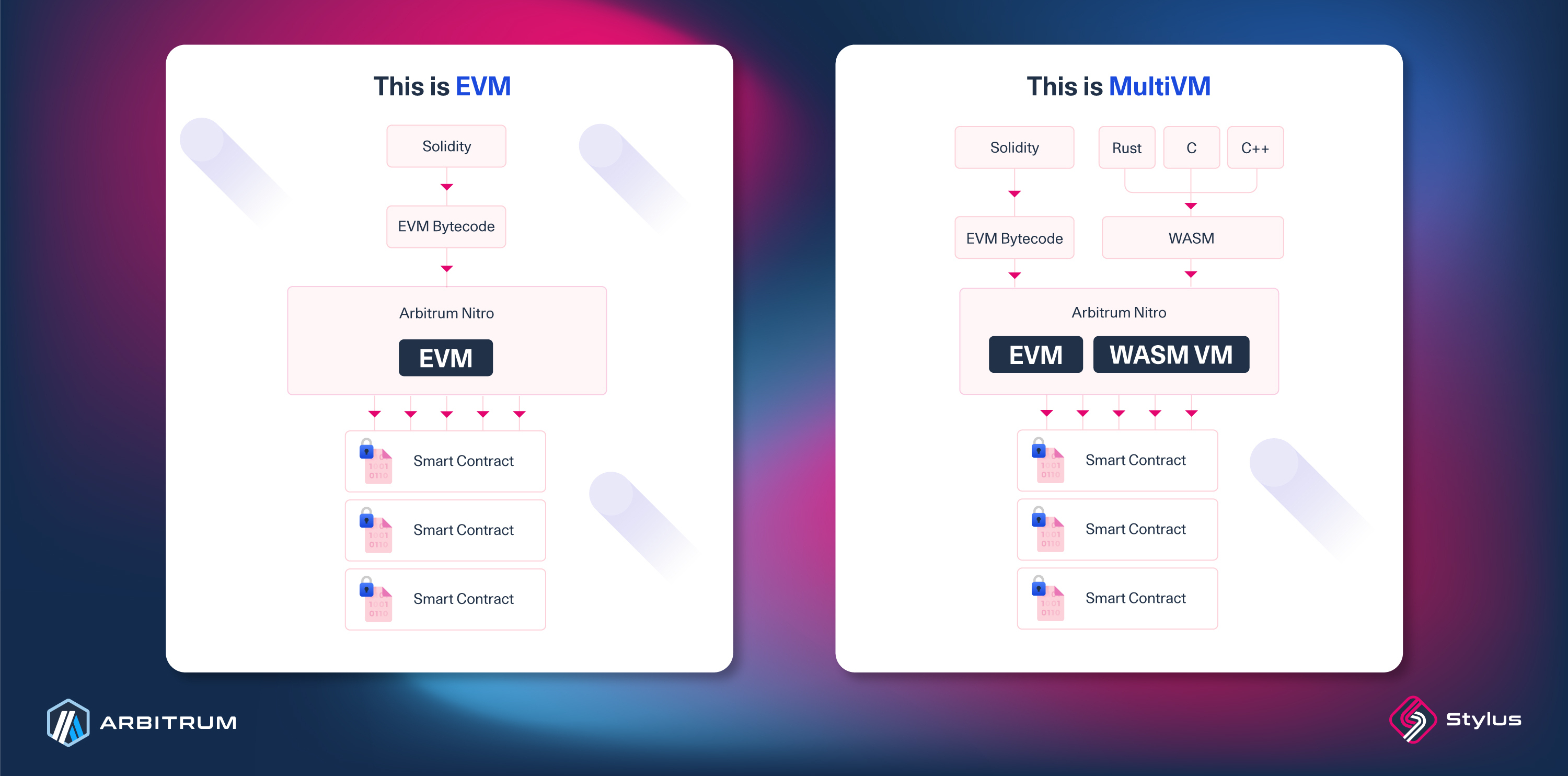
Arbitrum Stylus is a new execution layer for Arbitrum One that allows developers to write smart contracts in high-performance systems languages. Instead of replacing the existing EVM, Stylus runs alongside it, compiled into WebAssembly (WASM). This architecture means you can leverage languages like Rust, C, and C++ while maintaining full compatibility with the Ethereum infrastructure Arbitrum is built on.
This is not a separate chain. Stylus is a virtual machine upgrade on Arbitrum One, meaning it shares the same security model and settlement layer as the rest of the network. You are not migrating to a new ecosystem; you are expanding the toolset available within Arbitrum One. This distinction matters because it preserves the liquidity and composability of the existing Arbitrum environment while unlocking new performance capabilities.
The introduction of WASM support addresses a long-standing limitation of the EVM: its reliance on Solidity and Vyper. While those languages are powerful, they can be restrictive for complex logic or developers coming from traditional software engineering backgrounds. Stylus allows you to use the same languages you use for backend services or high-frequency trading engines, bringing those same libraries and toolchains to the blockchain.
By supporting WASM, Arbitrum is opening the door to a wider range of developers. You can now build applications that require the speed and efficiency of compiled languages without sacrificing the interoperability that makes Arbitrum one of the most active networks in the Ethereum ecosystem. For more details on how the architecture works, see the Arbitrum documentation.
Stylus vs. EVM: Core Technical Differences
The primary distinction between Stylus and the traditional EVM lies in the execution environment. Arbitrum Stylus introduces WebAssembly (WASM) support, allowing developers to write smart contracts in high-performance systems languages. This runs alongside the existing EVM, which remains the standard for Solidity and Vyper contracts. This dual-execution model lets teams choose the right tool for the job without abandoning the broader Ethereum ecosystem.
Language and Compilation
EVM contracts must be written in Solidity or Vyper and compiled to EVM bytecode. Stylus contracts compile to WASM modules, enabling the use of Rust and other systems languages. This shift allows developers to leverage existing libraries, stronger type safety, and familiar development workflows. The Stylus Rust SDK ensures that these new contracts remain ABI-compatible with Solidity, meaning they can interact seamlessly with existing DeFi protocols and user interfaces.
Performance and Efficiency
WASM execution offers significant performance gains over the EVM. WASM modules are more efficient to parse and execute, leading to lower gas costs and faster transaction finality. This efficiency is particularly valuable for complex computations or high-frequency trading applications that would be prohibitively expensive on the pure EVM. The ability to use more optimized code structures in Rust further reduces the computational overhead compared to traditional Solidity implementations.
Ecosystem Compatibility
Both environments share the same underlying Arbitrum infrastructure, ensuring that contracts written in either language can interact with each other. This compatibility is crucial for interoperability within the Arbitrum ecosystem. Developers can deploy a Stylus contract for heavy computation while using a Solidity contract for governance or token management, and both will function within the same network state.
| Feature | EVM (Solidity) | Stylus (WASM) |
|---|---|---|
| Primary Languages | Solidity, Vyper | Rust, C, C++ |
| Compilation Target | EVM Bytecode | WebAssembly (WASM) |
| Performance | Standard | High (optimized execution) |
| Gas Efficiency | Baseline | Improved (lower overhead) |
| ABI Compatibility | Native | Full (ABI-equivalent) |
| Library Ecosystem | Extensive (Solidity-focused) | Growing (Rust/C++ focused) |
The choice between Stylus and EVM depends on your specific development needs. If you are building a standard token or simple DeFi protocol, the EVM remains the most straightforward path. However, for applications requiring complex logic, heavy computation, or integration with existing Rust/C++ codebases, Stylus offers a compelling advantage in both performance and developer experience.
Performance Gains from WebAssembly
WebAssembly (WASM) delivers execution speeds that are orders of magnitude faster than the Ethereum Virtual Machine (EVM). While the EVM was designed for security and decentralization, it operates as an interpreted stack machine, which creates significant overhead for complex computations. WASM, by contrast, is a binary instruction format for a stack-based virtual machine, designed for execution speed and portability.
This architectural difference is critical for non-financial logic. Tasks like cryptographic verification, data processing, and state management that are prohibitively expensive or slow on the EVM become efficient and viable on Stylus. Developers can now deploy contracts written in Rust, C, or C++, languages that compile directly to WASM, bypassing the EVM's gas model bottlenecks for heavy computation.
The performance leap is not merely incremental; it is foundational. By offloading heavy lifting to WASM, Arbitrum Stylus enables use cases that were previously impractical on-chain. This includes real-time gaming, complex AI inference, and large-scale data analytics, all running with the security guarantees of the Ethereum ecosystem but with the speed required for modern applications.
Developer Experience and Language Support
Arbitrum Stylus transforms smart contract development by removing the strict requirement of Solidity or Vyper. Instead, developers can write contracts in systems programming languages like Rust, C, and C++. This shift dramatically lowers the barrier to entry, allowing engineers who already possess deep expertise in high-performance languages to enter the blockchain space without starting from scratch.
By compiling to WebAssembly (WASM), Stylus enables the use of mature ecosystems and existing code libraries. A developer proficient in Rust can leverage the extensive stylus-sdk-rs to build efficient, secure smart contracts directly. This compatibility means teams can migrate complex logic or reuse proven algorithms with minimal refactoring, preserving institutional knowledge and reducing development time.
The ability to use familiar languages also expands the pool of potential talent. Rather than relying solely on niche Solidity specialists, projects can recruit from the broader community of systems programmers. This diversity in developer background often leads to more robust code architecture and innovative solutions that might not emerge within the traditional EVM-only paradigm.
Comparison: EVM vs. Stylus Developer Workflow
| Feature | EVM (Solidity/Vyper) | Stylus (Rust/C/C++) |
|---|---|---|
| Primary Language | Solidity, Vyper | Rust, C, C++ |
| Compilation Target | EVM Bytecode | WASM |
| Performance | Standard EVM execution | Near-native speed |
| Ecosystem Access | Ethereum-specific | Broad systems programming |
| Learning Curve | Steep for systems devs | Familiar for systems devs |
This table illustrates the fundamental shift in developer experience. While EVM remains the standard for Ethereum compatibility, Stylus offers a parallel track for those prioritizing performance and language flexibility. The choice often depends on whether the project benefits more from widespread ERC standard support or from the computational efficiency and language diversity of WASM.
When to Choose Stylus Over Solidity
The decision between Stylus and Solidity comes down to computational needs. If your application relies on standard token transfers or simple DeFi logic, Solidity remains the stable default. It offers deep tooling support and a vast ecosystem of audited libraries that reduce development risk. For established primitives, the EVM environment provides the reliability and familiarity that users expect.
Stylus becomes the superior choice when you need to run complex logic that is inefficient or impossible in Solidity. Applications involving AI inference, high-frequency gaming, or advanced cryptography benefit from the performance of Rust and C++. These languages allow developers to write code that executes faster and costs less in gas than equivalent Solidity implementations.
Use this checklist to guide your architecture:
- Choose Stylus for AI models, complex cryptography, or game logic.
- Choose Solidity for standard tokens, basic DeFi protocols, and NFTs.
If your project requires heavy computation, Stylus offers the scalability that Solidity cannot match. Otherwise, stick with the proven EVM stack.
Risks and Security Considerations
Adopting Arbitrum Stylus introduces distinct security vectors that differ from standard EVM deployment. The primary concern is the increased attack surface created by compiling complex languages into WebAssembly. Unlike Solidity, which has decades of battle-tested libraries, WASM contracts require rigorous memory safety audits to prevent exploits that bypass traditional blockchain safeguards.
Tooling maturity remains a significant hurdle. The ecosystem for WASM debugging and formal verification is still evolving, meaning developers may face unpredictable behavior during deployment or interaction with existing DeFi protocols. This gap in standardized tooling can lead to subtle bugs that are difficult to detect without specialized expertise.
Beyond the code itself, you must consider the broader Arbitrum infrastructure. As noted in community discussions on the Arbitrum Foundation forum, risks include bridge vulnerabilities, sequencer centralization, and governance delays. These systemic factors can impact contract execution regardless of how secure your specific WASM code is.
To mitigate these risks, treat Stylus deployment with the same caution as a new chain launch. Prioritize contracts that have undergone third-party security audits and avoid integrating with unverified bridges or oracle services. The performance benefits are substantial, but they come with a higher burden of proof for reliability.
No comments yet. Be the first to share your thoughts!